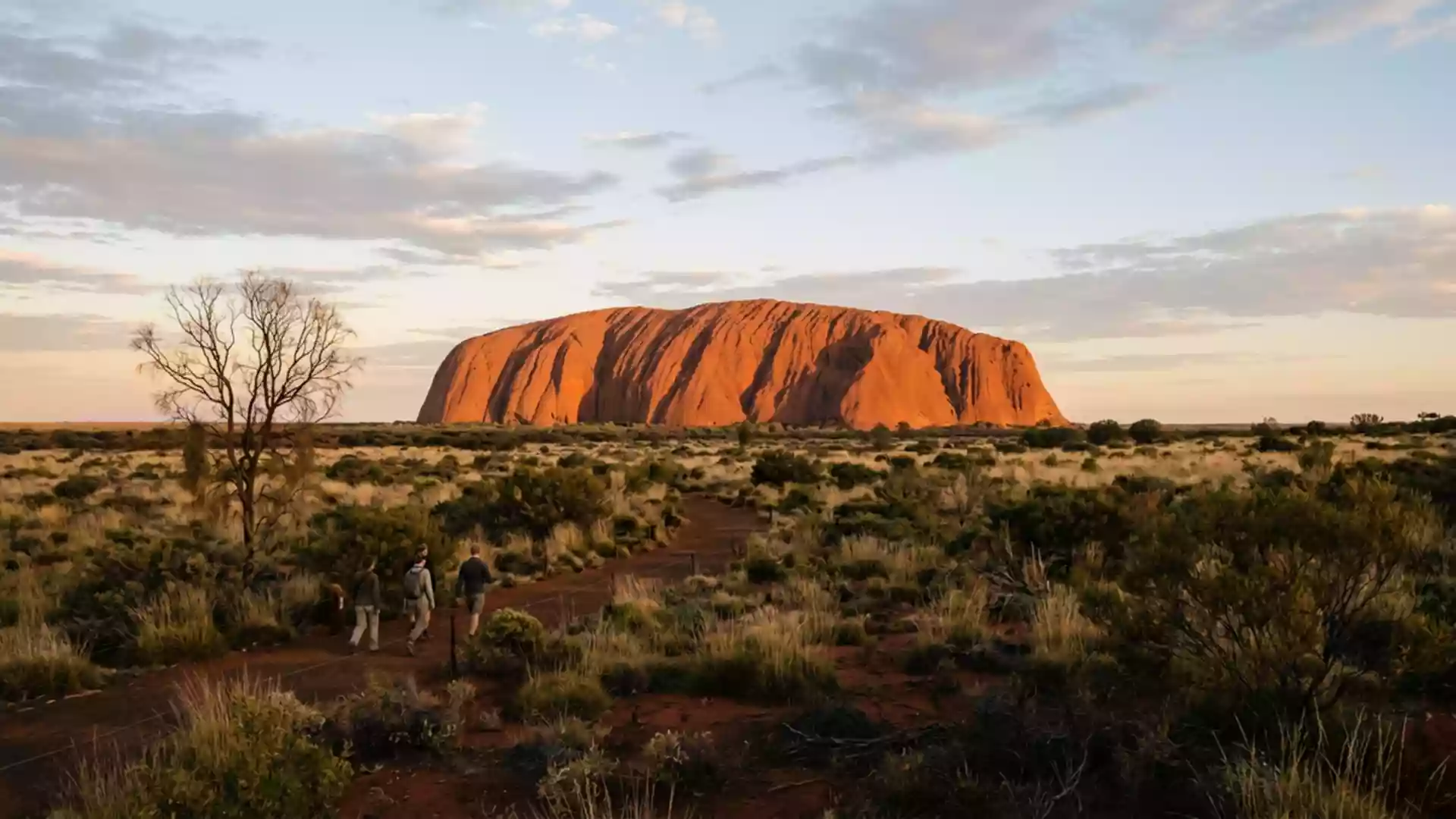
Uluru near Yulara: sandstone monolith in Australia’s Red Centre
Published on 09/11/2026 at 21:13 | Editorial responsibility: Rafael Müller, Editor-in-Chief AD HOC NEWS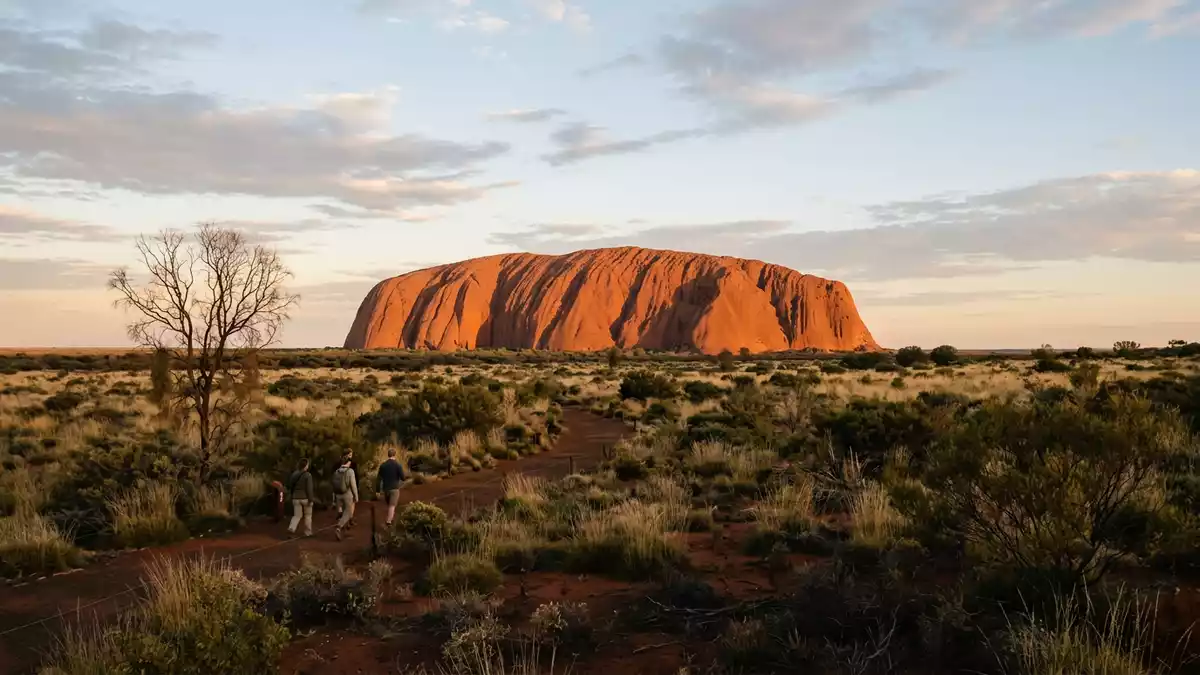
Uluru rises from the desert plains of central Australia as a single sandstone mass, dominating the horizon near the small settlement of Yulara. Set within Ulu?u-Kata Tju?a National Park in the Northern Territory, the rock combines striking physical presence with a deep role in the culture of the A?angu, the Aboriginal people whose ancestral lands surround it.Ulu?u sits within the national park
A single sandstone mass in the desert
From a distance Uluru appears as an immense bare rock rising from relatively flat desert country, with low scrub and sand plains stretching away on all sides.The monolith stands in the Northern Territory The rock is composed of arkosic sandstone, a coarse sedimentary rock rich in feldspar that has hardened over hundreds of millions of years and then tilted so its strata stand steeply in the ground.Uluru’s sandstone is feldspar-rich arkose
The exposed rock reaches a height of about 348 m (1,142 ft) above the surrounding plain and has a circumference of roughly 9.4 km (5.8 miles), giving it a scale that becomes apparent as visitors move around its base.The rock’s height and circumference are documented Its surface shows bands, ribs and weathered hollows where softer layers have eroded more quickly, and the sandstone often takes on a red-brown colour linked to iron minerals within the rock under high desert light.Weathering highlights structures on the surface
Ulu?u-Kata Tju?a National Park and World Heritage status
Uluru forms part of Ulu?u-Kata Tju?a National Park, which also includes the nearby group of rock domes known as Kata Tju?a to the west of the monolith. The park covers a broad tract of arid land with sand plains, rocky outcrops and sparse vegetation, and sits within the Amadeus Basin, a sedimentary region of central Australia shaped by long geological processes over immense time.The park lies on the Amadeus sedimentary basin
Ulu?u-Kata Tju?a National Park is recognised on the UNESCO World Heritage List for both its natural and cultural values. It was first inscribed in 1987 for its natural significance, reflecting its outstanding geological formations and arid ecosystems, and in 1994 it gained a second listing as a cultural landscape linked to the long-standing relationship between A?angu and their land.The park holds dual World Heritage status This dual recognition places Ulu?u-Kata Tju?a among a small group of protected areas where natural features and human culture are formally acknowledged together.
A?angu culture and Tjukurpa at Uluru
For A?angu peoples, including Pitjantjatjara and Yankunytjatjara groups, Uluru is inseparable from Tjukurpa, the body of traditional law and creation stories that shapes their understanding of the land.Tjukurpa is closely tied to Ulu?u Specific features on and around the rock are associated with ancestral beings whose actions are recorded in the form of ridges, caves, watercourses and other visible elements of the landscape.Particular sites carry ancestral stories
Some areas of the rock face, surrounding ground and nearby waterholes are regarded as sacred or restricted, with cultural protocols governing which parts of Uluru may be approached or photographed and which are reserved for ceremonies or teaching within A?angu communities.The monolith is a centre of religious significance The wider national park is jointly managed through arrangements that recognise traditional ownership and national conservation frameworks, embedding cultural knowledge within formal park governance.Management reflects both natural and cultural values
Visiting Uluru: what travellers from Western Europe should know
- Uluru lies in the Northern Territory of Australia, near the locality of Yulara, which serves as the main access point to Ulu?u-Kata Tju?a National Park by road and air.
- The terrain around the rock consists of flat desert plains with sandy soils and low vegetation, and paths at the base involve walking on uneven ground with sections of gentle gradient.
- Kata Tju?a stands to the west of Uluru within the same national park, and the wider area forms part of Australia’s central desert, with long horizons and sparse settlement.
- The official language is English and the currency is the Australian dollar.
- Entry requirements depend on your nationality; UK travellers can check the FCDO travel advice at gov.uk/foreign-travel-advice, Irish travellers the Department of Foreign Affairs at ireland.ie.
Searching for Uluru on social platforms
These links open searches for Uluru on each platform.
Frequently asked questions about Uluru
Where is Uluru and how is it protected?
Uluru stands in Australia’s Northern Territory near Yulara, within Ulu?u-Kata Tju?a National Park, which holds dual World Heritage recognition for natural and cultural values.UNESCO records the park’s status
What should visitors expect when walking near the rock?
Visitors encounter a large sandstone monolith with paths around its base crossing sandy ground, low vegetation and occasional rocky sections, together revealing the scale and surface forms of the rock.Park information outlines its physical features
What makes Uluru distinctive compared with other desert landscapes?
Uluru is distinctive as a single steep-sided sandstone monolith linked to A?angu Tjukurpa, set within a protected desert park where geological formations and Indigenous culture are formally recognised together.Datasheets describe the monolith and its cultural role