
U Bein Bridge, Amarapura’s teak walkway over water
Published on 08/30/2026 at 11:44 | Editorial responsibility: Rafael Müller, Editor-in-Chief AD HOC NEWS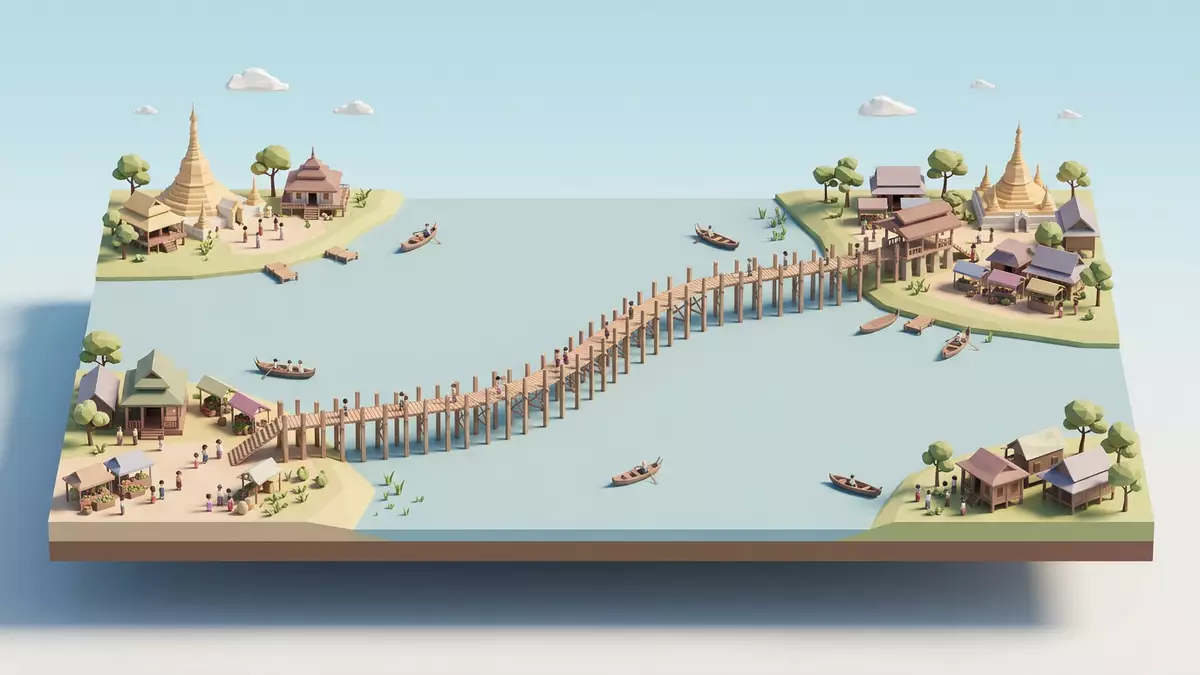
U Bein Bridge stretches as a narrow teak footway across Taungthaman Lake on the edge of Amarapura in Myanmar, turning a simple crossing into a long walk over water. Built in the nineteenth century during the Konbaung dynasty and named after the Amarapura official U Bein, it threads timber posts into the lakebed to link dry land and shallow water in a single raised line.
A nineteenth-century teak bridge across Taungthaman Lake
U Bein Bridge crosses Taungthaman Lake beside Amarapura, a former royal city in the Mandalay Region of central Myanmar. The bridge is widely dated to the middle of the nineteenth century, with construction placed around 1850 during the Konbaung dynasty, when Amarapura served as a royal capital for the Burmese kingdom.built around 1850 The name refers to U Bein, an Amarapura mayor or official associated with overseeing the project.Mayor U Bein built the bridge
The bridge runs for about 1.2 km (around 0.75 miles) from one shore of Taungthaman Lake to the other, its deck carried on a long sequence of spans supported by more than a thousand vertical posts sunk into the lake.stretches 1.2 kilometers Many of those posts are made of teak, and some have been supplemented or replaced by concrete supports where the original timber has deteriorated.1,086 pillars that stretch out of the water Viewed from the shore, U Bein Bridge appears as a slightly curving line of timber uprights and crossbeams, with the walkway resting just above the level of the lake.
Structure, materials and the long teak walkway
U Bein Bridge is built predominantly from teak, a dense tropical hardwood that was widely used in royal buildings in nineteenth-century Myanmar.long wooden bridge across Taungthaman Lake The posts rise from the lakebed, linked by horizontal beams that carry simple timber planks forming the deck. The track on top is narrow, designed for people on foot and, in some sections, bicycles, with the boards running lengthwise along the crossing. At intervals the walkway widens slightly into rest points where small pavilions stand above the water under plain roofs.
Along certain spans there are movable floor sections that can be lifted to let small boats pass beneath the bridge.crossing points where floors can be lifted The posts form a repeating rhythm in the water and continue into the soft ground at each end, where the bridge meets earth embankments instead of lake. Teak components have weathered over many decades of sun and rain, giving the bridge a darkened surface and highlighting the grain of the wood where handrails, balustrades and planks have been handled and worn.
Amarapura, Taungthaman Lake and daily life on the bridge
Amarapura lies a short distance south of Mandalay and served as a royal capital during parts of the Konbaung dynasty in the eighteenth and nineteenth centuries.former royal city of Amarapura Taungthaman Lake occupies a shallow basin beside the urban area, and U Bein Bridge connects the zone near the old city with villages and fields on the opposite shore. Low water levels expose mudflats in the dry season, while higher water means that the posts stand in broad expanses of reflective water.
Monks, traders, villagers and visitors all use the bridge as a straightforward route across the lake.walkway, marketplace, and meeting place Boats pass beneath the spans and move between the posts, and people on the deck look out across the lake towards pagodas and villages on the shore. The long line of timber creates an elevated vantage point above shallow water, and the contrast between the solid teak structure and the low-lying landscape underlines how the bridge ties Amarapura visually and physically to its surrounding lake.
Visiting U Bein Bridge: what travellers from Western Europe should know
- U Bein Bridge stands across Taungthaman Lake at Amarapura in central Myanmar, a short distance south of Mandalay in the country’s Mandalay Region.
- The bridge is a simple wooden footway without enclosed sides, with steps and uneven timber boards in places, so walking it involves basic balance and care on a long, narrow deck.
- The surrounding area includes Taungthaman Lake, villages and pagodas, and small boats operate on the water beneath and alongside the bridge.
- The official language is Burmese and the currency is the Myanmar kyat.
- Entry requirements depend on your nationality; UK travellers can check the FCDO travel advice at gov.uk/foreign-travel-advice, Irish travellers the Department of Foreign Affairs at ireland.ie.
Searching for U Bein Bridge on social platforms
These links open searches for U Bein Bridge on each platform.Frequently asked questions about U Bein Bridge
Where is U Bein Bridge?
U Bein Bridge spans Taungthaman Lake beside Amarapura in the Mandalay Region of central Myanmar, south of the city of Mandalay.
What is it like to walk across U Bein Bridge?
Walking the bridge means following a long, narrow teak deck above shallow water, with simple railings, occasional pavilions and open views across Taungthaman Lake.
What makes U Bein Bridge distinctive?
Its combination of nineteenth-century teak construction, length of about 1.2 km and position across Taungthaman Lake beside the former royal city of Amarapura makes it a distinctive crossing.


