
Tour Eiffel in Paris, an iron lattice tower above the Seine
Published on 09/14/2026 at 08:10 | Editorial responsibility: Rafael Müller, Editor-in-Chief AD HOC NEWS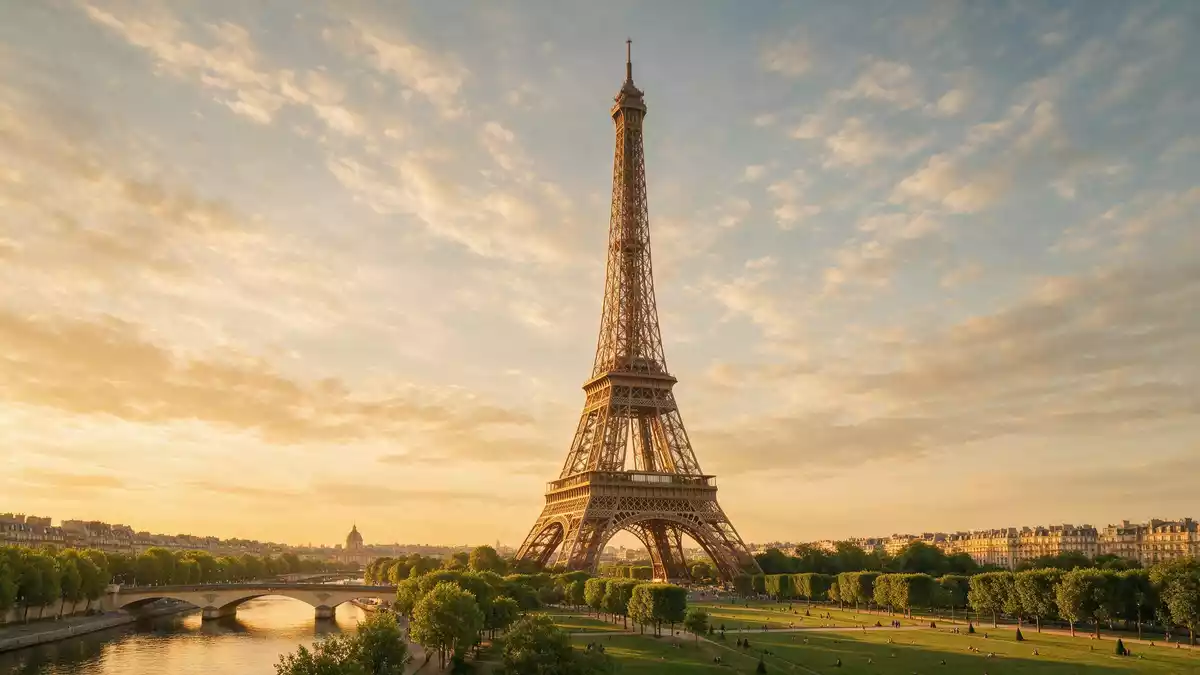
Tour Eiffel in Paris is an iron lattice tower from the late nineteenth century that has become a defining height on the city’s skyline, rising above the Seine and the open lawns of the Champ de Mars.
An iron tower for the Exposition Universelle
Tour Eiffel stands on the Champ de Mars beside the Seine in the 7th arrondissement of Paris, occupying a riverside site framed by broad avenues and formal gardens.Champ de Mars The tower was designed and built between 1887 and 1889 by engineer Gustave Eiffel and his company for the Exposition Universelle held in Paris in 1889, a world’s fair marking the centenary of the French Revolution.designed and built 1887–89
The project drew on structural work by Maurice Koechlin and Émile Nouguier and architectural refinements by Stephen Sauvestre, combining engineering and architectural practice to produce a tower of wrought iron members fixed by large numbers of rivets.Maurice Koechlin and Émile Nouguier Construction began in January 1887 and was completed on 31 March 1889 after a little over two years of work, with the tower opened to visitors in May 1889 as a centrepiece of the exposition.completed on 31 March 1889
Height, structure and levels
Tour Eiffel reaches a height of around 330 m (1,083 ft) including the mast and antennas that crown its structure, a figure that reflects successive additions to its upper framework.330 m (1,083 ft) At the base the tower stands on four separate iron lattice legs set on masonry foundations, forming a square footprint with sides of about 125 m (410 ft) that anchor the rising structure to the ground.square base of 125 m
The legs rise and curve inward, linked by horizontal platforms that form distinct levels with viewing areas, restaurants and service spaces built into the ironwork.iron lattice legs that converge Above the highest large platform, a narrower section carries the mast and antennas that extend the tower’s height, giving the structure its characteristic tapering profile against the sky.
A late nineteenth-century landmark
Tour Eiffel is a product of the nineteenth century’s interest in iron construction, using puddled iron in a lattice arrangement to achieve height with relatively light members and open framing.lattice iron tower When completed in 1889, the tower reached around 300 m (984 ft) and exceeded previous tall structures, holding the record for human-made height until skyscrapers in New York surpassed it in the early twentieth century.tallest structure at its inauguration
The tower’s form, with open ironwork instead of solid masonry walls, gave Paris a new kind of landmark, contrasting with the stone domes and church towers built in earlier centuries and adding an industrial-age silhouette to the view along the Seine.
Visiting Tour Eiffel: what travellers from Western Europe should know
- Tour Eiffel stands at the north-western end of the Champ de Mars beside the Seine in central Paris, reached by city streets and public transport serving the 7th arrondissement.
- The site combines paved areas with lawns and steps leading to the tower’s entrances, and movement within the structure uses lifts and stairways between the levels.
- Paris lies in France, where the official language is French and the currency is the euro.
Searching for Tour Eiffel on social platforms
These links open searches for Tour Eiffel on each platform.
Frequently asked questions about Tour Eiffel
Where is Tour Eiffel located in Paris?
Tour Eiffel stands beside the Seine at the north-western end of the Champ de Mars in the 7th arrondissement of Paris.
What can visitors expect when visiting Tour Eiffel?
Visitors encounter a tall iron lattice tower with several levels connected by lifts and stairways, with views over Paris from platforms set into the structure.
What makes Tour Eiffel distinctive among Paris landmarks?
Tour Eiffel is distinctive for its height, iron lattice construction and tapered profile, which differ from the stone domes and towers built in earlier periods.


