

Tour Eiffel in Paris, an iron lattice tower above the Seine
Published on 08/26/2026 at 10:19 | Editorial responsibility: Rafael Müller, Editor-in-Chief AD HOC NEWS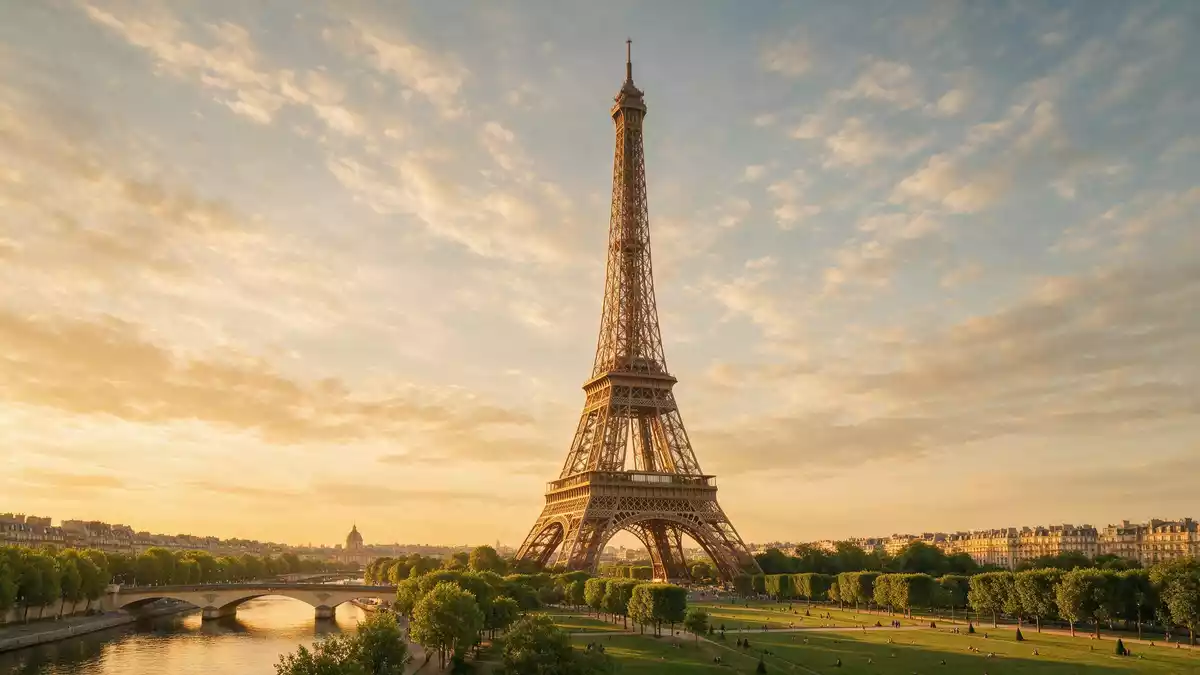
Tour Eiffel in Paris is a wrought?iron lattice tower that has become the clearest vertical marker on the city’s skyline, rising above the Seine and the Champ de Mars with its open metal framework and tapering profile from base to summit. Built between 1887 and 1889 under the direction of engineer Gustave Eiffel for the Exposition Universelle of 1889, it reaches a height of around 330 m (1,083 ft) including the mast and antennas that crown its structure.
An iron tower built for the 1889 Exposition Universelle
Tour Eiffel was conceived as a tall iron tower for the Exposition Universelle held in Paris in 1889, organised to mark the centenary of the French Revolution with a display of industrial and artistic achievements.Exposition Universelle in 1889 The project selected for the fair came from Gustave Eiffel’s company, with structural engineers Maurice Koechlin and Émile Nouguier and architect Stephen Sauvestre contributing to a design based on four great iron lattice legs that rise from separate foundations and converge towards the top.Gustave Eiffel and his collaborators
Work on the foundations began in January 1887 on the riverside site beside the Seine and on the open ground of the Champ de Mars, using masonry piers and iron anchorages to fix the feet of the tower’s legs.Construction beginning in 1887 The ironwork rose in stages, with the structure completed on 31 March 1889 after just over two years of assembly, and the tower opened to the public in May 1889 as a centrepiece of the fair, demonstrating the possibilities of iron construction on an unprecedented scale.completion in 1889
Form and structure: four legs, platforms and a tapering lattice
The defining feature of Tour Eiffel is its exposed iron lattice, formed from riveted wrought?iron elements arranged in a repeating pattern that lightens the appearance of the structure while providing stiffness against wind and weight.wrought?iron lattice construction At ground level four broad legs stand on separate foundations, separated by avenues and gardens, and connected by arches of iron that frame views towards the Champ de Mars and across the river.
Above the broad base, Tour Eiffel carries successive platforms supported by the converging iron lattice, with an extensive lower level occupying the first stage and a more compact level above it that sits within the narrowing form of the tower.platforms within the structure Elevators and stairways climb through and between the legs and lattice to reach these levels, and higher still a smaller viewing stage is set close to the top, beneath the mast and antennas that extend the tower’s height from the original 300 m (984 ft) structural figure to around 330 m (1,083 ft) after later additions for radio and television transmission.from 300 to 330 metres
Tour Eiffel as a symbol of Paris and France
Since its completion in the nineteenth century, Tour Eiffel has become a visual shorthand for Paris, and the iron silhouette rising above the city is tied closely to the identity of France in art, photography and film.symbol of French engineering Its survival beyond the 1889 Exposition Universelle, and beyond early debates about its appearance, turned a temporary fair structure into a permanent landmark that anchors views along the Seine and across the city’s low?rise urban fabric.
Tour Eiffel also carries a practical role as a support for broadcast antennas, a function that has led to changes in its tip height as new equipment has been added over decades, including mast extensions for television and more recent digital radio.height with digital radio antenna The combination of iron engineering from the 1880s and later communication technology marks the tower as both a monument of the industrial age and a working piece of infrastructure in the centre of Paris.
Visiting Tour Eiffel: what travellers from Western Europe should know
- Tour Eiffel stands on the Champ de Mars beside the Seine in central Paris, south?west of the historic core, and is reached by city streets and riverside walkways.
- The site is flat at ground level, but ascending the structure involves stairways and vertical movement within the tower, with elevators and stairs linking the different platforms.
- Nearby, the Seine flows past the tower and the open lawns of the Champ de Mars stretch away from its base, giving clear views of the iron structure from multiple directions.
Searching for Tour Eiffel on social platforms
These links open searches for Tour Eiffel on each platform.Frequently asked questions about Tour Eiffel
Where is Tour Eiffel located in Paris?
Tour Eiffel stands on the Champ de Mars on the Left Bank of the Seine in central Paris, in the country of France.
What should visitors expect when visiting Tour Eiffel?
Visitors encounter a large iron lattice tower with broad legs at ground level, platforms at successive heights and elevators and stairs providing access within the structure.
What makes Tour Eiffel distinctive among city landmarks?
Tour Eiffel is distinctive for its height of around 330 m (1,083 ft), its exposed wrought?iron lattice and its origin as the centrepiece of the 1889 Exposition Universelle.


