
Todai-ji in Nara and the vast timber hall of the Great Buddha
Published on 09/17/2026 at 09:06 | Editorial responsibility: Rafael Müller, Editor-in-Chief AD HOC NEWS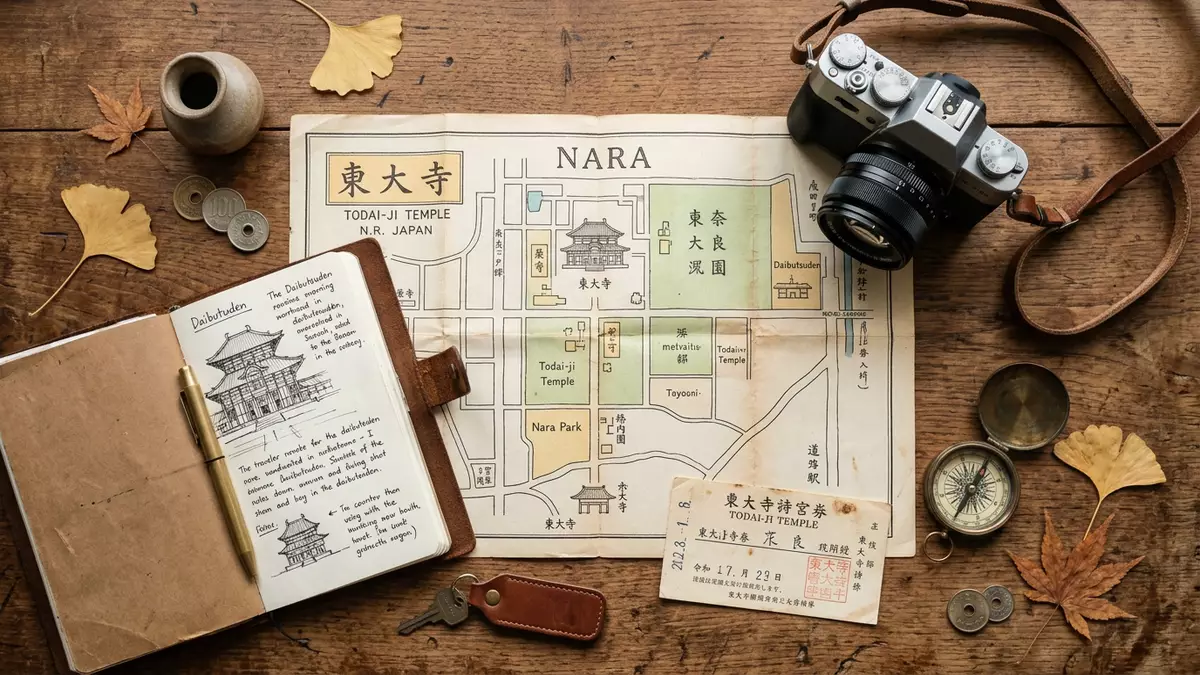
Todai-ji in Nara is one of the great Buddhist temple complexes of Japan, centred on a vast timber hall that shelters a colossal bronze image of the Buddha Vairocana. Founded in the eighth century under Emperor Sh?mu, it anchors the historical landscape of Nara with architecture and sculpture on a scale few religious sites attempt.
The Great Buddha Hall: a vast wooden main hall
At the heart of Todai-ji stands the Great Buddha Hall, or Daibutsuden, the main hall of the temple and one of the largest timber buildings ever raised. The hall that visitors encounter dates from the Edo period and was completed in 1709 under the direction of the monk K?kei, after earlier versions were lost to fire in 1180 and 1567.The present Great Buddha Hall The current structure was reduced from the wider Nara-period plan to a hall seven bays across, yet its height and depth follow the earlier proportions, maintaining an imposing profile against the surrounding precinct.
The Great Buddha Hall sits on a raised base and is carried by massive timber columns and complex bracket sets that step out to support deep eaves and layered roofing. The building measures about 57 m (187 ft) in width, roughly 50 m (164 ft) in length, and close to 49 m (around 160 ft) in height, dimensions that make it one of the largest wooden buildings in the world.Width, length and height Within this volume, the Daibutsu platform rises in the centre, framed by the timber grid and the rhythm of the columns, so that the seated figure commands the entire interior.
The Nara Daibutsu and eighth-century foundations
The bronze Buddha at the centre of Todai-ji is known in Japanese as the Nara Daibutsu and is properly identified as Vairocana Buddha, conceived as a cosmic Buddha whose enlightenment transcends space and time.Vairocana Buddha at Todai-ji The casting of this seated figure was commissioned by Emperor Sh?mu in 743, and the image was completed and dedicated in the mid-eighth century, when Nara served as the capital and Buddhism was closely tied to imperial authority.The eighth-century casting of the Great Buddha The statue rises to a height that dominates the hall and rests on a lotus base whose petals are engraved with scenes known as the World of the Lotus Treasury, visualising the enlightened realm described in the Avatamsaka Sutra.
Todai-ji’s origins lie in Kinsh?-ji, founded in 728 for the repose of Crown Prince Motoi, and the site was elevated when Emperor Sh?mu ordered a nationwide system of monasteries in 741.Kinsh?-ji and the Kokubun-ji system Construction of the Great Buddha and its hall progressed through the 740s, and a grand dedication ceremony took place in 752, marking Todai-ji as the chief temple of the Kokubun-ji network and a centre for rituals for the peace of the nation as well as the training of scholar monks.Todai-ji as head temple of provincial monasteries Over subsequent centuries, earthquakes, fires and warfare damaged the complex, yet restoration campaigns in the Kamakura and Edo periods kept the Great Buddha and its hall in active use.
Temple precincts and World Heritage status
Beyond the Great Buddha Hall, Todai-ji extends across a broad precinct north-east of central Nara, with monumental gates, subsidiary halls and ritual structures linked by paths and courtyards. The Great South Gate and halls such as Nigatsu-d? and Hokke-d? survived the sixteenth-century fire that destroyed much of the complex, and they frame approaches toward the main hall.Structures that survived the 1567 fire In front of the Great Buddha Hall stands an octagonal bronze lantern from the eighth century, with panels depicting celestial musicians and lions among clouds, resting on a lotiform pedestal and stone base that connect sculpture and architecture at the threshold of the hall.Octagonal Lantern in front of the hall
Todai-ji forms part of the UNESCO World Heritage ensemble “Historic Monuments of Ancient Nara”, a listing that brings together temples, shrines and archaeological remains from the era when Nara functioned as the political and cultural centre of Japan.Inclusion in Historic Monuments of Ancient Nara The temple preserves numerous cultural treasures, from its timber architecture and bronze sculpture to ritual practices such as the Shuni-e observances held at Nigatsu-d?, and it remains a place of worship that links the eighth-century foundations with later periods of Japanese Buddhist history.Preservation of cultural treasures and rituals
Visiting Todai-ji: what travellers from Western Europe should know
- Todai-ji stands in Nara, south of Kyoto in the Kansai region of Japan, with approaches leading through Nara Park towards the Great South Gate and the main temple precinct.
- The precinct includes broad paths, stone steps and large interior spaces in the Great Buddha Hall, where movement involves walking across uneven surfaces and ascending low rises between gates and courtyards.
- Within Nara Park, Todai-ji lies near other historic sites and lawns with free-roaming deer, so temple visits combine paved routes with parkland paths.
Searching for Todai-ji on social platforms
These links open searches for Todai-ji on each platform.
Frequently asked questions about Todai-ji
Where is Todai-ji and what kind of place is it?
Todai-ji is a large Buddhist temple complex in Nara in Japan, centred on the timber Great Buddha Hall housing a colossal bronze Vairocana statue.
What should visitors expect inside the Great Buddha Hall?
Inside the Great Buddha Hall, visitors encounter massive timber columns, a high-roofed interior and the seated Nara Daibutsu on a lotus base, flanked by attendant figures.
What makes Todai-ji distinctive among temples in Japan?
Todai-ji stands out for its eighth-century imperial foundations, its role in the Historic Monuments of Ancient Nara and the sheer scale of its wooden hall and bronze Buddha.


