

Todai-ji and the Great Buddha hall of Nara
Published on 08/27/2026 at 18:08 | Editorial responsibility: Rafael Müller, Editor-in-Chief AD HOC NEWS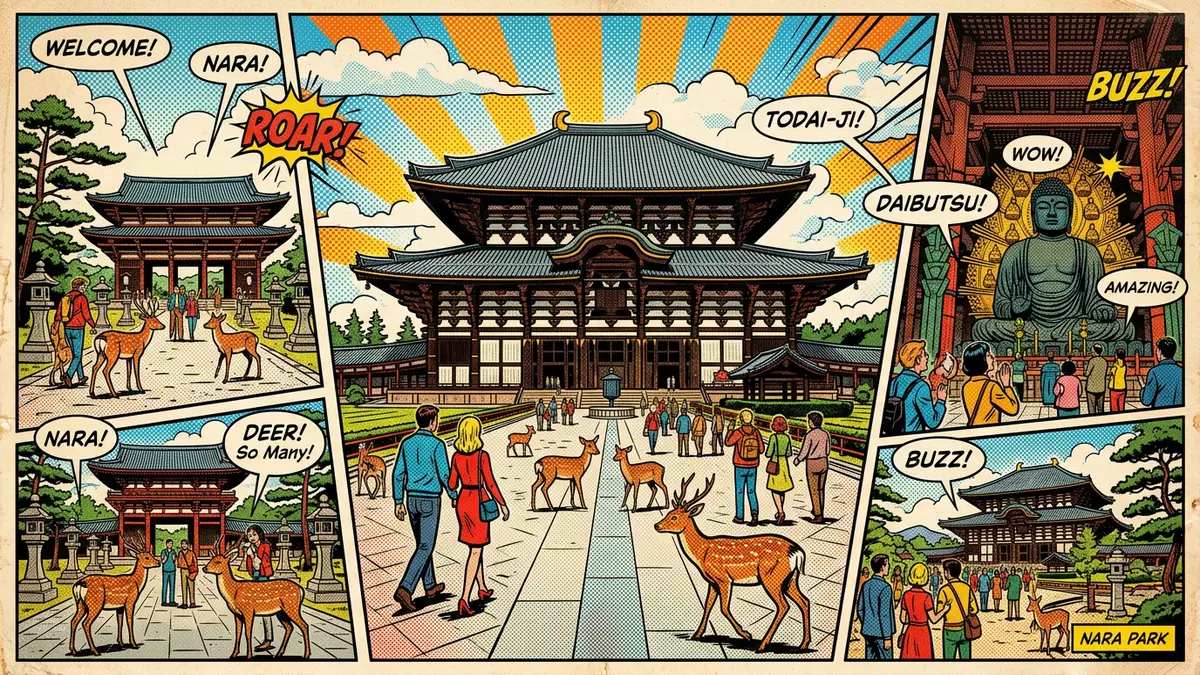
Todai-ji in Nara is a Buddhist temple complex where a vast timber hall and a monumental bronze Buddha sit among lawns, lanterns and subsidiary shrines. Founded in the eighth century when Nara was the imperial capital, it remains a place where scale, material and history are experienced in a single sweeping courtyard.
The Great Buddha hall in timber and bronze
The centre of Todai-ji is the Great Buddha Hall, known in Japanese as Daibutsuden, a main hall constructed in wood on a raised base.The Great Buddha Hall is described as the main hall and its frame rises above the surrounding buildings with layered roofs and projecting eaves. The present structure dates from the Edo period in the early eighteenth century, after fires destroyed earlier halls during the temple’s long history.The current hall dates from 1709
Inside this hall sits a bronze statue of the Buddha Vairocana, known in Japan as the Nara Daibutsu, rising to a height that dominates the interior.The Daibutsu is described as a large bronze statue of Vairocana The seated figure is flanked by attendant statues and backed by an ornate halo structure, while massive timber columns and bracket complexes surround the central platform. The combination of exposed timber, dark bronze and filtered light from high openings gives the hall a distinctive atmosphere anchored by the physical presence of the statue.
An eighth-century temple in the Nara landscape
Todai-ji was founded in the eighth century, when Nara served as the capital of Japan and Buddhism was closely linked with imperial authority.The founding is dated to 738 CE with an official opening in 752 CE Emperor Shomu, who reigned in the first half of the eighth century, is closely associated with the temple’s establishment and with the casting of the Great Buddha as part of a state-sponsored religious project. The temple belongs to the Kegon school of Buddhism, and its grounds retain the feel of a planned religious complex with axial approaches and subsidiary halls.
The complex lies on the eastern side of central Nara, backed by low wooded hills that form part of the city’s wider park landscape.Todaiji Temple is located in Nara near Nara Park Approaching from the west, visitors pass through a sequence of gates and courtyards, with stone lanterns lining paths and deer roaming the grass of Nara Park around the temple precinct. From the outer areas the Great Buddha Hall is partially framed by trees, so that its width and height become fully apparent only when stepping into the inner courtyard directly facing the hall.
Exploring the wider Todai-ji precinct
Beyond the Great Buddha Hall, Todai-ji includes a range of other structures, such as smaller halls, storehouses and a museum displaying temple treasures.The precinct description includes the Daibutsuden, other halls and a museum Many of these buildings follow traditional Japanese timber construction, with tiled roofs and painted details, giving a sense of how a major temple complex functioned in the Nara and subsequent periods. Some halls stand slightly apart on gentle slopes, reached by stairways that rise above the main precinct and offer different perspectives on the Great Buddha Hall and the city beyond.
Todai-ji forms part of the UNESCO World Heritage listing “Historic Monuments of Ancient Nara”, which brings together temples, shrines and remains from the era when Nara was the political and cultural centre of Japan.The temple is included among the Historic Monuments of Ancient Nara This status underlines the temple’s role in the history of Japanese Buddhism and architecture, from its eighth-century origins to the Edo-period reconstruction of its main hall. Walking through the precinct connects these layers, with interpretive boards, statues and architectural details all pointing back to the temple’s long continuity on the eastern edge of Nara.
Visiting Todai-ji: what travellers from Western Europe should know
- Todai-ji stands in the eastern part of Nara, within walking distance of both Nara Station and Kintetsu Nara Station through parkland and city streets.
- The approach to the Great Buddha Hall involves broad gravel paths and stone paving, with some steps and gentle gradients between gates, courtyards and the main hall platform.
- Nara is connected to Osaka and Kyoto by frequent regional rail services, making Todai-ji a straightforward temple visit to combine with wider travel in western Japan.
- The official language is Japanese and the currency is the Japanese yen. Entry requirements depend on your nationality; UK travellers can check the FCDO travel advice at gov.uk/foreign-travel-advice, Irish travellers the Department of Foreign Affairs at ireland.ie.
Searching for Todai-ji on social platforms
These links open searches for Todai-ji on each platform.
Frequently asked questions about Todai-ji
Where is Todai-ji located?
Todai-ji is in the city of Nara in Japan, on the eastern side of the built-up centre, close to Nara Park and low wooded hills.
What can visitors expect at Todai-ji?
Visitors encounter a large temple precinct with gates, paths and subsidiary halls, culminating in the Great Buddha Hall, where a monumental bronze Buddha stands within a vast timber interior.
What makes Todai-ji distinctive among temples?
Todai-ji combines an eighth-century foundation, a Great Buddha cast in bronze and one of the largest timber halls in Japan, all set within a historic landscape in Nara.


