
The British Museum and its stone, glass and stories in Bloomsbury
Published on 08/28/2026 at 07:27 | Editorial responsibility: Rafael Müller, Editor-in-Chief AD HOC NEWS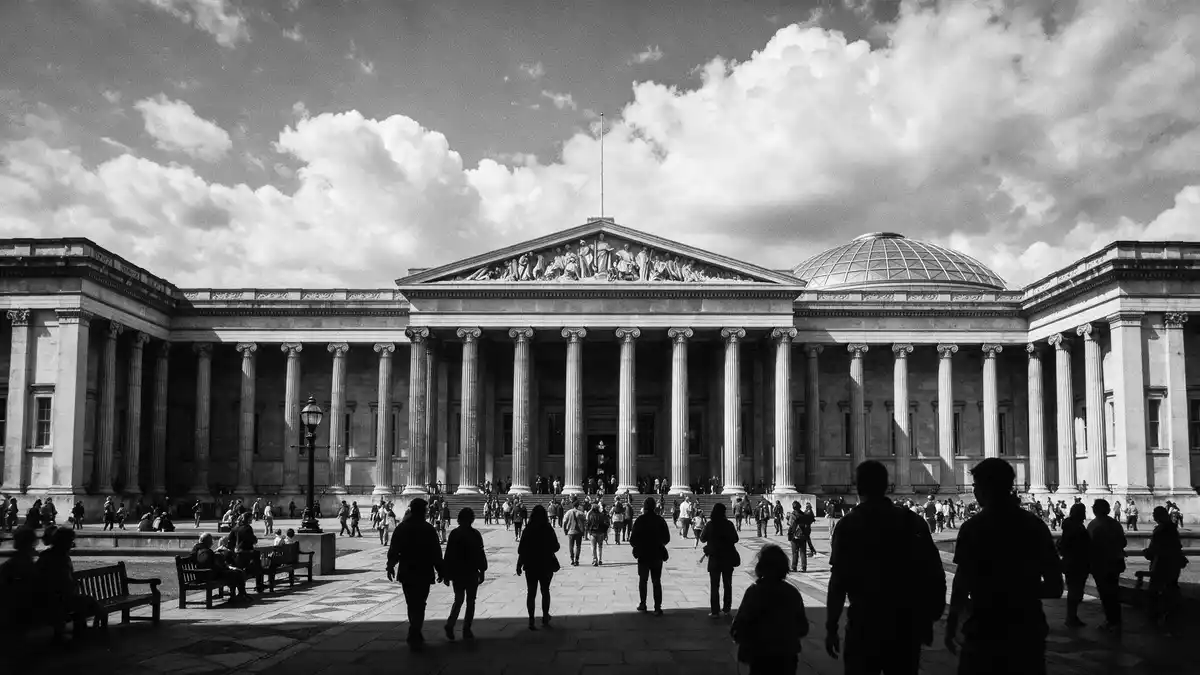
The British Museum in London brings together an Enlightenment-era collection, a nineteenth-century Greek Revival stone shell and a glass-roofed courtyard that reshaped its centre at the turn of the twenty-first century. Founded in 1753 from the bequest of Sir Hans Sloane and opened to the public in 1759, it stands on Great Russell Street in Bloomsbury as a museum of human history, art and culture.
Stone colonnades and an eighteenth-century foundation
The origins of The British Museum lie in the collections of the physician and collector Sir Hans Sloane, whose bequest led Parliament to create a public institution in 1753 for books, manuscripts and artefacts.Parliament created the museum in 1753 The museum opened under its own name in 1759 in Montagu House, a seventeenth-century mansion on Great Russell Street adapted to hold early displays and library rooms.The museum opened in 1759 in Montagu House
Through the late eighteenth and nineteenth centuries the collection expanded across manuscripts, antiquities, ethnographic material and natural specimens, fed by royal libraries and acquisitions from many regions. That growth eventually prompted purpose-built galleries and, later, the separation of natural history and library holdings into institutions such as the Natural History Museum and the British Library, leaving The British Museum focused on human cultures and material heritage.The museum’s collection grew across disciplines
Sir Robert Smirke’s Greek Revival building
The present main building of The British Museum dates from the nineteenth century and was designed by architect Sir Robert Smirke in a Greek Revival style, replacing Montagu House with a much larger stone complex.A Greek Revival building by Sir Robert Smirke Smirke’s plan set out long wings around internal courtyards, with a south entrance facing Great Russell Street that is marked by a broad colonnaded façade and a pedimented portico.The main façade with Greek-inspired columns
Seen from Great Russell Street, the museum reads as a monumental classical composition: a rhythmic forest of columns in front of a stone elevation, steps rising to the entrance and flanking wings that frame the site. Inside, Smirke’s arrangement of galleries around courtyards created a structured route along archaeology, art and material culture from many parts of the world, a layout still legible behind later alterations to the central court.
The Queen Elizabeth II Great Court and Reading Room
At the centre of The British Museum lies the Queen Elizabeth II Great Court, a vast covered quadrangle enclosed by a tessellated glass and steel roof that spreads across the entire courtyard.A glass roof over the Great Court The court surrounds the circular British Museum Reading Room, whose domed form remains intact at the heart of the museum even though its use has shifted over time from the main reading room of the British Library to an information centre and then to an archive space.
Designed by Foster and Partners and completed around 2000, the remodelling of the Great Court turned the previously enclosed inner yard into a large public square under glass, with walkways and staircases linking surrounding galleries and sculptures introducing cultures from the museum’s collections.The Great Court as a covered public square The Reading Room, inspired by the Pantheon in Rome and completed in 1857 under architect Sydney Smirke, stands at the centre as a circular hall with a domed roof and a diameter of over 40 m (about 140 ft), emphasising the layered relationship between nineteenth-century library architecture and late twentieth-century glass engineering.The circular Reading Room completed in 1857
Visiting The British Museum: what travellers from Western Europe should know
- The British Museum stands on Great Russell Street in the Bloomsbury district of London, north of Covent Garden and east of Tottenham Court Road Underground station, and is reached easily by public transport.
- Inside, visitors move between multi-level galleries, staircases and the wide open Great Court, with some spaces involving longer walks through connected exhibition rooms.
- The museum sits within central London’s urban fabric; its main entrance opens from Great Russell Street, while secondary access points connect with nearby streets and squares in Bloomsbury.
Searching for The British Museum on social platforms
These links open searches for The British Museum on each platform.Frequently asked questions about The British Museum
Where is The British Museum located?
The British Museum is located on Great Russell Street in the Bloomsbury area of London, in the United Kingdom.
What can visitors expect on a visit to The British Museum?
Visitors encounter galleries arranged around the Queen Elizabeth II Great Court, with collections spanning archaeology, art and material culture from many regions and periods.
What makes The British Museum distinctive among museums?
The British Museum combines an eighteenth-century foundation, Sir Robert Smirke’s Greek Revival architecture and the glass-roofed Great Court centred on the historic circular Reading Room.


