
The British Museum and its Greek Revival home in Bloomsbury
Published on 08/27/2026 at 07:52 | Editorial responsibility: Rafael Müller, Editor-in-Chief AD HOC NEWS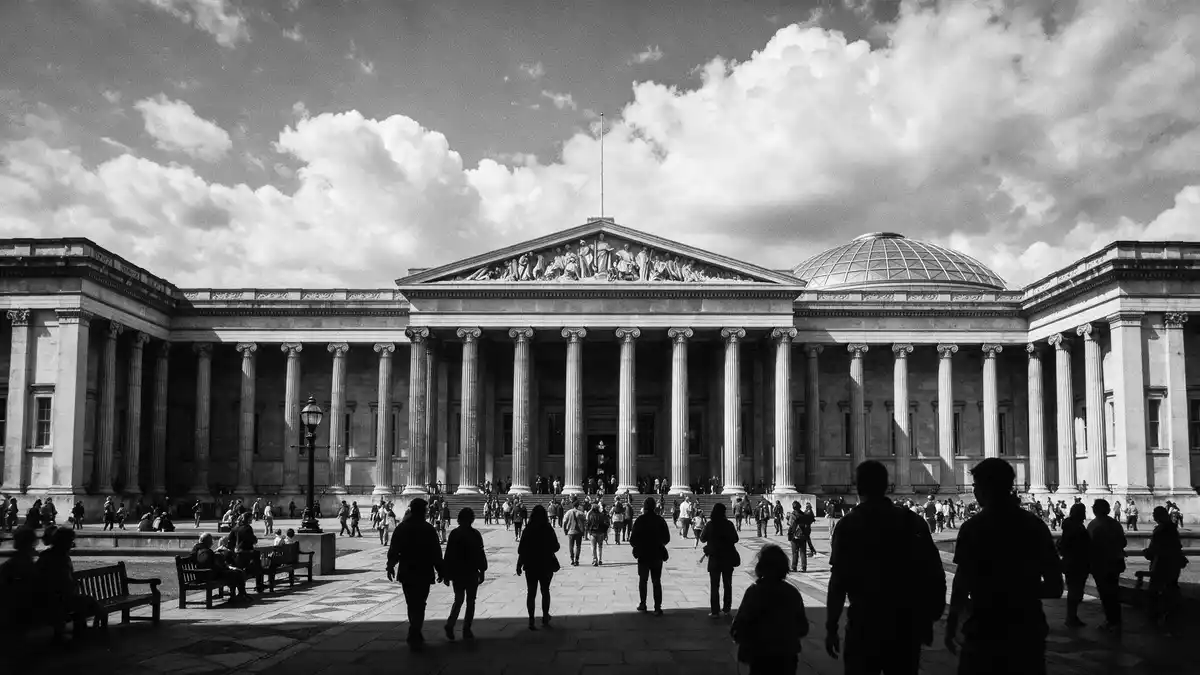
The British Museum in London is both a vast collection of human history and an architectural landmark in its own right, housed in a Greek Revival building that frames an expansive inner court in Bloomsbury. Founded in 1753 and opened to the public in 1759, it grew from the collections of Sir Hans Sloane into a museum that now holds millions of objects from many cultures and periods.
A national museum born from Sir Hans Sloane’s collection
The origins of The British Museum lie in the bequest of the physician and collector Sir Hans Sloane, who left his extensive collections to King George II for the nation under the condition that Parliament establish a public museum to house them.Sir Hans Sloane’s bequest Parliament accepted and on 7 June 1753 an Act of Parliament created The British Museum as a national institution.Founded in 1753
The museum opened under its own name in 1759 in Montagu House, a seventeenth-century mansion in the Bloomsbury district of London, with collections drawn not only from Sloane but also from the Cottonian and Harleian libraries.Opening in 1759 at Montagu House Over subsequent decades the collections expanded across archaeology, ethnography, manuscripts and natural history, leading to reorganisations of departments and, eventually, to the separation of natural history and library holdings into what became the Natural History Museum and the British Library.Growth of the collections
Sir Robert Smirke’s Greek Revival quadrangle
The present main building of The British Museum dates from the nineteenth century and was designed by Sir Robert Smirke in a Greek Revival style, replacing Montagu House with a purpose-built museum.Greek Revival building by Sir Robert Smirke Smirke’s design, developed from the 1820s, laid out a large quadrangle of galleries around a central open court, with an entrance fronted by a colonnade on Great Russell Street.Quadrangle plan around a central court
The architectural expression is marked by long ranges of top-lit galleries and an Ionic portico that has become one of the recognisable faces of Bloomsbury, reflecting a nineteenth-century fascination with classical Greek forms.Ionic south front on Great Russell Street Inside, spaces such as the former King’s Library, built to house the collection of King George III, present extended neoclassical interiors lined with bookcases and columns, showing how the building was conceived as a grand container for scholarship as well as for artefacts.King’s Library and neoclassical interiors
The Great Court and a global collection
At the heart of Smirke’s quadrangle is the central court, transformed at the turn of the twenty-first century into the Great Court, a large covered space with the Reading Room remaining as a freestanding structure at its centre.Great Court with glass roof and Reading Room The court is enclosed by a glass roof designed by Foster and Partners, creating an internal piazza that connects surrounding galleries and circulation routes while keeping the historic Reading Room visible within the composition.Glass-roofed Great Court by Foster & Partners
The British Museum describes its holdings as comprising around eight million objects covering approximately two million years of human history, arranged in departments that include antiquities from many regions and periods.Collections spanning two million years Among these is a substantial collection of Islamic art and archaeological material, numbering tens of thousands of objects, alongside artefacts from ancient Egypt, Greece and Rome, Asia, Africa, the Americas and Europe.Scale and range of the collections
Visiting The British Museum: what travellers from Western Europe should know
- The British Museum stands on Great Russell Street in the Bloomsbury district of central London, a short walk from major Underground stations on several lines.
- The museum’s public spaces are spread across multiple floors reached by staircases and lifts, with long gallery sequences and the expansive Great Court forming the core route.
- The surrounding area includes Russell Square and the campuses of several London universities, with other cultural institutions and museums within walking distance.
Searching for The British Museum on social platforms
These links open searches for The British Museum on each platform.
Frequently asked questions about The British Museum
Where is The British Museum located in London?
The British Museum is in the Bloomsbury district of central London, with its principal entrance on Great Russell Street in the borough of Camden.
What can visitors expect when exploring The British Museum?
Visitors encounter long sequences of galleries arranged around the covered Great Court, with artefacts from many regions and periods displayed in departments across several floors.
What makes The British Museum distinctive among museums?
The British Museum combines a nineteenth-century Greek Revival building by Sir Robert Smirke with an extensive collection covering around two million years of human history.


