
Teatro Amazonas and its Belle Époque dome above the Amazon
Published on 09/15/2026 at 21:24 | Editorial responsibility: Rafael Müller, Editor-in-Chief AD HOC NEWS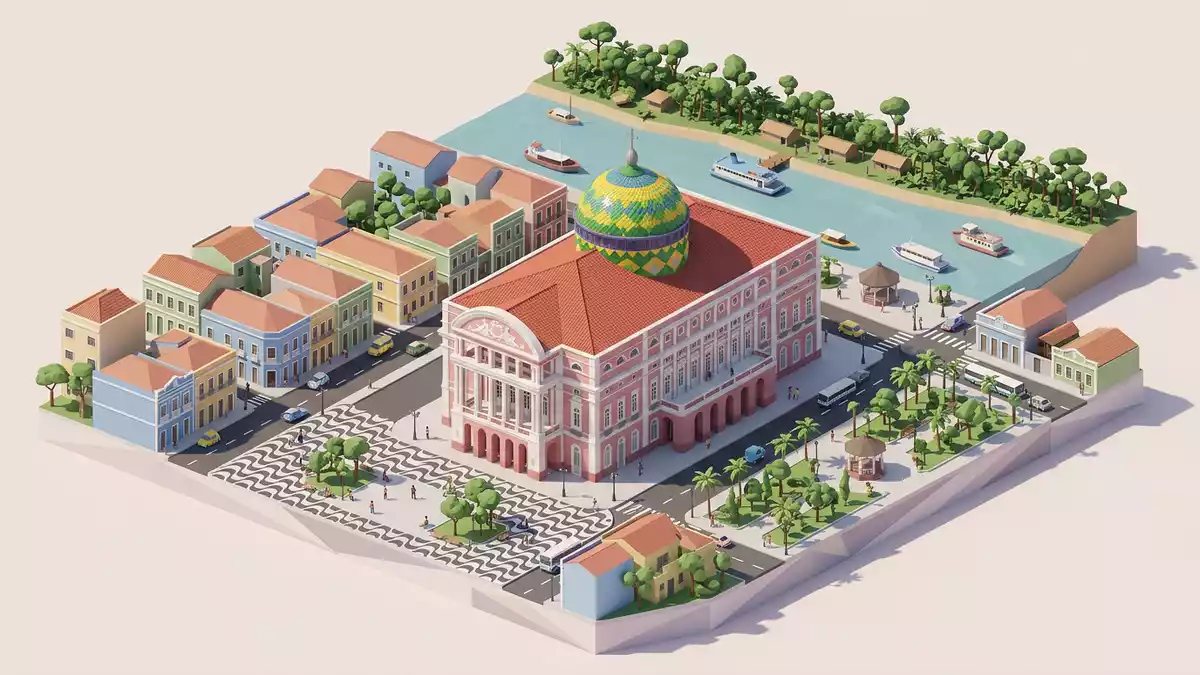
Teatro Amazonas in Manaus is an opera house from Brazil’s rubber-boom era, where a Belle Époque dome and imported materials meet the river city at the edge of the Amazon rainforest. Built in the late nineteenth century and inaugurated in 1896, it turns the wealth of that period into architecture that still dominates Praça São Sebastião in the historic centre of Manaus.
A Belle Époque opera house in the Amazon
Teatro Amazonas is an opera house in the centre of Manaus, the capital of the state of Amazonas in northern Brazil. It stands on Largo de São Sebastião, facing the church of São Sebastião and surrounded by late nineteenth-century buildings whose façades frame views of its dome and main entrance.Largo de São Sebastião The theatre’s location inside the Amazon basin gives it a distinctive setting, with the forest and the Rio Negro forming the wider landscape around the city.
The opera house is widely associated with the rubber cycle that shaped Manaus in the late nineteenth century, when international demand for latex brought wealth into this remote river port. The project for a major theatre was approved in the 1880s, and the architect Celestial Sacardim, an Italian working with a Portuguese engineering and architecture office in Lisbon, was chosen to design the building.Celestial Sacardim Construction began in 1884 and, after interruptions and resumptions, led to the inauguration on 31 December 1896.
Imported materials and Renaissance Revival detail
Sacardim’s design for Teatro Amazonas follows Renaissance Revival lines, with a symmetrical façade, pilasters and classical detailing that echo European opera houses of the period.Renaissance Revival lines The building’s construction used imported materials from Europe: marble from Carrara for staircases and interior finishes, Murano glass for chandeliers, decorative ironwork from England and France, and timber from European sources for floors and fittings.Carrara marble and Murano glass These elements sit within masonry walls that give the opera house a solid presence on the square.
The most visible feature of Teatro Amazonas is its dome, which rises above the roof and is covered with thousands of ceramic tiles in colours arranged to form a pattern reminiscent of the Brazilian flag.ceramic tiles on the dome The façade combines plaster and stone elements, painted in soft tones that contrast with the brighter dome. The surrounding square is paved with Portuguese-style stone patterns in black and white, forming waves that play visually against the straight lines of the theatre’s frontage.Portuguese-style paving
A working opera house and cultural landmark
Inside, Teatro Amazonas has an auditorium with tiers of boxes and a horseshoe-shaped plan typical of European opera houses of the nineteenth century, designed for musical and theatrical performance. Decorative painting, gilded details and chandeliers define the interior, and the theatre’s capacity of around 700 seats makes it a substantial venue for the city.auditorium and capacity The inaugural performance in the 1890s featured the Italian opera “La Gioconda” by Amilcare Ponchielli, aligning Manaus with the repertoire of European opera houses.La Gioconda premiere
Teatro Amazonas functions as a cultural centre for Manaus, hosting opera productions, concerts and other performances, and serving as the home of the Amazonas Philharmonic Orchestra. The annual Amazonas Opera Festival uses the theatre as its main stage, bringing together Brazilian and international performers in a building whose architecture is as much part of the experience as the music.Amazonas Philharmonic Orchestra Beyond performances, the opera house is recognised as a heritage site, listed as a National Historic Landmark by Brazil’s heritage institute IPHAN and included in a UNESCO tentative list alongside Teatro da Paz in Belém.UNESCO tentative list
Visiting Teatro Amazonas: what travellers from Western Europe should know
- Teatro Amazonas stands on Praça São Sebastião in the historic centre of Manaus, a short walk inland from the Rio Negro riverfront and surrounded by city streets laid out on a grid.
- The approaches to the theatre involve urban paving with patterned stone surfaces and a series of exterior steps leading from the square up to the main entrance.
- Manaus is reached by air via Eduardo Gomes International Airport, with road connections into the centre; from there, Teatro Amazonas lies within the central district and is accessible by city streets.
- The building sits in a humid equatorial climate, and the square around it is largely open, with limited shade provided by nearby trees and façades.
- The official language is Portuguese and the currency is the Brazilian real. Entry requirements depend on your nationality; UK travellers can check the FCDO travel advice at gov.uk/foreign-travel-advice, Irish travellers the Department of Foreign Affairs at ireland.ie.
Searching for Teatro Amazonas on social platforms
These links open searches for Teatro Amazonas on each platform.
Frequently asked questions about Teatro Amazonas
Where is Teatro Amazonas located?
Teatro Amazonas is in Manaus, in the state of Amazonas in northern Brazil, standing on Praça São Sebastião within the city’s historic centre close to the Rio Negro riverfront.
What can visitors expect inside Teatro Amazonas?
Visitors encounter a nineteenth-century opera house interior, with a horseshoe-shaped auditorium, tiers of boxes, decorative painting, chandeliers and marble staircases that reflect European Belle Époque style.
What makes Teatro Amazonas distinctive among opera houses?
The combination of European Renaissance Revival architecture, imported materials such as Carrara marble and Murano glass, and a colourful tiled dome rising over a city in the Amazon basin gives Teatro Amazonas a character closely tied to its rubber-boom origins.


