
Teatro Amazonas: an opera house of Belle Époque opulence in the Amazon
Published on 08/29/2026 at 22:38 | Editorial responsibility: Rafael Müller, Editor-in-Chief AD HOC NEWS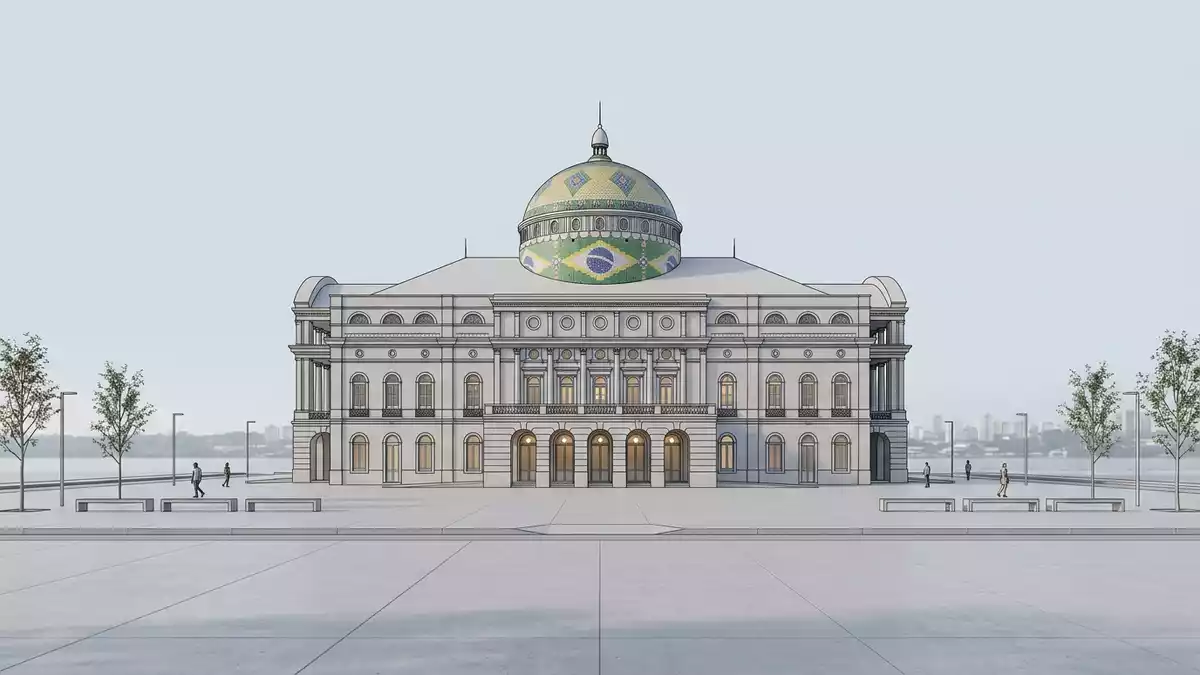
Teatro Amazonas in Manaus is an opera house that sets European-influenced Belle Époque architecture against the deep green of the Amazon rainforest, a contrast that defines the building’s character. Conceived during the rubber boom and inaugurated on 31 December 1896, it embodies a period when wealth from latex transformed this remote river city into a showcase of grandeur.inaugurated on 31 December 1896
Belle Époque ambitions in the Amazon
Teatro Amazonas arose from late nineteenth-century ambitions to give Manaus an opera house that matched the prosperity of the rubber cycle, tying this frontier city to cultural currents in Europe. The idea was introduced in 1881 by Antonio José Fernandes Júnior, a member of the local House of Representatives, who proposed a masonry theatre as a symbol of civilisation amid the forest.proposed in 1881 by Antonio José Fernandes Júnior The architectural project chosen a few years later came from the Gabinete Português de Engenharia e Arquitectura in Lisbon, reflecting transatlantic links between Brazil and Portugal during that era.Gabinete Português de Engenharia e Arquitetura de Lisboa
Construction began in 1884 under the Italian architect Celestial Sacardim, whose design followed Renaissance Revival principles typical of opera houses of the time.construction started in 1884 under Celestial Sacardim Work proceeded in stages across the late 1880s and early 1890s, with the masonry and external form completed by 1895 and interior decoration and electric lighting installed afterwards.masonry completed by 1895 When the theatre finally opened in 1896, Manaus had become one of the principal centres of the rubber trade, and the building’s opulence mirrored that economic peak.
Architecture, materials and the famous dome
The most striking feature of Teatro Amazonas is its domed roof, which rises above the surrounding streets in glazed tiles coloured to recall the Brazilian national flag. The dome is clad in tens of thousands of enamelled ceramic pieces imported from Alsace in France, giving the exterior a shimmering, patterned surface under equatorial light.ceramic pieces imported from Alsace Below this crowning element, the facade shows classical influences, with pilasters, arches and a central pediment that align it visually with European opera houses.
Materials for the theatre came from several parts of Europe, signalling the global reach of the rubber boom. Carrara marble from Italy lines selected interiors, while steel structures were produced in Glasgow, binding Scottish industrial output to this Amazonian landmark.Carrara marble and Glasgow steel Inside, the auditorium follows the horseshoe plan associated with nineteenth-century opera houses, with multiple tiers of boxes arranged around the stage. Italian painter Domenico de Angelis worked on the noble salon, the most lavish room in the building, while Brazilian artist Crispim do Amaral oversaw much of the remaining interior decoration, combining painted ceilings, gilded details and theatrical motifs.Crispim do Amaral and Domenico de Angelis
From rubber-boom opera to heritage landmark
Teatro Amazonas was inaugurated as an opera house and remains associated with staged performance, though its role within Manaus has shifted with economic and cultural changes. The first performance took place in January 1897 with the Italian opera “La Gioconda” by Amilcare Ponchielli, emphasising the link between this Amazon basin city and European musical repertoire.first performance of La Gioconda in January 1897 As the rubber boom faded in the twentieth century, the building went through periods of reduced use and physical decline before conservation became a priority.
Four major interventions have shaped the building’s preservation, including works undertaken between the 1920s and the late twentieth century to stabilise its structure and restore its decorative schemes.four major structural interventions In 1966 the theatre was listed by Brazil’s National Historical and Artistic Heritage Institute (IPHAN), becoming the first monument in Manaus to receive this national protection status.listed by IPHAN in 1966 This recognition confirmed Teatro Amazonas as a heritage landmark, anchoring its Belle Époque architecture in contemporary Manaus as both an active cultural venue and a reminder of the rubber era.
Visiting Teatro Amazonas: what travellers from Western Europe should know
- Teatro Amazonas stands on Praça São Sebastião in the historic centre of Manaus, close to the riverfront and approached along city streets lined with late nineteenth-century buildings.
- Reaching the theatre typically involves walking on paved urban terrain with some steps inside the building, where staircases link the entrance level to upper galleries and boxes.
- Manaus lies in northern Brazil; the official language is Portuguese and the currency is the Brazilian real.
- Entry requirements depend on your nationality; UK travellers can check the FCDO travel advice at gov.uk/foreign-travel-advice, Irish travellers the Department of Foreign Affairs at ireland.ie.
Searching for Teatro Amazonas on social platforms
These links open searches for Teatro Amazonas on each platform.Frequently asked questions about Teatro Amazonas
Where is Teatro Amazonas located?
Teatro Amazonas stands on Praça São Sebastião in the centre of Manaus, in the state of Amazonas in northern Brazil, close to the Rio Negro waterfront.Praça São Sebastião in Manaus
What can visitors expect inside the theatre?
Inside, visitors encounter a Renaissance Revival auditorium with tiers of boxes, painted ceilings, marble finishes and a noble salon richly decorated under the direction of Domenico de Angelis and Crispim do Amaral.noble salon decoration
What makes Teatro Amazonas distinctive among opera houses?
Teatro Amazonas is distinctive for its Belle Époque architecture and European materials set within the Amazon rainforest, marked by a colourfully tiled dome and its origin in the late nineteenth-century rubber boom.Belle Époque architecture in the Amazon


