
Teatro Amazonas and its Belle Époque dome above the Amazon
Published on 09/08/2026 at 15:27 | Editorial responsibility: Rafael Müller, Editor-in-Chief AD HOC NEWS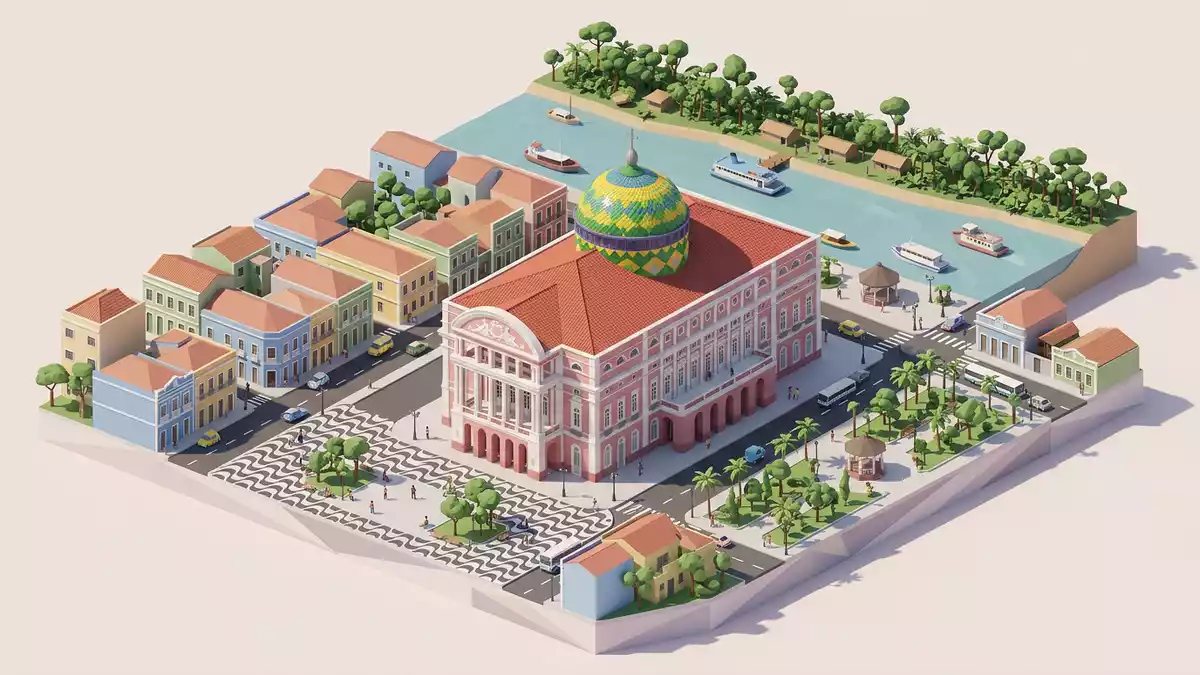
Teatro Amazonas in Manaus is an opera house from the late nineteenth century whose Renaissance Revival architecture and colourful dome rise above the Amazonian cityscape, a landmark of Brazil’s rubber-boom era inaugurated in 1896.
An opera house of the rubber boom
Teatro Amazonas stands in the historic centre of Manaus, a river port in northern Brazil that grew rapidly during the rubber cycle of the late nineteenth century. The idea of giving this remote city an opera house in masonry form emerged in 1881, when politician Antonio José Fernandes Júnior proposed a theatre that matched the ambitions of the region’s elite.
The architectural project selected for the building came from the Lisbon-based Gabinete Português de Engenharia e Arquitetura, reflecting close ties between Brazil and Portugal at the time.Gabinete Português de Engenharia e Arquitetura Construction began in 1884 under the direction of the Italian architect Celestial Sacardim, whose design followed Renaissance Revival principles and drew on European opera house models.construction began in 1884 Work advanced in stages across the 1880s and early 1890s, with the masonry and exterior forms completed by 1895 and interior decoration and lighting installed afterwards.masonry and exterior completed by 1895 The theatre was inaugurated on 31 December 1896, at a time when wealth from latex exports had turned Manaus into what was sometimes called the “Paris of the Tropics”.inaugurated on 31 December 1896
Renaissance Revival architecture with a painted dome
The exterior of Teatro Amazonas combines Renaissance Revival composition with eclectic detailing that brings European forms into an equatorial setting.Renaissance Revival architecture The building is organised around a central volume with a prominent dome, set above façades articulated by pilasters, arches and cornices. The dome itself is covered in thousands of ceramic tiles arranged in coloured patterns, forming a distinctive feature that lifts the profile of the opera house over the surrounding streets of the city.colourful dome above the city
Materials and components were brought from different parts of the world, underlining the global connections of Manaus during the rubber boom. Roofing elements came from Alsace, marble was imported from Italy, furniture from Paris and structural steel from England, giving the building a fabric assembled from European sources.materials imported from Europe Inside, painters and decorators such as Crispim do Amaral worked on the auditorium and other rooms, contributing ceiling paintings and interior schemes that echoed European theatres.Crispim do Amaral The overall composition places an opera house of Belle Époque opulence within the setting of the Amazon basin.
From inauguration to heritage landmark
When Teatro Amazonas opened at the end of 1896, Manaus had become one of the principal centres of global rubber trading, and the opera house stood as a symbol of that prosperity.opera house in the rubber boom The first opera performance in January 1897 brought Italian repertoire to a stage deep within the Amazon region, underlining the cultural ambitions associated with the theatre.first performance in January 1897 Over the twentieth century the building experienced changes in use, periods of reduced activity and restoration campaigns, including a programme that reinforced its status as a heritage site in the 1970s.
Teatro Amazonas has been recognised as a national historic landmark in Brazil, reflecting its architectural quality and its role in the cultural history of the Amazon region.national historic landmark designation It has also featured in proposals related to theatre ensembles in northern Brazil for UNESCO World Heritage consideration, underlining its importance among Amazonian performance spaces.Amazonia Theaters tentative list The building’s continued use for concerts and opera performances connects nineteenth-century architecture with contemporary cultural life in Manaus, while its dome and façades remain a visual reference within the city.
Visiting Teatro Amazonas: what travellers from Western Europe should know
- Teatro Amazonas stands on Largo de São Sebastião in the historic centre of Manaus, a short distance from the riverfront, and is reached by local road transport within the city.
- The opera house interior is arranged on several levels linked by staircases, and the approach from the square involves steps and paved surfaces.
- Manaus lies in northern Brazil along the Amazon River; the official language is Portuguese and the currency is the Brazilian real.
- Entry requirements depend on your nationality; UK travellers can check the FCDO travel advice at gov.uk/foreign-travel-advice, Irish travellers the Department of Foreign Affairs at ireland.ie.
Searching for Teatro Amazonas on social platforms
These links open searches for Teatro Amazonas on each platform.
Frequently asked questions about Teatro Amazonas
Where is Teatro Amazonas located?
Teatro Amazonas is located on Largo de São Sebastião in the historic centre of Manaus, a city in the state of Amazonas in northern Brazil.
What can visitors expect when they enter Teatro Amazonas?
Visitors encounter a Belle Époque opera house with Renaissance Revival interiors, painted ceilings, balconies and a main auditorium that reflect late nineteenth-century European theatre design.
What makes Teatro Amazonas distinctive among opera houses?
Its colourful tiled dome, imported materials from Europe and setting within the Amazon basin make Teatro Amazonas a distinctive example of Belle Époque architecture linked to the rubber-boom history of Manaus.


