
Teatro Amazonas and its Belle Époque dome in the Amazon
Published on 09/07/2026 at 17:44 | Editorial responsibility: Rafael Müller, Editor-in-Chief AD HOC NEWS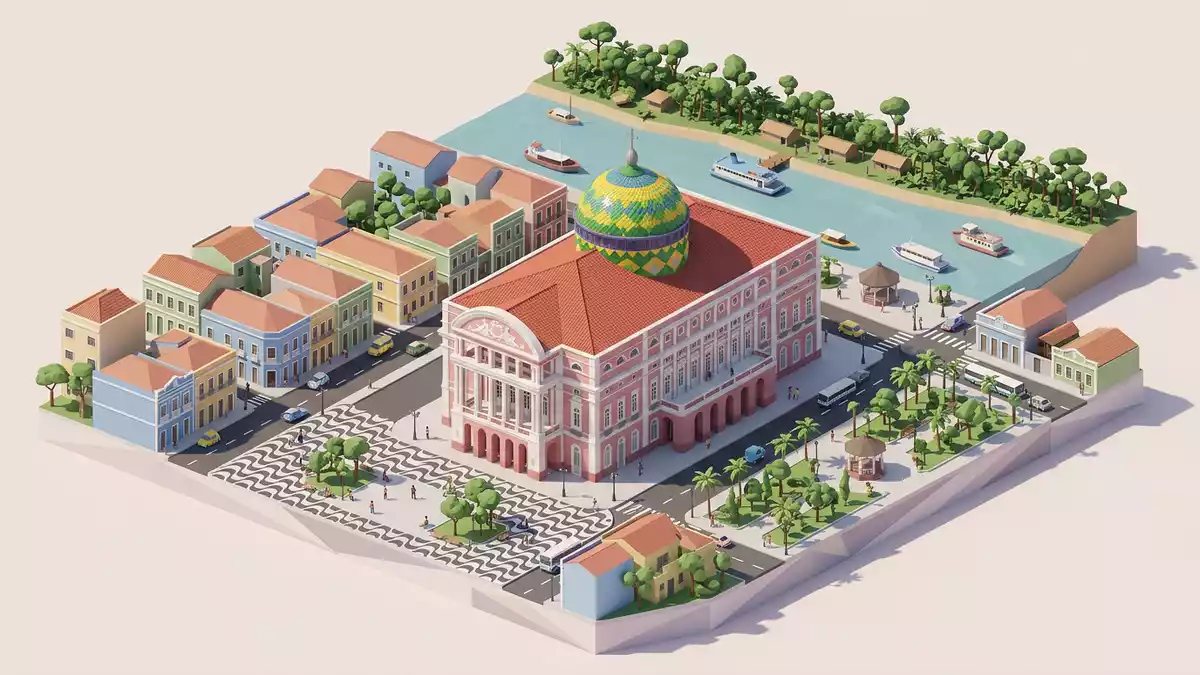
Teatro Amazonas in Manaus is an opera house of Renaissance Revival architecture whose colourful dome rises above the Amazonian city, a landmark of Brazil’s rubber-boom era completed in 1896.
A Belle Époque opera house in the Amazon
Teatro Amazonas stands in the historic centre of Manaus, the capital of the state of Amazonas in northern Brazil, facing Praça São Sebastião and the church of the same name. Conceived in the early 1880s during the rubber boom, the project for a masonry theatre was introduced in 1881 by politician Antonio José Fernandes Júnior as part of wider ambitions to give Manaus a grand cultural venue. Construction began in 1884 under the Italian architect Celestial Sacardim, following a design prepared by the Lisbon-based Gabinete Português de Engenharia e Arquitetura and developed in Renaissance Revival style.
The theatre was inaugurated on 31 December 1896 at the height of the region’s Belle Époque, with an Italian opera performance opening its stage in early January 1897. The building is widely regarded as a symbol of the rubber cycle, a period in the late nineteenth century when fortunes from latex exports transformed Manaus into what was sometimes called the “Paris of the Tropics”. Teatros in the Amazonia region, including Teatro Amazonas, have been recognised on Brazil’s tentative list for World Heritage status, underlining their importance as historic theatres of the Amazon basin.Amazonia Theaters tentative listing
Architecture, imported materials and the tiled dome
From the outside, Teatro Amazonas presents a neoclassical façade with columns, pediments and a central portico above a wide staircase, all executed in Renaissance Revival style adapted to the tropical setting.Renaissance Revival architecture The most striking feature is its dome clad in thousands of glazed ceramic tiles arranged in a geometric pattern in the colours of the Brazilian flag. These tiles were imported from Alsace in France, reflecting the extensive use of European materials during the building’s construction; marble from Carrara in Italy and steel supplied from Glasgow also contributed to the fabric of the theatre.European materials and tiled dome
The interior of Teatro Amazonas is richly decorated with painted ceilings, chandeliers and ornate plasterwork. Celestial Sacardim is recorded as having modelled aspects of the auditorium on the Palais Garnier in Paris, bringing a European opera-house typology into the Amazon region.auditorium inspired by Palais Garnier The interior artwork was supervised by Brazilian artist Crispim do Amaral, with the most elaborate rooms completed by the Italian painter Domenico de Angelis, blending local and imported craftsmanship. Decorative interventions and restorations in the twentieth century have respected the original Renaissance character, and the theatre was listed as a National Historic Heritage site in 1966, anchoring its status as a protected monument.heritage listing and restorations
Teatro Amazonas in Manaus today
Teatro Amazonas functions as an opera house and performance venue, hosting concerts and theatrical productions that maintain its role as a centre of cultural life in Manaus.opera house in Manaus The building forms part of a wider ensemble around Largo de São Sebastião, where Portuguese-style paving, the church and surrounding historic façades frame views of the theatre’s dome. Its designation on Brazil’s national heritage register and its inclusion in Amazonia theatre studies have supported restoration campaigns, including major works carried out between the late 1980s and 1990 that renewed structural elements while keeping the characteristic materials and decorative schemes.
The theatre also serves as a reference point in international discussions of Amazon-region architecture and the history of cities, appearing in scholarly work on tropical Belle Époque urbanism and in travel literature that focuses on the dramatic juxtaposition of European design and rainforest environment.Amazon Theatre in urban history Visitors encounter a building whose form and materials speak directly of a specific moment in Brazilian history: the late nineteenth century, when Manaus grew rapidly on rubber wealth and invested that prosperity into durable stone and tile rather than purely ephemeral displays.
Visiting Teatro Amazonas: what travellers from Western Europe should know
- Teatro Amazonas stands on Largo de São Sebastião in the central district of Manaus, a short walk inland from the riverfront and close to the city’s historic streets.
- The approach involves stone paving and exterior steps up to the main entrance; interiors include staircases between levels and seating arranged on balconies.
- Manaus lies in the Amazon basin, with hot, humid conditions and seasonal rainfall; the theatre provides an enclosed interior space sheltered from the tropical weather.
- The official language is Portuguese and the currency is the Brazilian real; English may be present in some visitor information but Portuguese dominates signage.
- Entry requirements depend on your nationality; UK travellers can check the FCDO travel advice at gov.uk/foreign-travel-advice, Irish travellers the Department of Foreign Affairs at ireland.ie.
Searching for Teatro Amazonas on social platforms
These links open searches for Teatro Amazonas on each platform.
Frequently asked questions about Teatro Amazonas
Where is Teatro Amazonas located?
Teatro Amazonas is in Manaus, the capital of the state of Amazonas in northern Brazil, on Largo de São Sebastião within the city’s historic centre.
What can visitors expect inside Teatro Amazonas?
Visitors encounter a richly decorated opera house with a Renaissance Revival auditorium, painted ceilings, chandeliers and period details that reflect late nineteenth-century design.
What makes Teatro Amazonas distinctive among opera houses?
The theatre combines imported European materials with a tiled dome in Brazilian colours, creating a Belle Époque opera house that rises above an Amazonian river city.


