
Sukhothai Historical Park and the stone grammar of early Thailand
Published on 09/15/2026 at 09:34 | Editorial responsibility: Rafael Müller, Editor-in-Chief AD HOC NEWS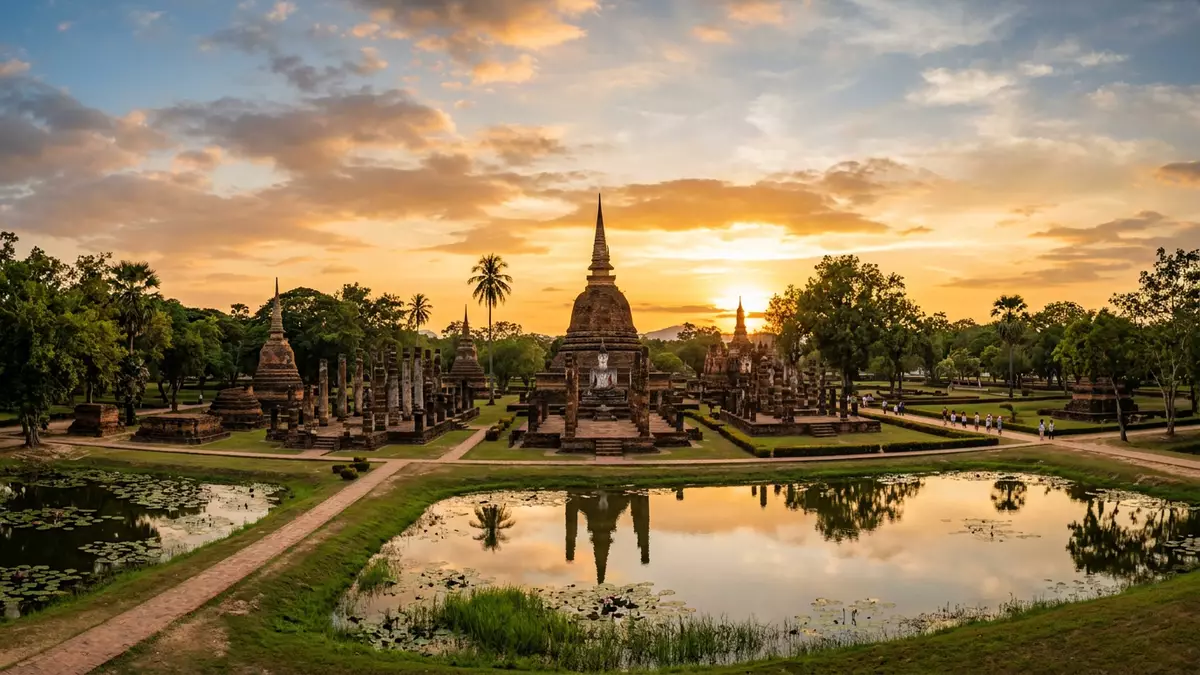
Sukhothai Historical Park in northern Thailand preserves the ruins of Sukhothai, the capital of the Sukhothai Kingdom in the thirteenth and fourteenth centuries, in a wide expanse of moats, reservoirs and stone monuments.capital of the Sukhothai Kingdom The park forms part of the UNESCO World Heritage property “Historic Town of Sukhothai and Associated Historic Towns”, inscribed in 1991 and managed by Thailand’s Fine Arts Department.Historic Town of Sukhothai and Associated Historic Towns
A planned royal city of stone, laterite and water
The core of Sukhothai Historical Park is a rectangular walled city laid out on a grid and encircled by moats, with the remains of a royal palace and major temples concentrated near the centre.rectangular walled city This central zone expresses the political and religious order of the Sukhothai Kingdom, with Wat Mahathat occupying the symbolic heart of the city and other temples aligned around it.
The urban fabric is built largely from laterite blocks and brick, surfaced in places with stucco that once carried refined reliefs of Buddhas, mythological beings and floral patterns.laterite blocks and brick Reservoirs, known locally as “traphang”, punctuate the city plan, forming broad sheets of water beside key monuments and reflecting stupas, columns and Buddha statues against the surrounding plain.
Zones, temples and the landscape of Buddhism
The historical park extends beyond the old city walls into several zones that together contain nearly 200 ancient monuments from different phases of Sukhothai’s history.nearly 200 ancient monuments The central zone includes Wat Mahathat with its lotus-bud stupas and Buddha images, Wat Sa Si rising beside a reservoir, and Wat Si Sawai with towers that recall Khmer architectural forms.
To the north of the walled city lie sites such as Wat Si Chum, known for its large seated Buddha, and Wat Phra Phai Luang, which preserves traces of early ritual architecture.Wat Si Chum and Wat Phra Phai Luang Further west the terrain rises into low hills, where temples like Wat Saphan Hin stand on elevated ground reached by stone paths, giving views back across the plain and the regular pattern of the former royal city.
From kingdom heartland to World Heritage landscape
Sukhothai served as the centre of a Thai kingdom whose influence extended across parts of present-day Thailand, and its architecture reflects both local developments and connections with neighbouring cultures in mainland South-East Asia.centre of the Sukhothai-Königreiches The site embodies the transition from older Khmer forms to distinctively Sukhothai styles, visible in the profile of stupas and the treatment of Buddha images.
In the twentieth century Thailand’s Fine Arts Department, working with UNESCO, undertook systematic conservation and presentation of the ruins, establishing Sukhothai Historical Park as a protected cultural landscape.conservation and opening as a historical park The Sukhothai component of the World Heritage property covers an area of about 7,000 ha, within a wider serial designation that also includes Si Satchanalai and Kamphaeng Phet.7,000 ha Sukhothai component
Visiting Sukhothai Historical Park: what travellers from Western Europe should know
- Sukhothai Historical Park lies near the modern town of Sukhothai in northern Thailand, reached overland from regional centres such as Phitsanulok and by road from Bangkok.
- The terrain inside the park combines level paths with stretches of uneven stone and laterite, and some monuments stand on raised platforms reached by flights of steps.
- The park is set on a broad plain with reservoirs and moats, so walking between zones involves exposed sections across open ground with limited shade away from the trees around the water.
- The official language is Thai and the currency is the baht.
- Entry requirements depend on your nationality; UK travellers can check the FCDO travel advice at gov.uk/foreign-travel-advice, Irish travellers the Department of Foreign Affairs at ireland.ie.
Searching for Sukhothai Historical Park on social platforms
These links open searches for Sukhothai Historical Park on each platform.
Frequently asked questions about Sukhothai Historical Park
Where is Sukhothai Historical Park located?
Sukhothai Historical Park lies near the modern town of Sukhothai in the lower northern region of Thailand, on a plain with moats and reservoirs.
What can visitors expect to see inside the park?
Visitors encounter walled-city ruins, reservoirs, stupas, Buddha statues and the remains of temples such as Wat Mahathat, Wat Sa Si, Wat Si Sawai and Wat Si Chum.
What makes Sukhothai Historical Park distinctive among Thai historical sites?
The park combines a clearly planned royal city layout, large numbers of temple ruins and a recognised World Heritage status linking it with Si Satchanalai and Kamphaeng Phet.


