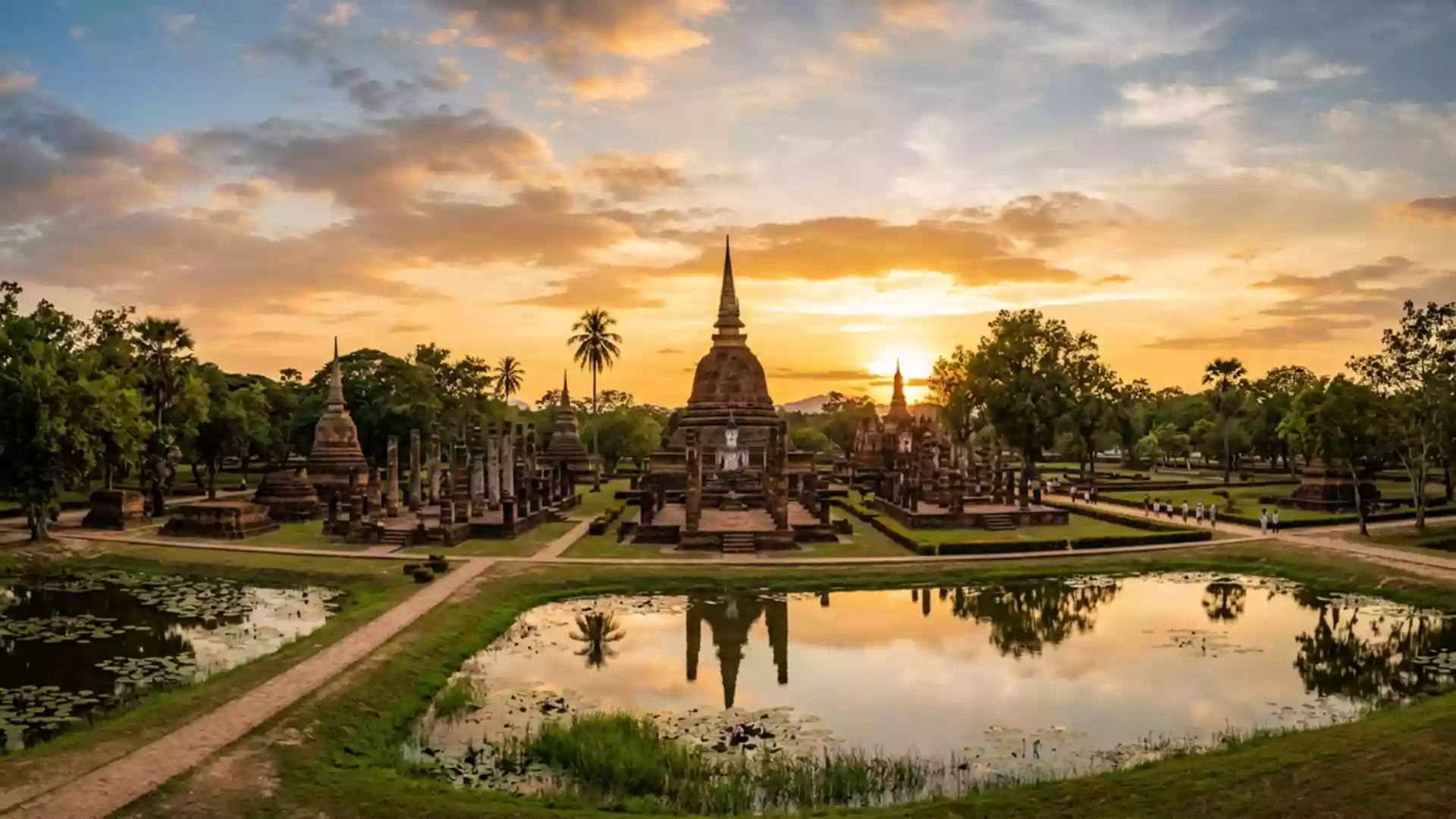
Sukhothai Historical Park and the geometry of an ancient Thai capital
Published on 09/07/2026 at 20:56 | Editorial responsibility: Rafael Müller, Editor-in-Chief AD HOC NEWS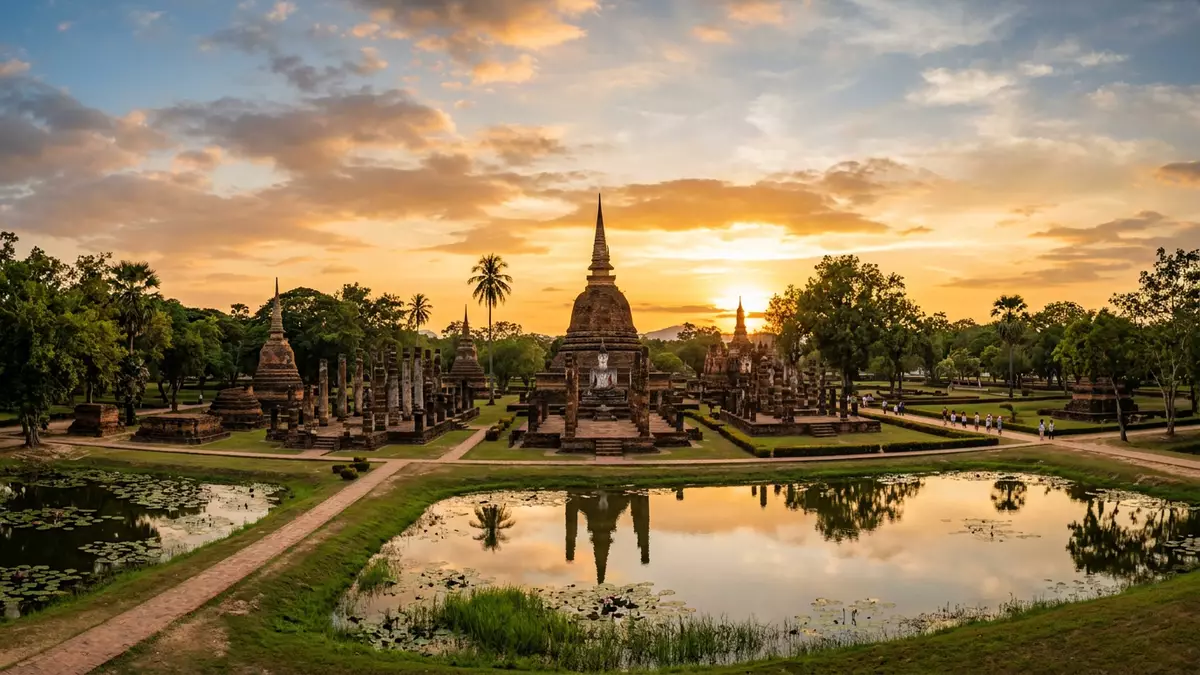
Sukhothai Historical Park west of the modern town of Sukhothai sets out the former capital of the Sukhothai kingdom as a planned city that can still be walked in coherent form.capital of the Sukhothai Kingdom in the thirteenth and fourteenth centuries remains traceable in its walls, moats, reservoirs and temple platforms, giving the park a distinctive geometric character.official registration embracing 70 square kilometres defines the protected landscape.
The planned city of Sukhothai in stone and earth
The historic core of Sukhothai Historical Park is enclosed by city walls that form a broad rectangle, with the main axis running roughly east–west and the shorter side north–south.about 2 km east–west by 1.6 km north–south gives a sense of scale, and within this perimeter are the foundations of the royal palace and numerous temple compounds aligned with the grid of streets and watercourses.
The terrain of the historic city lies on a gently sloping plain at the foot of low hills, with the ground descending towards the east so that the western horizon is marked by the range of Khao Pratak Mountain.located on a foothill plain, sloping down to the east with Khao Pratak Mountain to the west and south means visitors experience the ruins against a backdrop of wooded ridges and open sky.Historic Town of Sukhothai and Associated Historic Towns links the park to its wider setting at Si Satchanalai and Kamphaeng Phet.
Royal, religious and hydraulic structures within the park
Within the inner city, the outline of the royal palace sits close to the centre of the rectangle, surrounded by temple platforms and Buddha images that once formed the ceremonial core of the Sukhothai court.inside are the remains of the royal palace and twenty-six temples and many further monuments beyond the walls are recorded across the wider park.217 archaeological sites investigated gives an indication of how densely the area is layered with historical structures.
The most prominent temple complex in the inner zone is Wat Mahathat, laid out with a tall central sanctuary surrounded by secondary stupas and cloister walks, reflecting the architectural language of the Sukhothai period.the largest temple being Wat Mahathat anchors the skyline of the park, while other notable sites such as Wat Si Sawai and Wat Sa Si stand near the city walls or beside reservoirs.representative temples inside and outside the walls show how religious buildings extend out into the surrounding countryside.
A World Heritage landscape of water, walls and laterite
Sukhothai Historical Park is constructed largely from laterite, brick and stucco, materials that have weathered into warm reds and greys against the green of grass and trees, and its reservoirs and moats form a series of reflecting surfaces inside and outside the walls.ruins of royal palaces, Buddhist temples, city gates, walls, moats and water dyke control system together express how the historic capital combined defensive earthworks with managed water for agriculture and ritual use.
The park forms the Sukhothai component of the “Historic Town of Sukhothai and Associated Historic Towns” inscription on the UNESCO World Heritage List, recognised as a cultural property of international significance.Sukhothai with Si Satchanalai and Kamphaeng Phet inscribed as World Heritage in 1991 reflects the role of the Sukhothai kingdom in the history of Thailand and the way its planned city and religious architecture survive in situ.Sukhothai Historic Park opened officially on 20 November 1988 under the care of the Fine Arts Department shows how the ruins have been given formal protection as a historical park.
Visiting Sukhothai Historical Park: what travellers from Western Europe should know
- Sukhothai Historical Park lies west of Sukhothai in lower northern Thailand, near Tambon Mueang Kao in Sukhothai Province, reached along Thailand Route 12 by road or local transport.
- The ground within the park includes earth embankments, stone platforms and uneven laterite blocks, and exploring temple compounds and reservoirs involves extended walking on varied surfaces.
- The wider World Heritage landscape links Sukhothai Historical Park with Si Satchanalai Historical Park and Kamphaeng Phet Historical Park, all in northern Thailand and reachable by regional road networks.
- The official language is Thai and the currency is the baht.
- Entry requirements depend on your nationality; UK travellers can check the FCDO travel advice at gov.uk/foreign-travel-advice, Irish travellers the Department of Foreign Affairs at ireland.ie.
Searching for Sukhothai Historical Park on social platforms
These links open searches for Sukhothai Historical Park on each platform.Frequently asked questions about Sukhothai Historical Park
Where is Sukhothai Historical Park located?
Sukhothai Historical Park lies west of the modern town of Sukhothai in Sukhothai Province in lower northern Thailand, on a plain beneath the Khao Pratak range.
What should visitors expect on a visit to the park?
Visitors encounter stone and brick temple ruins, palace foundations, city walls, moats and reservoirs spread across a large protected landscape, with extended walking between historic zones.
What makes Sukhothai Historical Park distinctive among Thai heritage sites?
The park preserves the planned geometry of a former capital, with its rectangular walls, axial layout, hydraulic works and major temples such as Wat Mahathat forming a coherent World Heritage ensemble.