
Sukhothai Historical Park and its city of temples
Published on 09/24/2026 at 09:37 | Editorial responsibility: Rafael Müller, Editor-in-Chief AD HOC NEWS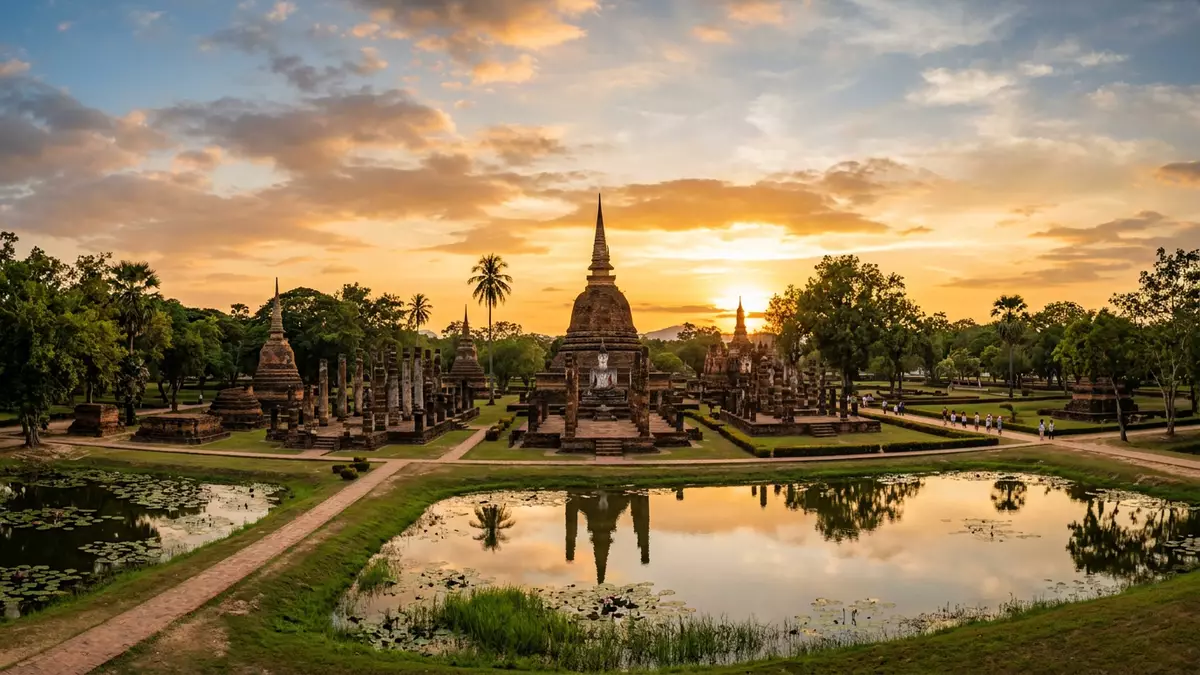
Sukhothai Historical Park preserves the remains of a royal city across a broad plain in Sukhothai, Thailand. Its temples, reservoirs, walls and Buddha images form a landscape where architecture and water appear together within the ruins of the thirteenth-century Sukhothai kingdom.
Sukhothai Historical Park: a capital laid across the plain
The historic city lies on a foothill plain west of the modern town. Khao Pratak rises from the western and southern sides, while the land slopes towards the east. The old urban area is enclosed by ramparts and a ditch, with archaeological remains extending across the wider park.
The city’s registered area covers 70 square kilometres. The UNESCO property places Sukhothai within a wider property that also includes Si Satchanalai and Kamphaeng Phet. The inscription dates from 1991 and records the three historic towns as a single World Heritage site.
Temples, reservoirs and the Sukhothai style
Wat Mahathat occupies the central ceremonial area, with towers, images and monastic remains arranged across a spacious enclosure. Wat Sa Si stands beside water, while Wat Si Sawai retains three distinctive prang towers associated with an earlier Khmer-influenced architectural vocabulary.
Sukhothai art is associated with lotus-bud chedis, slender stucco forms and walking Buddha images. The monuments combine brick, laterite and stucco, while ponds, moats and canals remain visible among trees and masonry. Wat Si Chum contains a large seated Buddha image behind a substantial enclosing structure.
From Sukhothai kingdom to protected historic park
Sukhothai became the centre of an independent Thai kingdom in the thirteenth century. Ramkhamhaeng is associated with the kingdom’s expansion and with the development of a written Thai tradition, while the city’s monuments preserve the artistic language known as the Sukhothai style.
The Department of Fine Arts registered the archaeological area in 1975. Sukhothai Historical Park opened officially in 1988, and the historic town entered the UNESCO World Heritage List in 1991. The protected landscape contains city walls, gates, religious buildings, reservoirs and scattered archaeological sites rather than a single enclosed monument.
Visiting Sukhothai Historical Park: what travellers from Western Europe should know
- Sukhothai Historical Park lies in Mueang Kao, west of modern Sukhothai. Road transport connects the historic area with Sukhothai and nearby provincial destinations.
- The park spreads across a wide plain, so visits involve movement between separated monuments. Paths pass ramparts, ponds, trees, brick ruins and open archaeological ground.
- The official language is Thai and the currency is the Thai baht.
- Several major monuments are grouped in the central area, while further ruins extend towards the northern, eastern, southern and western parts of the historic city.
Searching for Sukhothai Historical Park on social platforms
These links open searches for Sukhothai Historical Park on each platform.Frequently asked questions about Sukhothai Historical Park
Where is Sukhothai Historical Park?
The park is in Mueang Kao, within Sukhothai Province in Thailand. It lies west of modern Sukhothai on the historic city plain.
What can visitors expect at the park?
Visitors encounter temple ruins, Buddha images, city walls, reservoirs, ponds and archaeological remains distributed across a broad landscape.
What makes Sukhothai Historical Park distinctive?
Its monuments preserve the architectural and sculptural language of the Sukhothai kingdom. Water features and religious buildings remain closely associated within the old capital.


