
Suchitoto, El Salvador’s hillside colonial town above Lake Suchitlán
Published on 09/07/2026 at 17:08 | Editorial responsibility: Rafael Müller, Editor-in-Chief AD HOC NEWS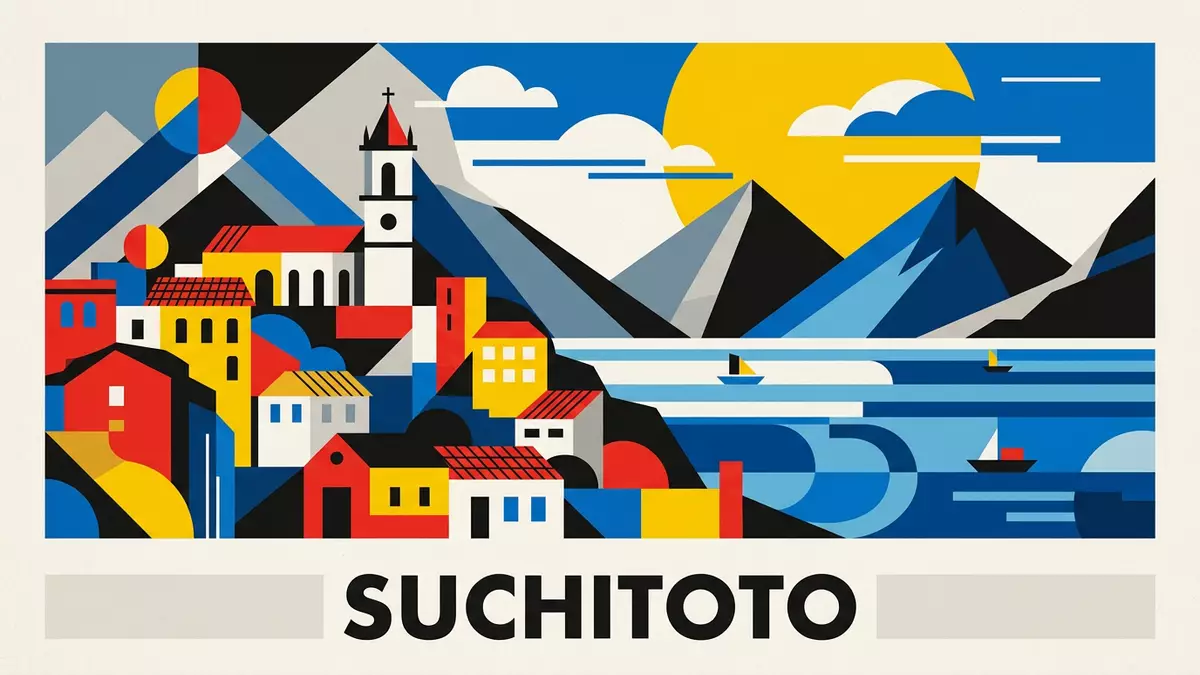
Suchitoto in central El Salvador is a colonial hillside town whose whitewashed houses and cobblestone streets step down towards the northern shore of Lake Suchitlán. The town lies in the Cuscatlán Department and has roots reaching back to pre?Columbian settlement and an early Spanish founding of San Salvador in 1528, giving its compact centre a layered sense of time beneath the bright stucco façades.Pre?Columbian habitation and the 1528 founding
Colonial streets and the Santa Lucía church
The core of Suchitoto follows a straight-street grid laid down under Spanish colonial rule, with roads meeting at right angles and converging on a central plaza lined with low, tiled-roof houses.Colonial street grid in the historic centre Walking across the square, the eye is drawn to the white façade of the Church of Santa Lucía, a nineteenth-century structure whose towers and front portico rise above the surrounding roofs and mark the town’s main gathering space.Santa Lucía church facing the plaza
Behind the church and along the grid of streets, small galleries and cafés occupy former colonial houses, their internal courtyards opening off heavy wooden doors set directly on the cobbles.Galleries and colonial houses with tile roofs Many buildings retain thick walls and timber beams, so the urban fabric feels continuous rather than pieced together; the architectural backdrop is unhurried, and the human scale of one- and two-storey structures keeps the town’s profile low against the sky.
Lake Suchitlán and the surrounding landscape
Suchitoto stands on rising ground north-east of San Salvador, between the Guazapa volcano and the Lempa River, looking down across the broad waters of Lake Suchitlán.Hillside setting between Guazapa and the Lempa The reservoir was formed in the 1970s behind the Cerrón Grande hydroelectric dam on the Lempa, flooding a valley and creating a wide expanse of water that now defines the town’s outlook.Lake Suchitlán as a man?made reservoir
From streets near the edge of the centre, viewpoints open towards the lake and low hills on the far shore, with small islands dotting the water and boats heading out from jetties below the town.Northern shore location on Lago Suchitlán The relationship between town and reservoir is direct: a short descent from the cobblestone grid leads to lakeside embarkation points, while returning uphill takes travellers back into the dense weave of streets, plazas and houses that form Suchitoto’s historic core.
History, indigo and Suchitoto’s cultural life
Long before its present-day role as a visitor destination, the area around Suchitoto formed part of indigenous territory where Nahuatl-speaking communities lived, and the name itself is linked to a Nahuatl phrase commonly rendered as “place of flowers and birds”.Nahuatl origin of the town’s name Within the municipal boundaries lies the site where the Villa of San Salvador was founded in 1528 and abandoned after a short period, placing Suchitoto within the earliest chapter of Spanish urban settlement in El Salvador.Original Villa de San Salvador in 1528
Over the nineteenth century and into the twentieth, the town consolidated as a municipality framed by agriculture, lake fishing and small-scale crafts, including the production of natural indigo dye, known locally as añil.Natural indigo dyeing tradition In recent decades, an arts scene linked in part to filmmaker Alejandro Cotto has brought cinema and performance into restored colonial spaces, reinforcing Suchitoto’s reputation for galleries, cultural centres and festivals that sit comfortably within its narrow streets and central square.Arts scene tied to Alejandro Cotto
Visiting Suchitoto: what travellers from Western Europe should know
- Suchitoto lies north-east of San Salvador in the Cuscatlán Department of El Salvador, reached by road from the capital on routes including regional buses towards the town.
- The historic centre occupies a hillside above Lake Suchitlán, with streets on noticeable gradients and sections of uneven cobblestone; walking between the plaza and lakeside involves an uphill or downhill approach.
- The town’s setting brings visitors close to the northern shore of a large reservoir, with jetties and boat departures reached by descending from the colonial grid towards the water.
- El Salvador’s official language is Spanish and the national currency is the United States dollar.
- Entry requirements depend on your nationality; UK travellers can check the FCDO travel advice at gov.uk/foreign-travel-advice, Irish travellers the Department of Foreign Affairs at ireland.ie.
Searching for Suchitoto on social platforms
These links open searches for Suchitoto on each platform.
Frequently asked questions about Suchitoto
Where is Suchitoto in El Salvador?
Suchitoto is a municipality in the Cuscatlán Department of central El Salvador, north-east of San Salvador on a hillside above the northern shore of Lake Suchitlán.Location in Cuscatlán Department
What can travellers expect on a visit to Suchitoto?
Travellers encounter cobblestone streets, colonial houses with tiled roofs, the white Santa Lucía church on the main square, galleries and cafés, and views down to Lake Suchitlán from streets around the historic centre.Cobblestone town with lake views
What makes Suchitoto distinctive among El Salvador’s towns?
Suchitoto combines a well-preserved colonial grid, a Nahuatl-derived name linked to “flowers and birds”, its role in the early history of San Salvador’s foundation in 1528, and a hillside position directly above the country’s largest reservoir, Lake Suchitlán.Colonial architecture and cultural setting


