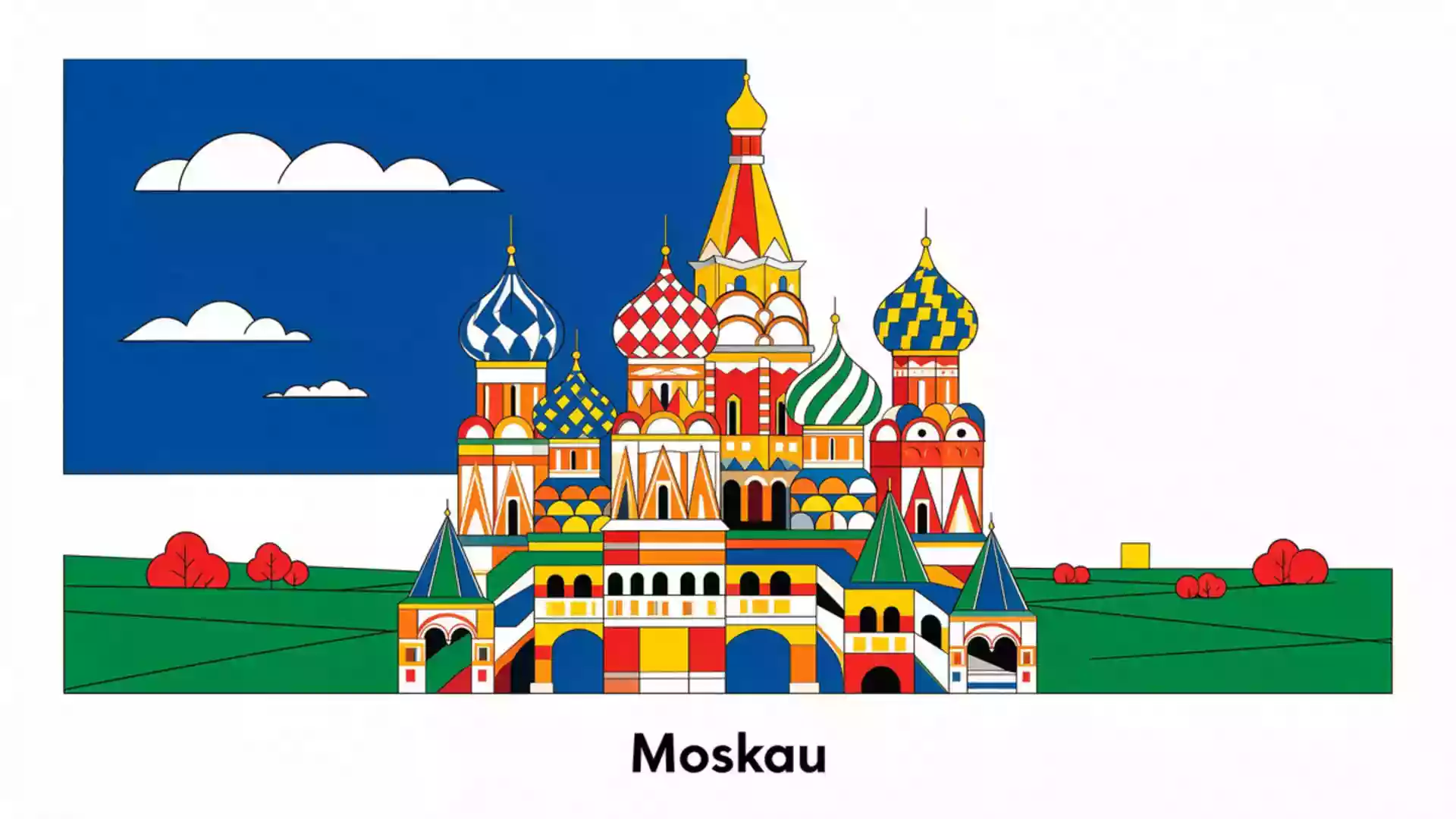
Sobor Vasiliya Blazhennogo and its painted chapels on Red Square
Published on 09/11/2026 at 19:28 | Editorial responsibility: Rafael Müller, Editor-in-Chief AD HOC NEWS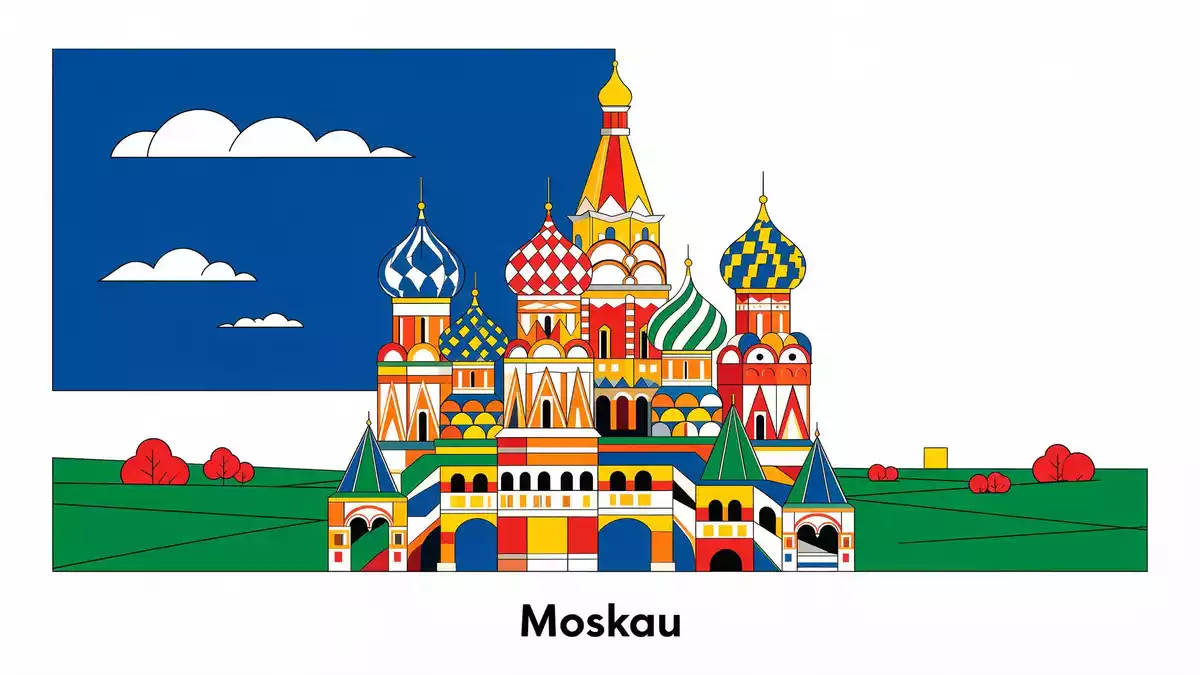
Sobor Vasiliya Blazhennogo, better known in English as Saint Basil’s Cathedral, rises at the southern end of Red Square in Moskau as a compact cluster of chapels gathered around a central tower. Built in the mid sixteenth century as a Russian Orthodox church, it is officially titled the Cathedral of the Intercession of the Most Holy Theotokos on the Moat and stands beside the Kremlin walls in the historic centre of Moscow, forming a brick landmark above the embankment of the Moskva River.
Brick, chapels and colour in the centre of Moscow
The core of Sobor Vasiliya Blazhennogo is a brick ensemble of several small churches grouped on a single base, with a taller central church rising above them in the middle of the plan.eight pillar-shaped churches Each chapel carries its own dome, and the whole composition gathers into a dense mass that gives the cathedral its distinctive silhouette on Red Square.Cathedral of Vasily the Blessed
The exterior walls and domes are painted in strong colours and intricate patterns, laid over the underlying brick structure. Swirling bands, geometric motifs and contrasting tones mark out the individual chapels, so that each dome has its own character while still belonging to the shared base below. Seen against the relatively plain façades of the Kremlin and the cobbled surface of Red Square, this painted skyline turns the cathedral into a focal point of the urban panorama.
Ivan IV and a sixteenth-century church on Red Square
Sobor Vasiliya Blazhennogo belongs to the reign of Ivan IV, widely known as Ivan the Terrible, who ordered its construction after his campaigns against the Khanate of Kazan in the 1550s.Tsar Ivan IV the Terrible The cathedral was built between 1555 and 1561, on the southern edge of Red Square, and dedicated under its formal title to the Intercession of the Virgin.constructed in 1555 In the later sixteenth century, the association with Saint Vasily (Basil) the Blessed, a Russian holy figure buried there, gave the building the name by which it is now commonly known.
The cathedral’s position beside the Kremlin walls and close to the Moskva River places it at the heart of Moscow’s historic power centre. Red Square stretches northwards from the building, while the river runs beyond the embankment to the south, so that Sobor Vasiliya Blazhennogo stands at a point where political, religious and commercial histories of the city intersect in the open space around it.church in Red Square
From church interior to museum of painted spaces
The building that began as a Russian Orthodox church now functions as a museum, its chapels and galleries opened to visitors who move through the brick structure and painted interiors. Narrow passages connect the individual chapels, and internal stairways and corridors lead between different levels within the clustered mass of the cathedral. Fresco work and ornamental painting line many of the interior surfaces, echoing the vivid colour schemes of the exterior domes.
As a museum, Sobor Vasiliya Blazhennogo presents both its religious origin and its architectural form. Visitors encounter icon screens, vaulted ceilings and small spaces that reflect its sixteenth-century ecclesiastical use, alongside later additions and restorations that have preserved the building through fires, political upheavals and changing attitudes to historic monuments across the centuries.structure ordered in 1555
Visiting Sobor Vasiliya Blazhennogo: what travellers from Western Europe should know
- Sobor Vasiliya Blazhennogo stands on Red Square in central Moskau, immediately south of the Kremlin and close to the embankment of the Moskva River, with metro stations including Ploshchad Revolyutsii and Teatralnaya within walking distance.
- The cathedral’s interior is reached by stairways and corridors that can be narrow and uneven underfoot, and some chapels sit on upper levels accessed by flights of steps inside the brick structure.
- The official language is Russian and the currency is the Russian rouble.
- Entry requirements depend on your nationality; UK travellers can check the FCDO travel advice at gov.uk/foreign-travel-advice, Irish travellers the Department of Foreign Affairs at ireland.ie.
Searching for Sobor Vasiliya Blazhennogo on social platforms
These links open searches for Sobor Vasiliya Blazhennogo on each platform.
Frequently asked questions about Sobor Vasiliya Blazhennogo
Where is Sobor Vasiliya Blazhennogo located in Moskau?
Sobor Vasiliya Blazhennogo stands on the southern edge of Red Square in central Moskau, immediately beside the Kremlin walls and close to the Moskva River embankment.
What can visitors expect inside Sobor Vasiliya Blazhennogo?
Visitors enter a brick interior of interconnected chapels, narrow corridors and stairways, with painted walls, devotional spaces and museum displays reflecting its history as a sixteenth-century church.
What makes Sobor Vasiliya Blazhennogo distinctive among Moscow’s landmarks?
Its clustered group of chapels on a shared base, each crowned by a vividly painted dome around a taller central tower on Red Square, gives Sobor Vasiliya Blazhennogo a distinctive profile in Moskau’s historic centre.