
Sobor Vasiliya Blazhennogo and its layered domes
Published on 09/21/2026 at 16:14 | Editorial responsibility: Rafael Müller, Editor-in-Chief AD HOC NEWS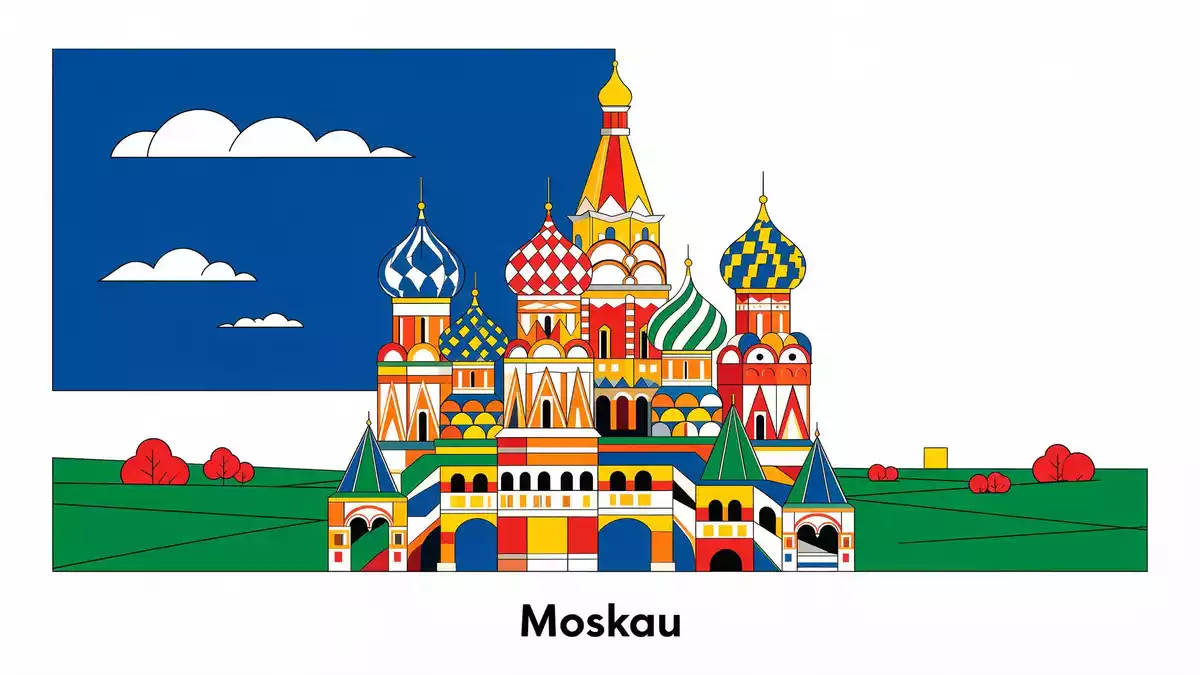
Sobor Vasiliya Blazhennogo stands on Red Square in Moskau as a dense cluster of chapels, domes and galleries. Its brick mass and painted surfaces make it one of the city’s clearest architectural landmarks, and its core dates to the reign of Ivan IV.
Brick, domes and a sixteenth-century core
The cathedral’s main body belongs to the years 1555 to 1561, the period when the structure rose under Ivan the Terrible. The building is tied to the conquest of Kazan, and it has long been known in English as Saint Basil’s Cathedral.
The name Sobor Vasiliya Blazhennogo points to Vasily the Blessed, while the formal dedication is to the Intercession of the Most Holy Theotokos on the Moat. That double identity matters, because the building combines courtly history, Orthodox devotion and a name linked to a Moscow holy fool.
Inside a compact cluster of churches
The exterior reads less like a single nave than a group of linked sanctuaries gathered around a central core. The plan is made visible by the separate domes, the narrow connecting passages and the stepped composition of roofs and walls.
The cathedral’s appearance changed in the centuries after its completion, and its present form reflects later work as well as the original sixteenth-century brick fabric. The result is a building that still shows the contrast between its compact base and its restless skyline.
Red Square and the Kremlin edge
The cathedral occupies the southern end of Red Square, close to the Kremlin wall. It belongs to the UNESCO World Heritage property Kremlin and Red Square, Moscow, which places the church within one of the best-known ensembles in the Russian capital.
From that position, the building acts as a visual stop at the edge of the square. Its coloured domes and brick walls stand against the open expanse around them, while the church itself remains one of the most recognisable pieces of Moscow’s historic centre.
Visiting Sobor Vasiliya Blazhennogo: what travellers from Western Europe should know
- Red Square in central Moskau is the setting, with the Kremlin immediately beside it. The cathedral sits at the southern end of the square.
- The building is reached on foot across a large paved public space. The approach is level, with no special terrain beyond the open square itself.
- The exterior is easiest to read from different sides, because the domes and gables form a compact cluster. The brickwork, painted detail and small-scale chapels reward a slower look.
- The cathedral belongs to the Moscow Kremlin and Red Square UNESCO property. That designation places it among the core historic monuments of the city.
Searching for Sobor Vasiliya Blazhennogo on social platforms
These links open searches for Sobor Vasiliya Blazhennogo on each platform.
Frequently asked questions about Sobor Vasiliya Blazhennogo
Where is Sobor Vasiliya Blazhennogo?
It stands on Red Square in Moskau, beside the Kremlin wall. The cathedral marks the southern end of the square.
What does a visit reveal?
The building presents a tight group of domes, chapels and brick passages. Its exterior is as important as any interior space, because the silhouette is the main visual feature.
What makes it distinctive?
The cathedral combines a sixteenth-century brick core with later surface changes and a formal dedication that differs from its common name. That pairing gives it a layered identity in the centre of Moskau.


