
Sidi Bou Said’s blue and white hill village above the Gulf of Tunis
Published on 09/19/2026 at 09:43 | Editorial responsibility: Rafael Müller, Editor-in-Chief AD HOC NEWS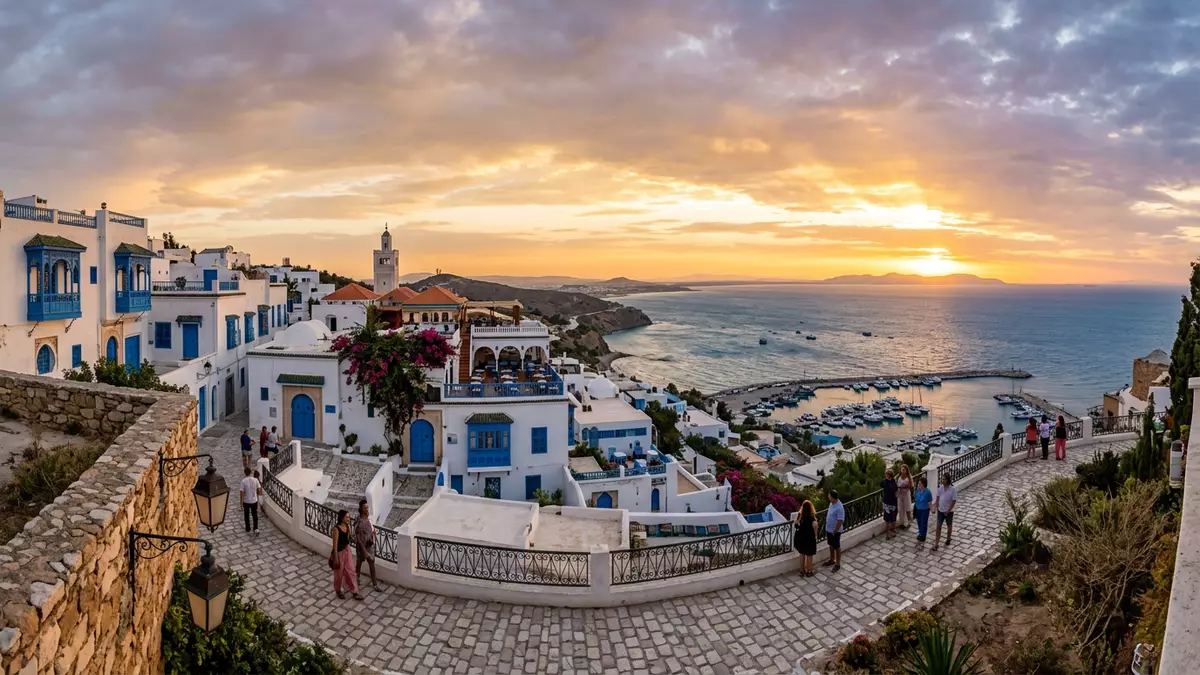
On a limestone headland above the Gulf of Tunis, the village of Sidi Bou Said spreads across the slope in whitewashed terraces broken by cobalt blue doors and ironwork. It sits within the Tunis Governorate in northern Tunisia, close to Carthage and a short distance from the capital city. The settlement takes its name from the Sufi figure Abu Said al-Baji, whose tomb lies at its heart and whose presence turned the hill into a place of devotion and retreat in the thirteenth century.
A hilltop village shaped by blue and white
Sidi Bou Said’s most striking feature is its disciplined palette of white walls and blue wood and metal, applied across houses, religious buildings and small shops on the lanes. White limewash covers exterior surfaces, giving the village a uniform brightness against the Mediterranean sky, while doors, shutters and balcony grilles are painted in strong blue tones that stand out even in shadow. This blue-and-white identity is now protected by heritage regulations that fix the colours and basic forms used in new work and restorations, extending a visual language rooted in Tunisian vernacular building into a codified scheme for the whole village.Arab-Andalusian architecture Ironwork adds a further layer of detail: grilles and gates in front of windows and entrances carry repeating geometric and floral patterns, many of them painted blue to match the timber, and on some streets these elements line up to form continuous bands along the façades.
The palette sits on a steep plan. Cobbled lanes climb and twist up and across the headland, linking small squares and terraces that open towards the sea. Houses are commonly arranged around internal courtyards, with external walls broken only by doors and a small number of windows directly on the lane, a pattern linked to building traditions in Tunis and Andalusian towns.Ennejma Ezzahra palace Bougainvillaea, jasmine and other climbers grow over walls and pergolas, adding seasonal colour that plays against the fixed blue and white. On the upper parts of the village, terraces and café roofs frame wide views across the Gulf of Tunis and towards Cap Bon and the low islands off the northern coast, making the landscape an everyday backdrop to village life.
From Sufi sanctuary to protected coastal settlement
The hill now occupied by Sidi Bou Said has long been tied to the approaches to Carthage and Tunis, but the village as it is known today grew around a religious complex dedicated to Abu Said al-Baji in the medieval period.Abu Said al-Baji sanctuary Abu Said Ibn Khalaf Yahya al-Tamimi al-Beji reached what was then called Jbel el-Menar, the Hill of the Lighthouse, and established a sanctuary that became a centre of Sufi teaching. After his death in 1231, he was buried on the site, and over the following centuries a zawiya, or religious complex, and the houses that served it formed the core of a small settlement carrying his name.zawiya and tomb
In the seventeenth and eighteenth centuries, the role of the headland changed as families from Tunis and members of the local elite built residences here, treating the slope above the sea as a retreat connected to the city yet distinct from it.patrician mansions These houses introduced enclosed gardens, shaded arcades and reception rooms with views over the water, blending Ottoman influences with Arab-Andalusian forms. In the early twentieth century, Baron Rodolphe d’Erlanger, an Anglo-French musician and painter, settled on the slope below the village and built the palace Ennejma Ezzahra, completed in 1922, with interiors that echo and refine the decorative vocabulary found in the lanes above.Baron Rodolphe d’Erlanger During the French Protectorate a municipal ordinance was introduced that fixed the colour scheme and key architectural traits of the village, ensuring that new construction respected the established character.
Sea views, heritage status and everyday life
Geographically, Sidi Bou Said belongs to the Carthage delegation within the Tunis Governorate, standing on a cliff that rises above the rail and road lines linking Tunis with the northern coast.location north-east of Tunis From the terraces and streets, the Gulf of Tunis fills the horizon in one direction, while the wooded slopes and archaeological sites of Carthage lie below in another. The relationship between built fabric and landscape is central to the village’s character: houses and religious buildings are oriented along the contours of the headland, and many openings frame specific segments of sea and shoreline rather than broad panoramas.
Sidi Bou Said holds formal recognition as a heritage site. For many years it fell within the boundary of the Archaeological Site of Carthage on the World Heritage List, a designation centred on Punic and Roman remains, with the village attached as part of the wider landscape.World Heritage context In 2026 the village received its own inscription as “Village of Sidi Bou Saïd”, recognising not only its architecture but also its spiritual heritage and coastal setting.World Heritage inscription Within this framework, the blue-and-white buildings, the zawiya of Abu Said al-Baji, the palace of Ennejma Ezzahra and the relationship to Carthage and the Gulf are treated as elements of a single historic ensemble.
Visiting Sidi Bou Said: what travellers from Western Europe should know
- The village stands north-east of Tunis in the Tunis Governorate, above the coastal corridor linking the capital with Carthage and the northern suburbs. It is reached by road and by the TGM rail line that runs between Tunis and suburban stations on the shore.
- The lanes rise steeply from the lower approaches, with cobbled surfaces and stairways connecting different levels; moving through the village involves climbing and descending steps as well as walking on uneven paving.
- Sidi Bou Said lies in Tunisia, outside the UK, Ireland and the EU. The official language is Arabic and the currency is the Tunisian dinar. Entry requirements depend on your nationality; UK travellers can check the FCDO travel advice at gov.uk/foreign-travel-advice, Irish travellers the Department of Foreign Affairs at ireland.ie.
Searching for Sidi Bou Said on social platforms
These links open searches for Sidi Bou Said on each platform.
Frequently asked questions about Sidi Bou Said
Where is Sidi Bou Said in relation to Tunis and Carthage?
Sidi Bou Said stands on a headland in the Tunis Governorate, north-east of the centre of Tunis and immediately above the archaeological zone of Carthage.
What should visitors expect when walking through the village?
Visitors encounter steep cobbled lanes, stairways connecting different levels, whitewashed houses with blue doors and ironwork, and terraces that frame views across the Gulf of Tunis.
What makes Sidi Bou Said distinctive among coastal villages in Tunisia?
The disciplined blue-and-white architecture, the presence of the zawiya and tomb of Abu Said al-Baji, and the combination of Ottoman, Arab-Andalusian and coastal elements give the village its particular character.


