
Sidi Bou Said, blue-and-white hilltop village above the Bay of Tunis
Published on 09/05/2026 at 09:29 | Editorial responsibility: Rafael Müller, Editor-in-Chief AD HOC NEWS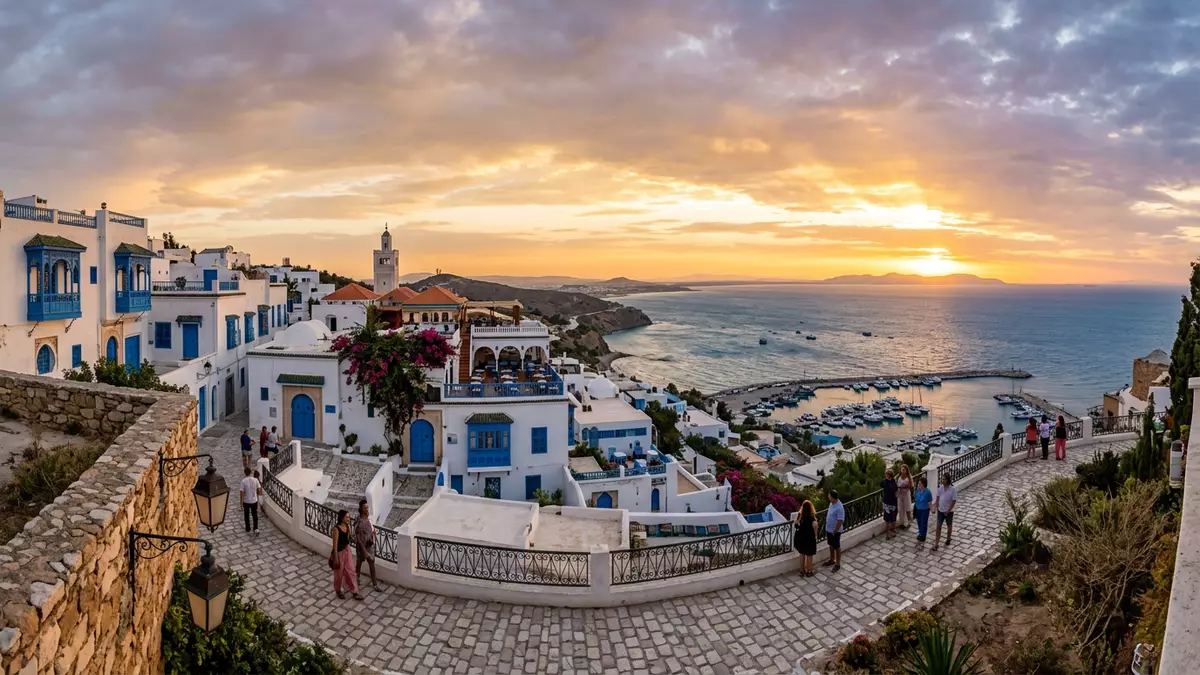
Sidi Bou Said is a hill village above the Bay of Tunis in northern Tunisia, known for its blue-and-white houses, cobbled lanes and long views over the sea. Set on a coastal cliff a short distance north-east of Tunis, it combines Mediterranean light with a compact townscape shaped over centuries of religious, Andalusian and Ottoman influence.hill village above the Bay of Tunis
Blue and white on a Tunisian headland
The most striking impression of Sidi Bou Said is the uniform palette of whitewashed walls and blue woodwork, carried across houses, cafés, mosques and small shops on the main streets. Doors, shutters and balcony railings are painted in strong blues that stand out against white façades, with ironwork patterns casting shadows onto the plaster in the bright coastal light.blue-and-white architecture The colour scheme ties the village together visually, so that even buildings from different periods read as parts of a single ensemble rather than isolated structures.
Many houses in Sidi Bou Said follow an inward-facing layout, with gateways leading to courtyards, gardens and tiled reception rooms that are hidden from the street. Facades along the lanes carry carved wooden doors, small projecting windows and occasional mashrabiya screens in wood, while rooflines step down the slope of the headland towards the sea. Bougainvillea and other climbing plants spill over walls and pergolas, adding flashes of pink and red against the established blue-and-white base. At the upper levels, terraces and café platforms open towards the Gulf of Tunis, giving clear views of the bay and the coastline towards Carthage and La Marsa.promontory overlooking the Gulf of Tunis
From Sufi retreat to Ottoman summer village
The village takes its name from the Sufi saint Abou Said Khalaf Ibn Yahya El Tamimi El Beji, often shortened to Abu Saïd al-Baji, who used the headland as a place of retreat and teaching in the thirteenth century.Sufi saint Abu Saïd al-Baji A religious complex, or zawiya, dedicated to him grew up on the site, and his tomb lies within the village, anchoring its spiritual significance. Around these structures, lanes and houses formed a small settlement that looked over the sea and across to the ancient remains of Carthage on the lower ground below.town in northern Tunisia
During the Ottoman period, when Tunis was an important port on the southern shore of the Mediterranean, Sidi Bou Said developed as a favoured location for residences connected to the city. From the eighteenth century onwards, families from Tunis built summer houses on the headland, adding gardens, shaded courtyards and salons that looked over the water.summer houses above the bay Architectural details in the village echo styles from Andalusian towns, with arcades, ceramic tiles and latticework appearing beside elements associated with Tunisian religious buildings. The streets preserve this layering of spiritual buildings and domestic architecture, so that mosques, prayer halls and houses stand close together along the ridge and down the slopes.
Legal protection and World Heritage recognition
Sidi Bou Said has long received formal protection for its built fabric and skyline, which helped preserve its character as development spread along the coast north of Tunis. Early regulations in the twentieth century encouraged the consistent use of white walls and blue woodwork, reinforcing the visual identity that visitors recognise immediately in the streets.protected village with colour regulations These rules limited alterations that would break the harmony of the ensemble, and the compact scale of the village allowed this approach to shape the appearance of almost every public-facing building.
In the twenty-first century, the architectural harmony, spiritual heritage and Mediterranean coastal character of the “Village de Sidi Bou Saïd” were recognised through inscription on the UNESCO World Heritage List.World Heritage Site designation This status sits alongside Sidi Bou Said’s role within the wider Carthage area, linking the village to the surrounding archaeological and historic landscapes along the Gulf of Tunis. The combination of religious sites, Ottoman-period town planning and twentieth-century protective measures is visible in the everyday street scene, from the layout of the lanes to the treatment of doors, windows and roof terraces.
Visiting Sidi Bou Said: what travellers from Western Europe should know
- Sidi Bou Said lies north-east of Tunis on a coastal headland above the Bay of Tunis, close to Carthage and La Marsa along the same stretch of shore.
- The village stands on a steep slope, with cobbled streets and stairways linking the upper district around the mosque and zawiya to lower levels closer to the marina.
- A suburban railway known as the Tunis–Goulette–Marsa line links central Tunis with Sidi Bou Said and nearby Carthage, with a station serving the village.Tunis - Carthage TGM light rail line
- The official language is Arabic and the currency is the Tunisian dinar.
- Entry requirements depend on your nationality; UK travellers can check the FCDO travel advice at gov.uk/foreign-travel-advice, Irish travellers the Department of Foreign Affairs at ireland.ie.
Searching for Sidi Bou Said on social platforms
These links open searches for Sidi Bou Said on each platform.
Frequently asked questions about Sidi Bou Said
Where is Sidi Bou Said in relation to Tunis?
Sidi Bou Said stands on a cliff above the Bay of Tunis, around twenty kilometres north-east of the centre of Tunis, near Carthage and La Marsa.about 20 km northeast of the capital
What kind of place can visitors expect when they arrive?
Visitors encounter a compact hill village with blue-and-white houses, narrow cobbled streets, religious buildings linked to Abu Saïd al-Baji and terraces overlooking the Gulf of Tunis.blue and white village overlooking the bay
What makes Sidi Bou Said distinctive among coastal settlements near Tunis?
The combination of its thirteenth-century Sufi heritage, Ottoman-period summer houses, strict colour scheme and cliff-top position above the Bay of Tunis gives Sidi Bou Said a distinctive character within the Carthage area.white-and-blue hill village overlooking Carthage


