
Shwezigon Pagoda and the golden form of early Bagan
Published on 09/24/2026 at 06:29 | Editorial responsibility: Rafael Müller, Editor-in-Chief AD HOC NEWS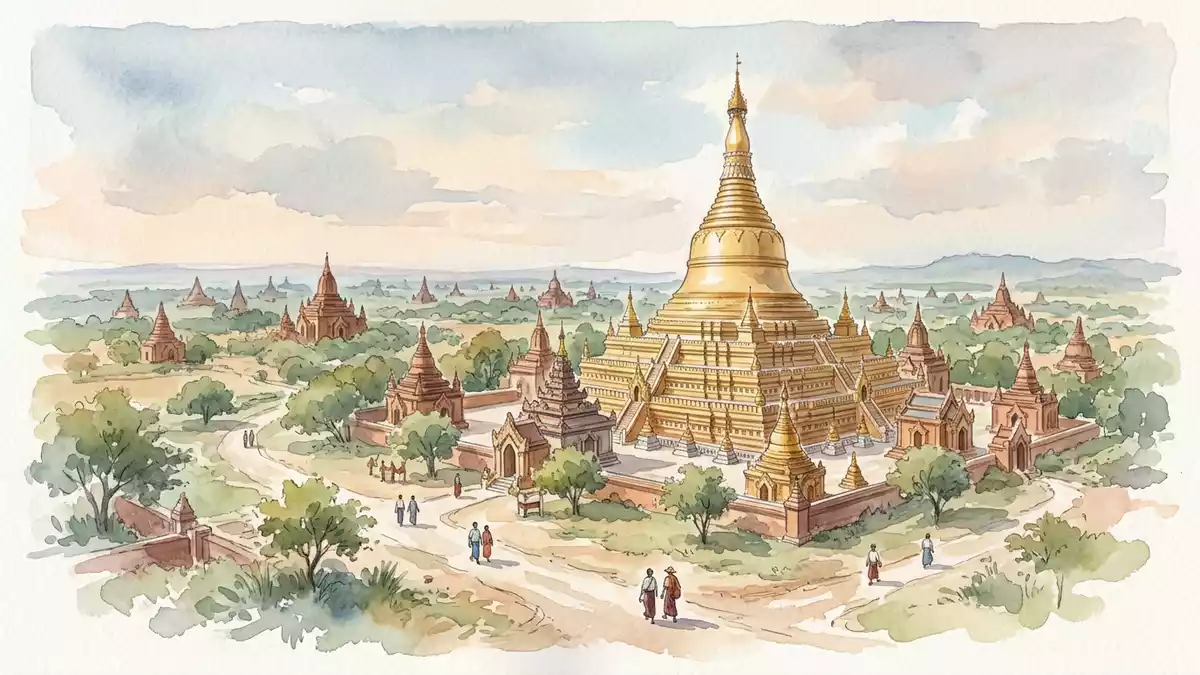
Shwezigon Pagoda is a gilded Buddhist stupa in Nyaung-U, within the historic landscape of Bagan in Myanmar. Its broad terraces and bell-shaped upper structure form a clear architectural profile, while its history connects King Anawrahta with King Kyansittha and the formative period of the Bagan kingdom.
Shwezigon Pagoda’s terraces and gilded stupa
The monument rests on square terraces beneath a solid, rounded stupa. The lower platform gives the building a broad base, while the gilded upper mass narrows towards its finial. This combination of stepped geometry and curved volume became a recognisable form in Myanmar Buddhist architecture.
Shwezigon Pagoda is constructed from masonry and covered in gold-coloured surfaces. Its appearance changes across the complex: the terraces present horizontal bands, while the central stupa rises as a continuous vertical form. The contrast gives the monument a clearly ordered silhouette across the Bagan plain.
The pagoda’s architectural type is associated with the early Bagan period. It is also identified as a prototype for later Myanmar stupas, making its form significant beyond the immediate compound. The building’s name is linked with the idea of a golden victory pagoda.
The surrounding complex contains shrines, images and religious features connected with Burmese Buddhist practice. Carved and painted details appear within the architectural setting, while the principal stupa remains the dominant element.
From Anawrahta to Kyansittha in the eleventh century
Construction began during the reign of King Anawrahta, who ruled from 1044 to 1077. The work started around 1059, placing Shwezigon Pagoda in the eleventh-century formation of the Bagan kingdom. construction began under Anawrahta.
King Kyansittha, Anawrahta’s successor, continued the project. The pagoda was completed in 1102, during Kyansittha’s reign, and its finished form belongs to the transition between two important royal periods. completion in 1102.
The building therefore carries the names of two rulers rather than a single moment of patronage. Anawrahta is associated with the beginning of the work, while Kyansittha is associated with its completion and the finished stupa.
Religious tradition connects Shwezigon Pagoda with relics of the Buddha, including a tooth and a frontal bone. The relic tradition places the monument within the wider network of Buddhist pilgrimage and royal religious foundations in Myanmar.
A Buddhist landmark beside Nyaung-U
Shwezigon Pagoda stands near Nyaung-U, northeast of Old Bagan and close to the Ayeyarwady River. Its setting links the monument with both the archaeological landscape of Bagan and the inhabited town that serves as a regional centre.
Bagan contains temples, monasteries and stupas from the period when the Pagan kingdom developed into a major centre of Buddhist culture. Shwezigon Pagoda belongs to this landscape but has a distinct visual identity through its gilded surface and compact, rising form.
The pagoda is part of the Bagan Archaeological Zone, which was inscribed on the UNESCO World Heritage List in 2019. the Bagan World Heritage inscription places the monument within a protected cultural landscape rather than treating it as an isolated structure.
Architectural details around the stupa include Buddha images, shrine buildings and representations connected with nat belief. These elements show the range of religious traditions present in Burmese sacred spaces, with the central pagoda providing the principal focus.
The combination of a square terraced base, a gilded bell-shaped stupa and an eleventh-century royal history gives Shwezigon Pagoda its particular character. At Bagan, the monument is read through its visible form as much as through the stories attached to its rulers and relics.
Visiting Shwezigon Pagoda: what travellers from Western Europe should know
- Shwezigon Pagoda is in Nyaung-U, northeast of Old Bagan, near the Ayeyarwady River. It can be reached by road from Bagan and Nyaung-U, with local taxis and bicycles used in the surrounding archaeological area.
- The compound includes paved approaches, masonry terraces and raised platforms. Footwear is removed in sacred areas, and the upper surfaces can include steps and uneven transitions.
- The official language is Burmese and the currency is the Myanmar kyat.
- Entry requirements depend on your nationality; UK travellers can check the FCDO travel advice at gov.uk/foreign-travel-advice, Irish travellers the Department of Foreign Affairs at ireland.ie.
Searching for Shwezigon Pagoda on social platforms
These links open searches for Shwezigon Pagoda on each platform.
Frequently asked questions about Shwezigon Pagoda
Where is Shwezigon Pagoda?
Shwezigon Pagoda is in Nyaung-U, northeast of Old Bagan, within the Bagan Archaeological Zone in Myanmar. The monument stands near the Ayeyarwady River.
What can visitors expect at the pagoda?
Visitors encounter a Buddhist compound with masonry terraces, shrines, Buddha images and a gilded central stupa. Sacred areas include raised surfaces and places where footwear is removed.
What makes Shwezigon Pagoda distinctive?
Its distinctive features are the square terraced base, the rounded gilded stupa and its connection with King Anawrahta and King Kyansittha. Construction began around 1059 and the pagoda was completed in 1102.


