
Shwezigon Pagoda, a golden landmark of early Bagan
Published on 08/30/2026 at 13:47 | Editorial responsibility: Rafael Müller, Editor-in-Chief AD HOC NEWS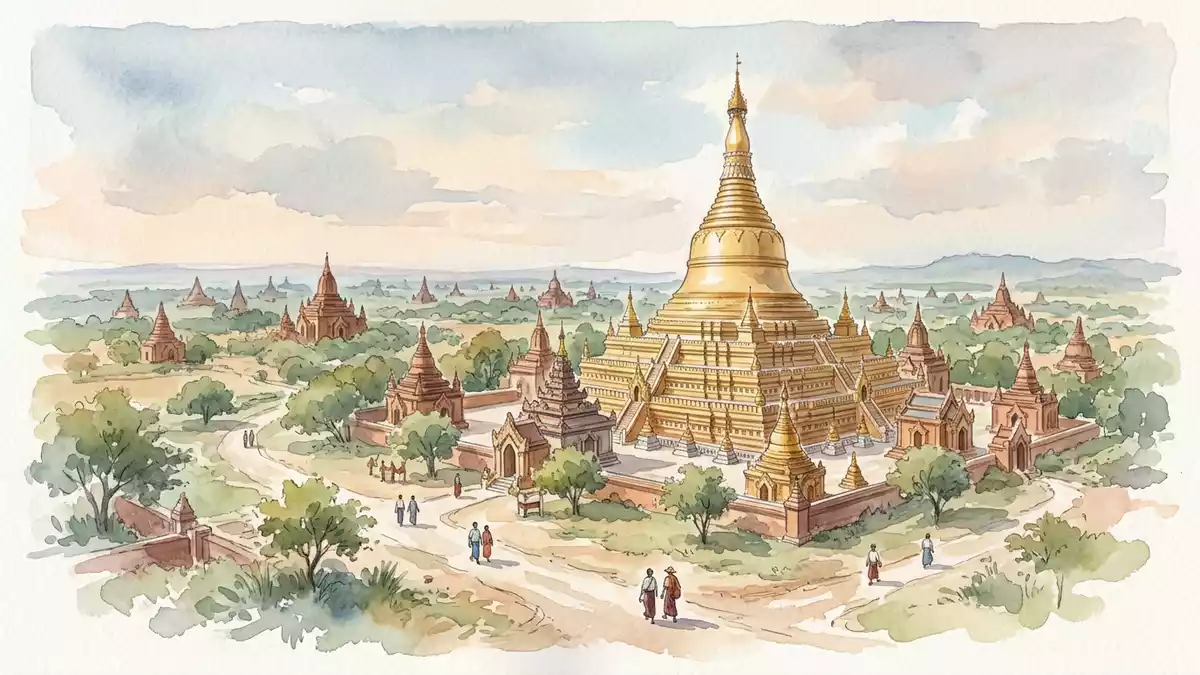
Shwezigon Pagoda in Bagan is one of the defining monuments of the Pagan Empire, its gilded stupa rising above a spacious courtyard lined with shrines and images. Construction began under King Anawrahta in the eleventh century and was completed under his successor King Kyansittha, giving the complex a central place in the story of Buddhist Bagan.Construction began under King Anawrahta
A golden stupa from the Pagan Empire
Shwezigon Pagoda stands near Nyaung U on the northeastern fringe of the Bagan plain, a short distance from the Irrawaddy River. The pagoda complex centres on a bell-shaped stupa sheathed in gold-coloured metal, set on tiered terraces that rise from a square base.The stupa stands on a series of terraces
Historical chronicles date the start of construction to about 1059 during the reign of King Anawrahta, founder of the Pagan Empire, with completion recorded in the later eleventh century under King Kyansittha.Construction started in 1059 and was finished by 1102 The lower terraces are attributed to Anawrahta, while the upper structure is linked to Kyansittha, giving the stupa a layered royal authorship that mirrors the consolidation of Bagan’s power.The lower terraces are associated with Anawrahta
Courtyards, shrines and Buddha images
A walled enclosure surrounds the central stupa, forming a rectangular courtyard paved with stone. Around the inner edge of this courtyard stand shrines, prayer halls and smaller stupas, creating a ring of structures that frame the main monument.Shrines and small stupas line the enclosure The surfaces of many buildings are covered with glazed tiles, carved woodwork and painted ornament, reflecting the blend of brick construction and decorative craft typical of Bagan.
At the foot of the main stupa are four large standing Buddha images facing the cardinal directions, placed within open-fronted halls that project towards the courtyard.Four standing Buddha images face out from the core Smaller shrines in the compound house seated images, reliefs and votive tablets, while stone inscriptions and carved plaques record donors’ names and religious texts in the scripts of the period.
Relics, nats and religious significance
Shwezigon Pagoda was conceived as a major reliquary, and traditions associate it with relics of Gautama Buddha, including a frontal bone, a collarbone and a tooth or tooth replica. These relics gave the stupa a central role in Theravada Buddhist practice during and after the reigns of Anawrahta and Kyansittha.Traditions link the pagoda to Buddha relics
Shwezigon is also linked with the formal recognition of the 37 nats, the pre-Buddhist spirits that remain part of religious life in Myanmar.The site is associated with the 37 nats Nat images stand in a dedicated shrine within the complex, so that worship of these spirits and Buddhist devotion share the same sacred ground, giving Shwezigon a distinctive role among Bagan’s many religious sites.The pagoda is described as an early major work of Bagan art
Visiting Shwezigon Pagoda: what travellers from Western Europe should know
- Shwezigon Pagoda stands near Nyaung U, to the northeast of Old Bagan, and is reached by road from the main Bagan hotel zones and from Nyaung U Airport.
- The complex is arranged around a paved courtyard, with covered walkways and a sequence of steps leading up from the outer approaches into the inner precinct.
- The Irrawaddy River flows to the west of the site, and some local excursions approach the Nyaung U area by river boat before continuing by road to the pagoda.
- The official language is Burmese and the currency is the Myanmar kyat.
- Entry requirements depend on your nationality; UK travellers can check the FCDO travel advice at gov.uk/foreign-travel-advice, Irish travellers the Department of Foreign Affairs at ireland.ie.
Searching for Shwezigon Pagoda on social platforms
These links open searches for Shwezigon Pagoda on each platform.
Frequently asked questions about Shwezigon Pagoda
Where is Shwezigon Pagoda?
Shwezigon Pagoda stands near Nyaung U on the northeastern side of the Bagan archaeological zone in central Myanmar, not far from the Irrawaddy River.
What can visitors expect at the site?
Visitors encounter a large gilded stupa on tiered terraces, surrounded by a paved courtyard with shrines, prayer halls, standing Buddha images and a shrine to the 37 nats.
What makes Shwezigon Pagoda distinctive among Bagan’s monuments?
Its early eleventh-century origins, association with King Anawrahta and King Kyansittha, role as a major reliquary and formal link between Theravada Buddhism and nat worship give it a singular place in Bagan.


