
Se de Evora and its granite mass over the city
Published on 09/09/2026 at 08:14 | Editorial responsibility: Rafael Müller, Editor-in-Chief AD HOC NEWS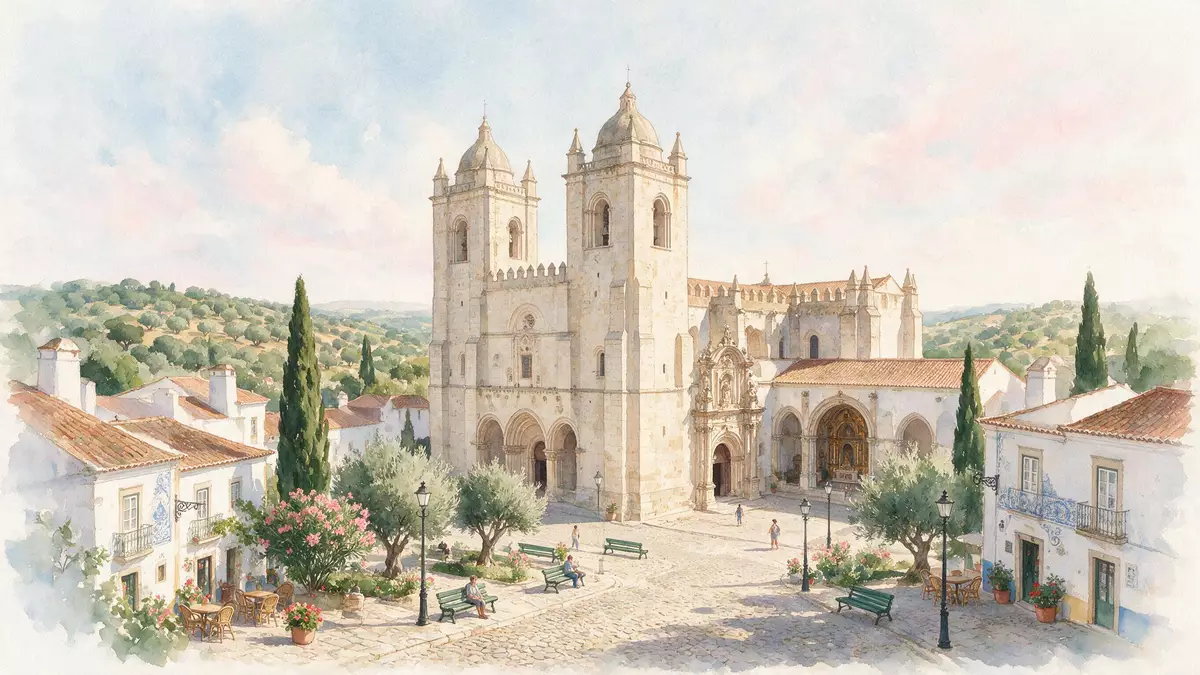
Se de Evora rises above Evora in granite, with towers, terraces and a fortified outline visible across the old city. Begun in 1186 under Bishop D. Paio and linked to the UNESCO-listed historic centre, it is one of Portugal’s most important medieval churches. Begun in 1186 UNESCO-listed historic centre
Granite walls above the medieval streets
The cathedral sits in the historic core of Évora, near Largo do Marquês de Marialva, and the surrounding streets lead up to it on foot. Its mass is compact, with a broad western front, twin towers and a stone presence that dominates nearby roofs.
The exterior belongs to the shift between Romanesque and Gothic architecture. Thick masonry, relatively small openings and pointed details sit together in a building that was formed over the thirteenth century.
From Romanesque work to Gothic cloister
The present church began in the late twelfth century and was consecrated in 1204 under Bishop D. Soeiro. Completion around 1250 places the main body in the thirteenth century, when the cathedral’s profile became fixed in granite.
Inside, the plan follows a Latin cross. The nave, aisles, crossing and choir read clearly, while the cloister adds a separate Gothic layer with arcades around its courtyard. Latin cross completed in 1746
Later layers in marble and wood
Se de Evora also carries later interventions that stand out against the granite shell. A marble main chapel from the eighteenth century, associated with King João V and João Frederico Ludovice, adds a brighter interior note, while the Chapel of Nossa Senhora da Piedade introduces Renaissance and Manueline work.
The cathedral’s long history is visible in the mix of periods rather than in any single finish. Romanesque mass, Gothic structure, Manueline ornament and Baroque additions remain legible as separate layers within one church.
Visiting Se de Evora: what travellers from Western Europe should know
- Se de Evora stands in Évora’s historic centre in southern Portugal, within the old walled city and near Largo do Marquês de Marialva.
- The approach is on foot through sloping streets, and the upper parts of the cathedral are reached by stairs and terraces.
- The building is granite throughout, so the exterior reads as a heavy stone mass rather than a delicate façade.
- The official language is Portuguese and the currency is the euro.
Searching for Se de Evora on social platforms
These links open searches for Se de Evora on each platform.
Frequently asked questions about Se de Evora
Where is Se de Evora?
It stands in the historic centre of Évora, in southern Portugal, close to the city’s main civic spaces and within the old walls.
What does a visit involve?
The visit centres on the granite church, its Latin cross interior, the cloister and the upper terraces. Stairs connect the different levels.
What makes Se de Evora distinctive?
Its granite mass, Romanesque-Gothic character and layering of later marble and Renaissance details give the cathedral its distinct profile in Évora.


