
Se de Evora and its granite mass over the medieval city
Published on 09/07/2026 at 21:20 | Editorial responsibility: Rafael Müller, Editor-in-Chief AD HOC NEWS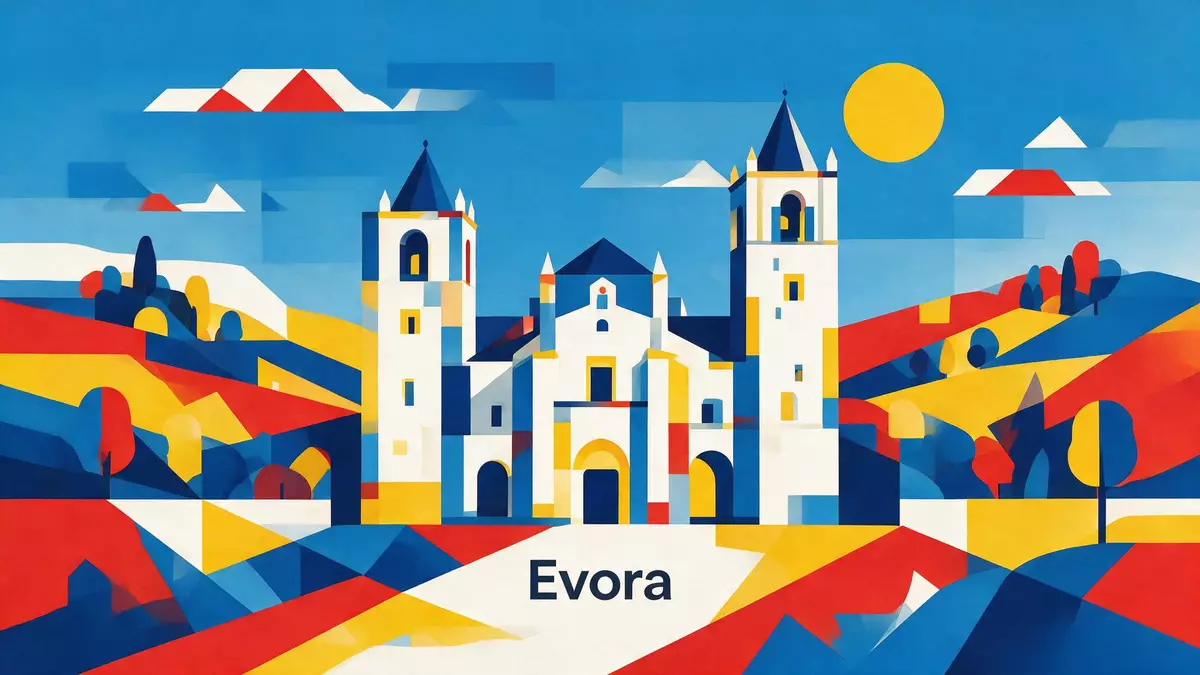
Se de Evora, the Cathedral of Évora in southern Portugal, is a granite Roman Catholic basilica whose compact mass and towers rise over the whitewashed roofs of the medieval city. Begun in 1186 and consecrated in 1204, it took shape through the thirteenth century as a major church dedicated to Santa Maria and later became part of the UNESCO-listed historic centre of Évora.
Granite, scale and a fortified silhouette
Se de Evora stands within the walled historic centre of Évora in the Alentejo region, a short walk up from the city’s main squares, and occupies one of the higher points of the old town. Its structure is built largely of granite, giving the exterior a solid, austere appearance that distinguishes it from the limewashed houses around it and underlines its character as a fortified medieval church.fortified medieval church The building serves as the seat of the Archdiocese of Évora and carries the official title Basílica Sé Catedral de Nossa Senhora da Assunção, reflecting its basilica status and dedication under the Marian title of Our Lady of the Assumption.Basílica Sé de Nossa Senhora da Assunção
The overall form is that of a large stone mass articulated by towers, terraces and buttressed walls, an architecture that belongs to the transition between Romanesque and Gothic in Portugal.transition between Romanesque and Gothic Two square towers flank the western front, rising above the main entrance and contributing to the cathedral’s recognisable silhouette over the city’s roofscape.two square towers flanking the stone facade Above the nave, the terraces and high points of the roof form a broad platform from which Évora’s historic streets, medieval walls and outlying districts can be seen in all directions.terrace of the cathedral is the highest point of the city
A thirteenth-century cathedral between Romanesque and Gothic
The foundation of Se de Evora is dated to 1186 under Bishop D. Paio, with consecration in 1204 under Bishop D. Soeiro, and the building reached its present volumetric form during the thirteenth century under Bishop D. Durando Paes.founded by Bishop D. Paio in 1186 and consecrated in 1204 The dominant architectural language of the main body is Romanesque blended with early Gothic, expressed in thick stone walls, relatively small openings and a robust overall composition.
Inside, the plan follows the Latin cross tradition, with a nave and two aisles running towards the crossing and choir, the layout being particularly evident when viewed from above.shape of a Latin cross The cloister, dated to the fourteenth century, attaches to the main church and presents pointed arches and a more open Gothic vocabulary around its courtyard.cloister is from the fourteenth century Later interventions added further layers: in the eighteenth century the original Gothic apse was demolished and replaced by a new main chapel dominated by marble, designed under King João V and attributed to architect João Frederico Ludovice, the designer associated with the Convent of Mafra.eighteenth-century main chapel in marble
UNESCO setting and views over Évora
Se de Evora forms part of the historic centre of Évora, which is inscribed on the UNESCO World Heritage List for its concentration of medieval and early modern architecture.historic centre of Évora inscribed by UNESCO The cathedral stands near Largo do Marquês de Marialva and within walking distance of Praça do Giraldo, placing it among civic squares, narrow streets and other historic buildings that reflect Évora’s development from the Middle Ages onwards.Largo do Marquês de Marialva, Évora
The terraces of Se de Evora mark the highest point of the city, and from there the contrast between the dense historic core within the walls and the newer quarters beyond can be seen.view over the historic city within the walls Within the surrounding streets, the granite volume of the cathedral dominates views along lanes and across small squares, its towers and upper levels standing above tiled roofs and façades.
Visiting Se de Evora: what travellers from Western Europe should know
- Se de Evora stands in the historic centre of Évora in the Alentejo region of southern Portugal, within the old town and near Largo do Marquês de Marialva.
- The cathedral is reached on foot along narrow, gently rising streets of the medieval centre, with internal staircases leading up to the cloister and the rooftop terraces.
- The railway station of Évora lies outside the old town walls; from there the cathedral area is approached along city streets towards the historic centre.
- The official language is Portuguese and the currency is the euro.
Searching for Se de Evora on social platforms
These links open searches for Se de Evora on each platform.
Frequently asked questions about Se de Evora
Where is Se de Evora located within the city?
Se de Evora is in the historic centre of Évora in southern Portugal, near Largo do Marquês de Marialva and close to major public squares.
What should visitors expect inside Se de Evora?
Inside, visitors encounter a nave and aisles in a Latin cross plan, a Gothic cloister and an eighteenth-century marble main chapel that contrasts with the granite exterior.
What makes Se de Evora distinctive among Portuguese cathedrals?
Se de Evora is distinguished by its granite mass, Romanesque-Gothic character, high terraces over the city and its setting within Évora’s UNESCO-listed historic centre.


