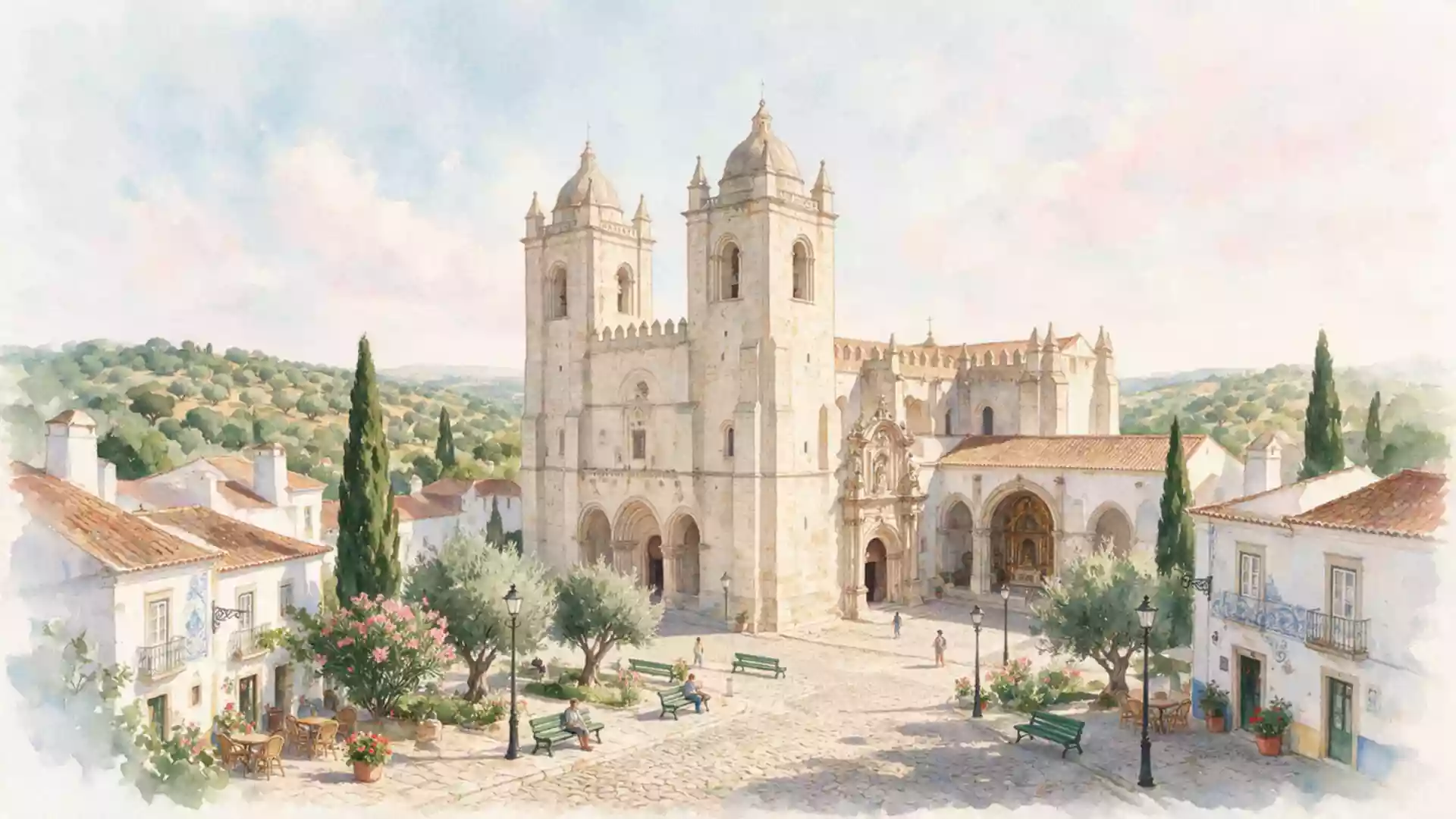
Se de Evora and its granite bulk above the Alentejo city
Published on 09/11/2026 at 20:08 | Editorial responsibility: Rafael Müller, Editor-in-Chief AD HOC NEWS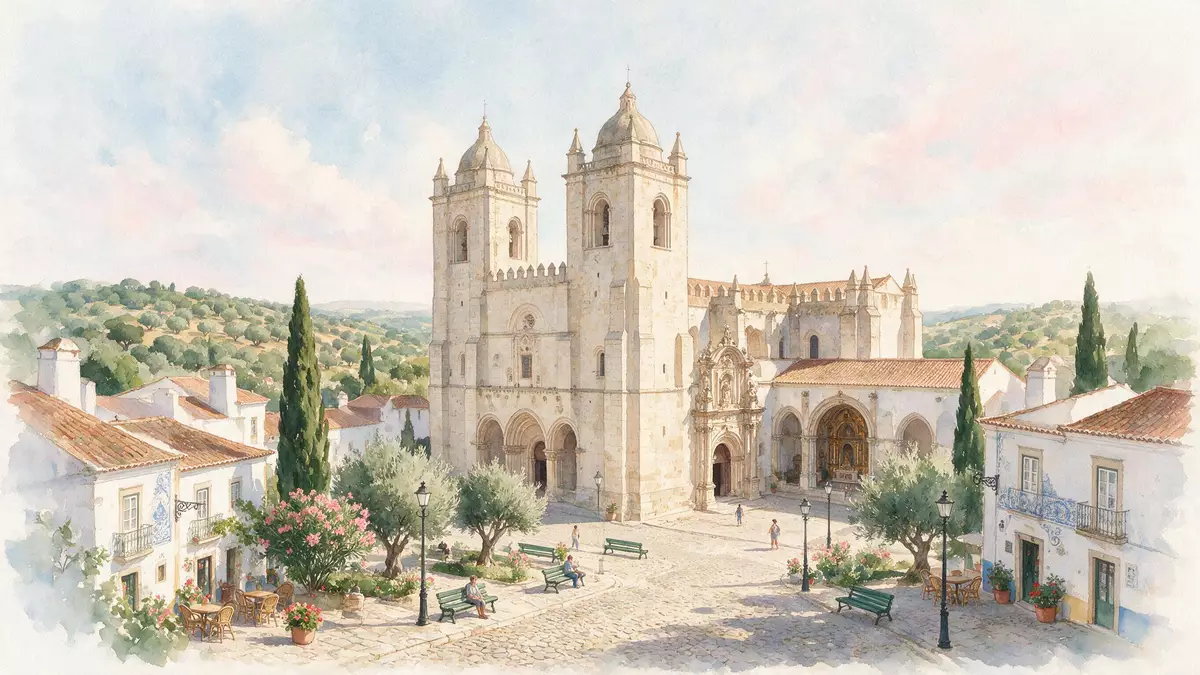
Se de Evora, the Cathedral of Évora in southern Portugal, is a granite Roman Catholic basilica whose medieval mass and towers rise over the whitewashed roofs of the old city. Built between the late twelfth and mid thirteenth century, it anchors the historic centre that forms part of Évora’s UNESCO World Heritage listing and stands as one of the country’s major medieval churches.Cathedral of Évora
Granite walls and a fortress-like silhouette
Se de Evora is built largely of granite, giving the exterior a solid, austere character that contrasts with the limewashed houses clustered around its base.Completely made of granite The cathedral’s bulk is articulated by twin western towers, a high nave and projecting transepts, which together form a compact volume that reads almost like a fortified stronghold above the streets.Romanesque foundations and Gothic massing
The earliest phases of the building belong to the Romanesque tradition of Western Europe, with thick walls and a heavy, fortress-like outline, while later work introduced pointed Gothic forms and more elaborate stone carving.Romanesque-Gothic cathedral From outside, the interplay of crenellated parapets, tower pinnacles and the large central lantern over the crossing gives the silhouette a layered profile that changes as pedestrians move around the tight medieval streets below.
A medieval cathedral shaped between 1186 and 1250
Construction of Se de Evora is dated to the late twelfth and early thirteenth centuries, with work begun in 1186 and the main Romanesque body consecrated in 1204.Built beginning in 1186 and completed in 1204 Further building and enlargement continued through the thirteenth century, with completion around 1250 and subsequent Gothic additions extending the complex, including a cloister built in the period between roughly 1280 and 1340 under Bishop Pedro.expanded between 1280 and 1340
Architecturally, the cathedral is often described as a transitional building, combining Romanesque foundations with Gothic elements and later influences from the Manueline and Baroque periods.transitional Romanesque-Gothic building Inside, the long nave with its arcades and stone columns leads towards the choir and high altar, while side chapels and the treasury preserve carved woodwork, metalwork and liturgical objects that reflect successive artistic phases in Portugal from the late medieval era onwards.treasury and cloister
Basilica status and UNESCO-listed setting
The official name of Se de Evora is Basílica Sé Catedral de Nossa Senhora da Assunção, signalling both its dedication to Our Lady of the Assumption and its rank as a basilica and cathedral.Basílica Sé de Nossa Senhora da Assunção It serves as the seat of the Archdiocese of Évora, tying the building into a wider ecclesiastical network across Portugal and giving the structure an administrative role in addition to its liturgical functions.seat of the Archdiocese of Évora
The cathedral stands within the historic centre of Évora, a walled old town whose urban fabric of medieval and early modern buildings is inscribed on the UNESCO World Heritage List.largest medieval cathedral in Portugal Its granite bulk occupies one of the higher points of the city, close to Praça do Giraldo and reached on foot through narrow streets such as Rua 5 de Outubro, so that the towers and lantern remain visible from many vantage points in the surrounding Alentejo landscape.granite mass over the medieval city
Visiting Se de Evora: what travellers from Western Europe should know
- Se de Evora stands in the historic centre of Évora in the Alentejo region of southern Portugal, close to Praça do Giraldo and reached on foot along streets such as Rua 5 de Outubro.Cathedral location in Largo do Marquês de Marialva
- The approaches around the cathedral involve cobbled streets and short climbs, and access to elevated areas such as rooftop terraces and tower viewpoints is by staircases with many steps.roof visit and 135 steps
- The cathedral forms part of Évora’s dense historic fabric, with other landmarks such as the Roman Temple and town museums within walking distance, and views from higher levels take in the surrounding Alentejo countryside.historic centre and nearby sights
- Portuguese is the official language and the currency is the euro, reflecting Portugal’s place within the European Union.
Searching for Se de Evora on social platforms
These links open searches for Se de Evora on each platform.Frequently asked questions about Se de Evora
Where is Se de Evora located?
Se de Evora stands in the historic centre of Évora, a city in the Alentejo region of southern Portugal, close to principal squares such as Praça do Giraldo.
What should visitors expect inside the cathedral?
Visitors encounter a stone-built medieval interior with a long nave, side chapels, a cloister and a treasury displaying religious art and objects from different periods.
What makes Se de Evora distinctive among Portuguese churches?
Its granite construction, fortress-like Romanesque outline, later Gothic and Manueline details, basilica status and position within a UNESCO-listed medieval city give Se de Evora a distinctive character among Portuguese churches.