
San Miguel de Allende, a highland city of baroque stone and pink towers
Published on 09/16/2026 at 17:34 | Editorial responsibility: Rafael Müller, Editor-in-Chief AD HOC NEWS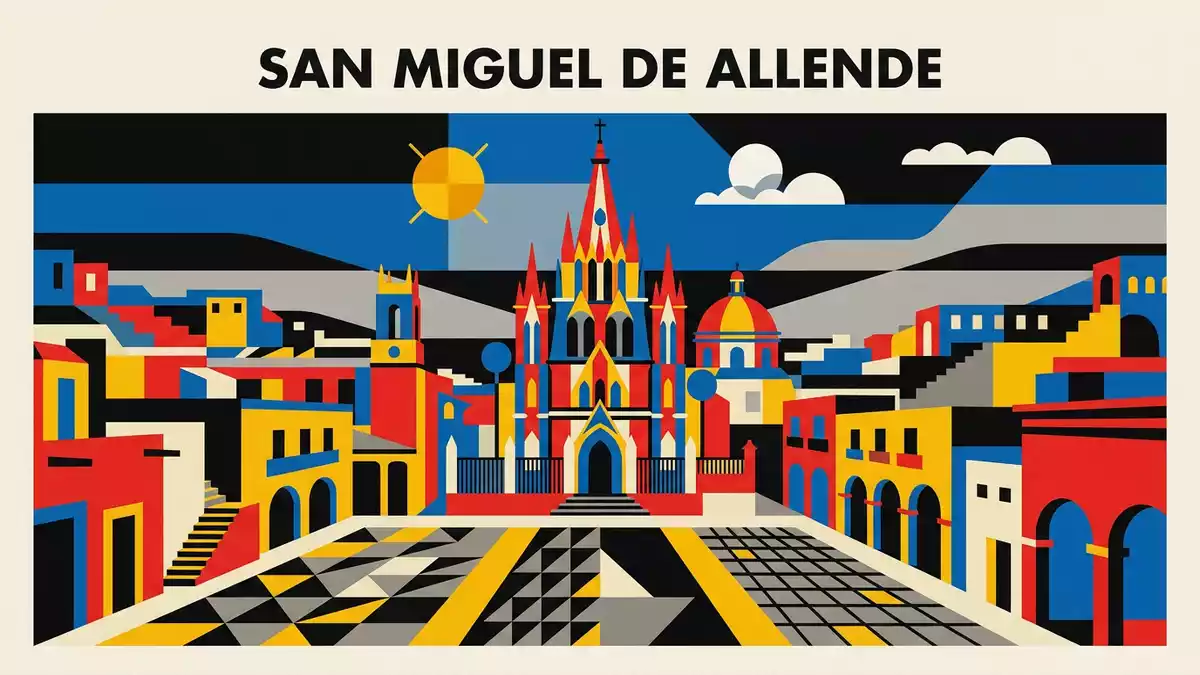
San Miguel de Allende in central Mexico is a colonial highland city laid out on a grid of cobbled streets, with low stone houses and church towers rising above the Mexican Plateau. Founded in 1542 and renamed in 1826 to honour Ignacio Allende, it has a historic centre recognised as part of a UNESCO World Heritage Site that brings together baroque façades, later neo-Gothic additions and intimate plazas framed by warm-coloured masonry.
Baroque stone and a pink neo-Gothic landmark
San Miguel de Allende lies in Guanajuato state on the Mexican Plateau, at an elevation of around 1,870 m (6,135 ft), where stone streets climb and dip between blocks of masonry houses and churches.Mexican Plateau elevation The town crystallised as a colonial settlement in the seventeenth and eighteenth centuries, when religious and civic buildings in the Mexican Baroque style were constructed along a rational street grid aligned with inland trade routes.Mexican Baroque street grid
At the heart of the city stands the Parroquia de San Miguel Arcángel, a parish church whose current pink neo-Gothic façade dates from work carried out between the 1880s and 1890s by local builder Zeferino Gutiérrez.pink neo-Gothic façade Behind that façade is an earlier stone structure completed in 1709, so the building combines an eighteenth-century core with nineteenth-century towers clad in pale, rose-toned masonry that catch the light above the main plaza. Around it, lower churches and former mansions show baroque and neoclassical fronts rendered in colours such as ochre, terracotta and deep red, giving the centre a continuous band of earthy tones broken by the pale vertical accents of the parish.
A colonial grid shaped by silver routes and independence history
The city originated as one of the first Spanish settlements in Guanajuato, founded in 1542 by the Franciscan monk Juan de San Miguel on a tributary of the Laja River.foundation in 1542 It developed along the Antiguo Camino Real, part of the silver route linking mining centres such as Zacatecas, and served as a fortified stopover protecting inland transport in northern New Spain.silver route stopover The blocks around the central plaza still follow this planned grid, with narrow, paved streets meeting at right angles and small squares marking the junctions.
In 1826 the town’s name was extended to honour Ignacio Allende, a local figure in the struggle for Mexican independence, linking the urban fabric to national history.renaming for Ignacio Allende Its historic centre, together with the nearby Sanctuary of Jesús Nazareno de Atotonilco, was inscribed on the World Heritage List in 2008 as the “Protective town of San Miguel and the Sanctuary of Jesús Nazareno de Atotonilco”, recognising both the architecture and the role played in independence movements.World Heritage inscription in 2008 Walking the grid reveals sequences of arcaded frontages, iron balconies and timber doors opening onto patios, all set against the gentle slopes of the plateau.
Streets, plazas and views on the Mexican Plateau
Approaching the centre of San Miguel de Allende, the first impression is of low masonry buildings grouped along cobbled streets, with façades rendered in warm tones that echo the pink parish towers.highland baroque city of pink stone The main plaza, the Jardín Principal, is bordered by the parish to the south and arcaded civic buildings to other sides, forming an enclosed urban room where stone paving, trees and benches sit beneath the pale towers. From streets leading away from the plaza, views open towards other churches and up to ridges marking the edge of the plateau.
Beyond the core, the town’s position in the Bajío mountains of central Mexico gives distant vistas over rolling highland terrain.Bajío mountains setting The Sanctuary of Jesús Nazareno de Atotonilco lies outside the central grid, about 14 km from the town, where a complex of chapels and courtyards shows richly painted interiors alongside its baroque architecture.Sanctuary of Atotonilco complex Together, the compact urban centre and this outlying sanctuary form the paired locations of the World Heritage Site, tying the city’s baroque stone and neo-Gothic towers to a wider religious landscape on the Mexican Plateau.
Visiting San Miguel de Allende: what travellers from Western Europe should know
- San Miguel de Allende lies in east-central Guanajuato state in Mexico, on the Mexican Plateau north of Celaya and reached by road from cities such as Guanajuato and Mexico City.
- The historic centre is built on sloping terrain with cobbled streets; moving between plazas and churches involves walking on uneven stone surfaces and negotiating narrow pavements.
- The Sanctuary of Jesús Nazareno de Atotonilco stands outside the city in the surrounding countryside, reached by regional roads that cross the highland landscape north of San Miguel de Allende.
- The official language is Spanish and the currency is the Mexican peso.
- Entry requirements depend on your nationality; UK travellers can check the FCDO travel advice at gov.uk/foreign-travel-advice, Irish travellers the Department of Foreign Affairs at ireland.ie.
Searching for San Miguel de Allende on social platforms
These links open searches for San Miguel de Allende on each platform.
Frequently asked questions about San Miguel de Allende
Where is San Miguel de Allende located in Mexico?
San Miguel de Allende is a city in Guanajuato state in central Mexico, on the Mexican Plateau north of Celaya and west of Querétaro.
What should visitors expect when exploring the historic centre?
Visitors encounter a compact colonial grid of cobbled streets, low stone houses and churches, centred on the Jardín Principal and the pink neo-Gothic towers of the parish church.
What makes San Miguel de Allende distinctive among Mexican colonial cities?
It combines a planned baroque highland town founded in 1542 with a later pink neo-Gothic parish façade, and forms part of a paired UNESCO World Heritage Site with the Sanctuary of Jesús Nazareno de Atotonilco.


