
San Miguel de Allende, a highland baroque city of pink stone
Published on 08/31/2026 at 19:23 | Editorial responsibility: Rafael Müller, Editor-in-Chief AD HOC NEWS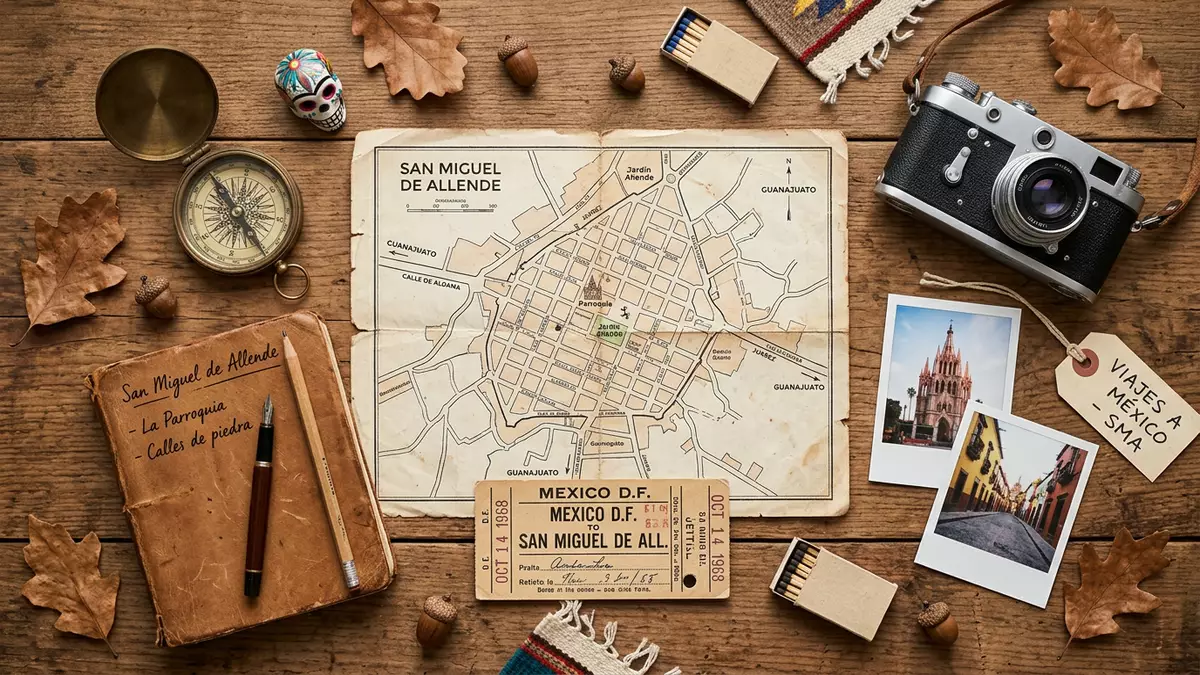
San Miguel de Allende in central Mexico is a colonial highland city whose historic centre of stone streets, plazas and churches has been recognised as a UNESCO World Heritage Site since 2008. Founded in 1542 and renamed in 1826 to honour independence leader Ignacio Allende, it has grown into a compact hill town where a pink neo-Gothic parish church rises above cobbled lanes and low, earth-toned houses.
A baroque grid in the Guanajuato highlands
San Miguel de Allende lies in the east-central part of Guanajuato state on the Mexican Plateau, at an elevation of around 1,870 m (6,135 ft) above sea level.east-central Guanajuato state The city developed as an early Spanish settlement aligned with inland trade routes, laid out on a rational grid of streets that climb and dip with the underlying terrain.early example of territorial and urban development That grid still structures the centre: narrow, paved lanes meet at right angles, broken by small plazas, church frontages and the occasional stepped alley.
The historic core of San Miguel de Allende extends across dozens of blocks that retain a largely eighteenth-century appearance, with quarry-stone facades, heavy wooden doors and ironwork balconies.protected area covers blocks of stone houses Many streets slope gently and are surfaced in cobbles rather than asphalt, giving the centre a distinct texture underfoot. Low-rise buildings line the lanes with painted plaster and stone, generally keeping to a consistent height so that towers and belfries of churches stand clear above the roofline rather than being hemmed in by taller structures.
The UNESCO-listed historic town and sanctuary
In 2008 the “Protective town of San Miguel and the Sanctuary of Jesús Nazareno de Atotonilco” was inscribed as a cultural World Heritage Site under criteria (ii) and (iv).Protective town of San Miguel and Sanctuary listing The inscription covers the historic centre of San Miguel de Allende with its regular street plan and colonial building stock, together with the sanctuary complex at Atotonilco around 14 km to the north.World Heritage Site designation The ensemble is noted for the way European baroque and neo-Gothic forms were adapted in stone and plaster in a specific regional context, and for the town’s role in Mexico’s struggle for independence.
The protected zone in San Miguel de Allende includes a defined core and buffer areas set out by the Mexican federal authorities, taking in streets such as Insurgentes, Quebrada, Terraplén and Huerta.historic core zone boundaries Within this area, civic buildings, mansions and churches display a range of styles from baroque through neoclassical to later nineteenth-century additions. The sanctuary at Atotonilco, linked historically to the town, adds a separate religious complex of chapels and painted interiors to the World Heritage ensemble, giving visitors a second, contrasting site within the same inscription.
Parroquia de San Miguel Arcángel and the city’s skyline
At the southern edge of the main plaza, Jardín Allende, stands the Parroquia de San Miguel Arcángel, the parish church whose neo-Gothic stone towers have become the emblem of the city. The building’s origins go back to the early eighteenth century, but its current facade of pink stone was created between about 1880 and 1890 by Zeferino Gutiérrez, a self-taught local mason and designer.pink neo-Gothic facade by Zeferino Gutiérrez Gutiérrez gave the church tall vertical towers, pointed detailing and an ornate front that visually departs from the heavier baroque volumes elsewhere in the centre.
The parish church’s towers are visible from many parts of San Miguel de Allende because surrounding buildings in the centre remain relatively low.neo-Gothic facade with tall towers From streets climbing away from the main square, the view often aligns with the towers rising above tiled roofs and balconies, giving the skyline a clear focal landmark. Around the church, the plaza and nearby streets bring together civic buildings, arcades and smaller chapels, so that religious, administrative and commercial structures sit in close proximity within the UNESCO-listed grid.
Visiting San Miguel de Allende: what travellers from Western Europe should know
- San Miguel de Allende lies in Guanajuato state in central Mexico, reached by road from larger cities on the Mexican Plateau such as Celaya and Guanajuato, and by regional buses from Mexico City.
- The historic centre is built on gently undulating terrain, with cobbled streets and stone pavements; many routes involve short slopes and some stepped alleys rather than level asphalt.
- The city sits at highland altitude, so approaches from surrounding valleys involve uphill travel and the central streets can feel noticeably higher than outlying areas.
- Central Mexico’s climate brings a marked dry season, and in those months the surrounding countryside often appears brown and open compared with the denser stone fabric of the town.
- The official language is Spanish and the currency is the Mexican peso. Entry requirements depend on your nationality; UK travellers can check the FCDO travel advice at gov.uk/foreign-travel-advice, Irish travellers the Department of Foreign Affairs at ireland.ie.
Searching for San Miguel de Allende on social platforms
These links open searches for San Miguel de Allende on each platform.Frequently asked questions about San Miguel de Allende
Where is San Miguel de Allende?
San Miguel de Allende is a city in Guanajuato state in central Mexico, on the Mexican Plateau east of the state capital and north of Celaya.location on the Mexican Plateau
What should travellers expect in the historic centre?
The historic centre is a grid of cobbled streets, plazas and colonial buildings in stone and plaster, with relatively low-rise houses and several churches defining the skyline.
What makes San Miguel de Allende distinctive?
San Miguel de Allende combines a UNESCO-listed historic core, an eighteenth-century colonial layout and the pink neo-Gothic towers of the Parroquia de San Miguel Arcángel, all set at highland altitude.


