
Ruinas de Sao Paulo and the stone façade that defines Macau
Published on 09/08/2026 at 19:55 | Editorial responsibility: Rafael Müller, Editor-in-Chief AD HOC NEWS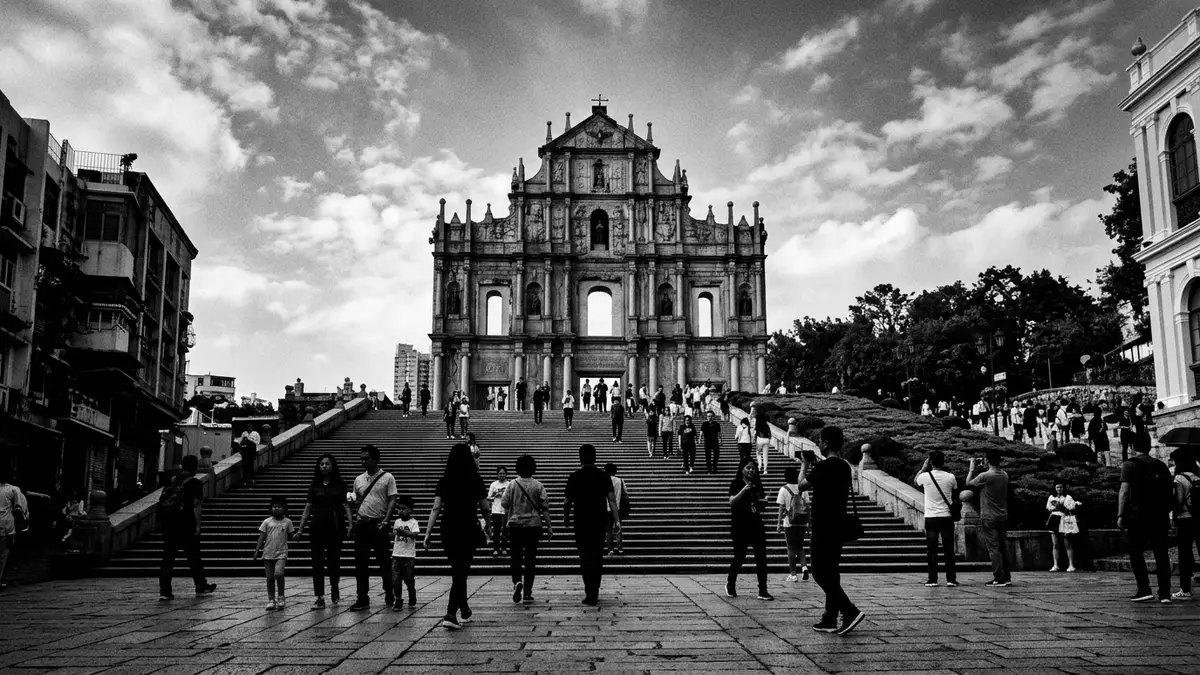
In Macau’s Santo António district, Ruinas de Sao Paulo is the surviving stone façade of a seventeenth-century Catholic complex, rising above a broad stairway and standing open to the sky where a grand church once enclosed the space. Built as the Church of Mater Dei with the adjoining College of St Paul in the early 1600s under Jesuit direction, the ensemble was largely destroyed by fire in 1835, leaving this front wall and the foundations as one of the clearest traces of Portuguese baroque architecture in southern China.
A stone façade from a Jesuit acropolis
Ruinas de Sao Paulo marks the former heart of a Jesuit complex that once linked the Church of Mater Dei, St Paul’s College and Mount Fortress into what contemporary observers described as an acropolis above the harbour-front town. The church and college were constructed between 1602 and 1640 by Jesuit missionaries and their craftsmen, creating one of the most ambitious Catholic ensembles in East Asia during the height of the Portuguese overseas empire.Church of Mater Dei The institution beside it, St Paul’s College, is recorded as having been founded in the late sixteenth century as a Jesuit centre of learning, often described by historians as the first Western-style university in East Asia.College of St Paul
The church that once stood behind the façade was dedicated under the name Mater Dei and is dated to construction in the first decades of the seventeenth century, with records specifying building phases between 1602 and about 1640.seventeenth-century construction In its completed form, it was regarded as one of the largest Catholic churches in Asia east of Goa, reflecting the scale of Jesuit ambition in Macau at a time when Portuguese traders and missionaries were establishing the city as a key gateway between Europe and East Asia.largest Catholic church in East Asia
Baroque stone carving open to the sky
What visitors see at Ruinas de Sao Paulo today is a monumental façade built from granite, standing atop a broad flight of stone steps and framed by the remains of the foundations behind. The wall is composed in a baroque manner, rising through several tiers with pilasters, niches and statuary translating European religious imagery into a Macau setting. Contemporary descriptions and later studies highlight a blend of Renaissance and oriental influences in the carved decoration, reflecting both Jesuit iconography and the craftsmanship available in Macau at the time.blend of western and eastern architecture
The façade in its present form is linked to a building campaign in the seventeenth century that gave the church its elaborate stone front and vaulted interior; research traces the completion of this granite front to the period between 1637 and 1640, with Italian Jesuit Carlo Spinola named among those responsible for the design.granite façade and Carlo Spinola The wall has survived multiple fires which destroyed the timber structure behind, most notably in 1835 when a typhoon-driven blaze swept through the complex and left the church as a ruin, turning the façade into a freestanding screen overlooking the city.1835 fire during a typhoon
From Jesuit college to UNESCO-listed landmark
For centuries, the Church of Mater Dei and St Paul’s College formed part of the Catholic and educational network of Macau, connected to missionary activity from the late sixteenth century through to the suppression of the Jesuits in the eighteenth century.Jesuit college history After the 1835 fire, the remaining façade and foundations became a landmark of loss and continuity, with later excavation and conservation programmes in the 1990s organised by Macau’s cultural authorities to stabilise the masonry and to interpret the site as an open-air monument and museum.1990s conservation and excavation
Ruinas de Sao Paulo forms part of the Historic Centre of Macao, which was inscribed on the UNESCO World Heritage List in 2005 as a group of sites illustrating the long encounter between Portuguese and Chinese cultures in the city.Historic Centre of Macao inscription At Ruinas de Sao Paulo, this cultural layering is visible in the Latin inscriptions and Catholic imagery on the stone, read against the dense urban fabric of Macau and the nearby Mount Fortress, which together recall the city’s role as an early European foothold on the southern Chinese coast.
Visiting Ruinas de Sao Paulo: what travellers from Western Europe should know
- Ruinas de Sao Paulo stands in the Santo António district of Macau, on Rua de Sao Paulo above a broad stairway that climbs from the surrounding streets towards the former Jesuit complex.
- The approach from the lower streets rises over many stone steps; the stairway and the platform at the top are paved, and the ground behind the façade includes excavated foundations and terraces.
- Macau lies on the southern coast of China and is reached by international flights to Macau International Airport as well as regional connections from neighbouring Hong Kong and cities in Guangdong.
- The official languages in Macau are Chinese and Portuguese, and the currency is the Macanese pataca.
- Entry requirements depend on your nationality; UK travellers can check the FCDO travel advice at gov.uk/foreign-travel-advice, Irish travellers the Department of Foreign Affairs at ireland.ie.
Searching for Ruinas de Sao Paulo on social platforms
These links open searches for Ruinas de Sao Paulo on each platform.
Frequently asked questions about Ruinas de Sao Paulo
Where is Ruinas de Sao Paulo in Macau?
Ruinas de Sao Paulo stands in Macau’s Santo António district on Rua de Sao Paulo, above a broad flight of steps leading up from the surrounding streets towards the former Jesuit acropolis.
What can visitors expect when they reach the site?
Visitors find a freestanding baroque stone façade, a wide stone stairway and the remains of the foundations and terraces behind, with the space that once formed the church interior now open to the sky.
What makes Ruinas de Sao Paulo distinctive among Macau’s historic sites?
The site combines a seventeenth-century granite façade designed under Jesuit guidance with the open foundations of St Paul’s College and its later status as part of the UNESCO-listed Historic Centre of Macao.


