
Ruinas de Sao Paulo and the stone façade above Macau’s old streets
Published on 09/17/2026 at 11:20 | Editorial responsibility: Rafael Müller, Editor-in-Chief AD HOC NEWS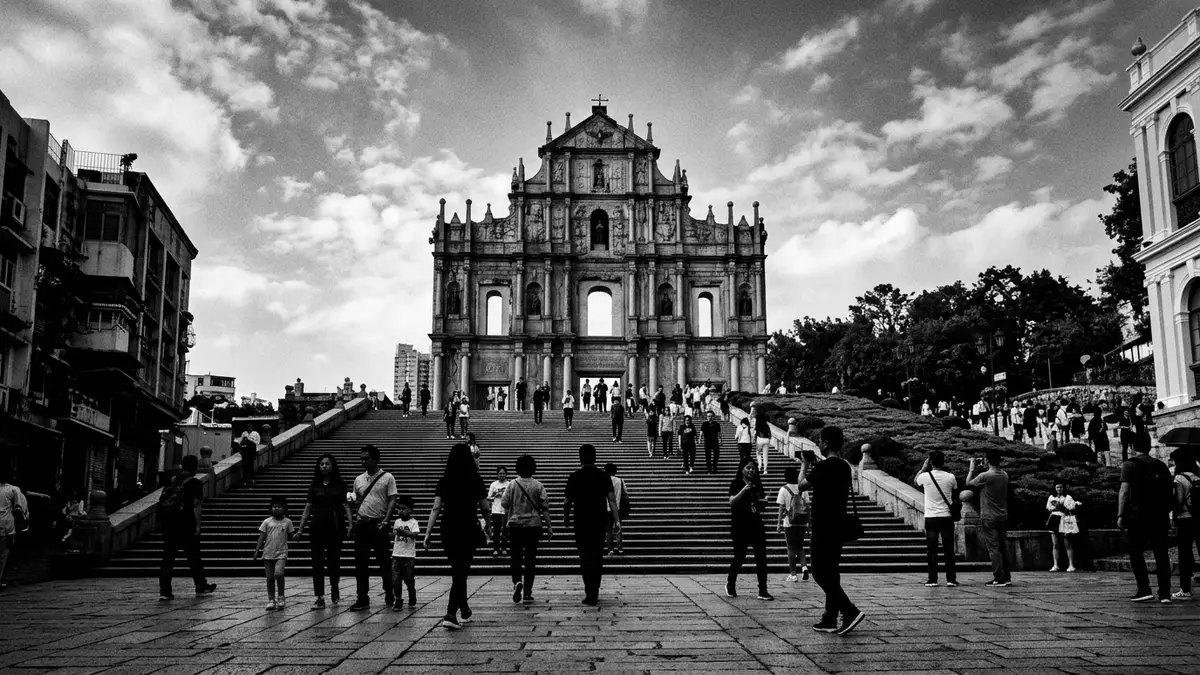
In Macau, Ruinas de Sao Paulo is the surviving stone façade of a seventeenth-century Catholic complex, rising above a broad stairway and framing the sky where a vaulted nave once stood. The site formed part of a Jesuit ensemble built between 1602 and 1640, combining the Church of Mater Dei with St Paul’s College as a major Catholic presence in the Portuguese colony.
A wall of granite, carvings and empty windows
The façade that visitors see at Ruinas de Sao Paulo is built in granite, standing above a long flight of stone steps that climbs from the surrounding streets towards the former church platform.granite façade dimensions It is divided into horizontal tiers with classical columns and entablatures, creating a vertical composition that once formed the front wall of the Church of Mater Dei.Baroque architectural style
Above the lowest level, the façade carries relief sculptures and inscriptions carved into the granite, mixing European iconography such as Christian figures and Latin texts with imagery that references East Asia. Openings in the wall look through to the sky or to the structural remains behind, making the combination of carved stone and empty space one of the most distinctive views in Macau’s historic centre.stone façade that defines Macau
From Jesuit complex to UNESCO-listed ruins
Ruinas de Sao Paulo stands on the site of the Church of Mater Dei and the adjoining College of St Paul, built and managed by the Society of Jesus during the early seventeenth century.construction from 1602 to 1640 The college is described by historians as the first Western-style university in East Asia, reflecting the role Macau played as an entry point between Europe and Asian societies.first Western-style university
In 1835 a fire destroyed most of the church and the college buildings, leaving the granite façade and parts of the foundations as visible remains.fire in 1835 The surviving wall and archaeological traces later became part of the “Historic Centre of Macao”, which UNESCO inscribed as a World Heritage site in 2005.UNESCO World Heritage listing in 2005 Together with nearby sites such as Fortaleza do Monte and Senado Square, Ruinas de Sao Paulo represents several centuries of sustained contact between Portuguese and Chinese cultures.
Ruinas de Sao Paulo within Macau’s historic streets
Ruinas de Sao Paulo stands in the Santo António district on Rua de Sao Paulo, forming a focal point in the dense street pattern of Macau Peninsula.Company of Jesus Square location The broad staircase leads up from the commercial streets towards the façade, and from the upper platform the view extends over tiled roofs, neighbouring church towers and the surrounding urban slopes.adjacent to Mount Fortress
Behind and beside the granite wall, an archaeological zone marks the footprint of St Paul’s College, indicating the outline of the former buildings and their relationship to the church foundations.archaeological remains of the college The combination of visible façade, stairway and excavated traces situates Ruinas de Sao Paulo both as a landmark and as an organised heritage site within the wider urban fabric of Macau.
Visiting Ruinas de Sao Paulo: what travellers from Western Europe should know
- Ruinas de Sao Paulo stands on Rua de Sao Paulo in the Santo António district of Macau Peninsula, close to Company of Jesus Square and within the UNESCO-listed Historic Centre of Macao.
- The site is reached on foot from surrounding streets via a long, wide stone staircase, with further steps and level changes around the terrace behind the façade.
- Macau is served by transport links to Hong Kong and mainland China, and public buses run to stops near the Historic Centre, from where the ruins are approached through narrow urban streets.
- The official languages are Chinese and Portuguese, and the currency is the Macanese pataca.
- Entry requirements depend on your nationality; UK travellers can check the FCDO travel advice at gov.uk/foreign-travel-advice, Irish travellers the Department of Foreign Affairs at ireland.ie.
Searching for Ruinas de Sao Paulo on social platforms
These links open searches for Ruinas de Sao Paulo on each platform.
Frequently asked questions about Ruinas de Sao Paulo
Where is Ruinas de Sao Paulo located within Macau?
Ruinas de Sao Paulo stands in the Santo António district on Rua de Sao Paulo, on Macau Peninsula within the area recognised as the Historic Centre of Macao.
What can visitors expect when they reach the site?
Visitors encounter a tall granite church façade rising above a wide stone staircase, with open views through its windows and access to the archaeological zone marking the former college.
What makes Ruinas de Sao Paulo distinctive among Macau’s landmarks?
The combination of seventeenth-century Jesuit church architecture, East–West carved imagery, and the transformation into ruins after the 1835 fire gives the façade a character that is closely tied to Macau’s role as a meeting point between Europe and China.


