
Rijksmuseum: a nineteenth?century palace of Dutch art
Published on 09/17/2026 at 07:21 | Editorial responsibility: Rafael Müller, Editor-in-Chief AD HOC NEWS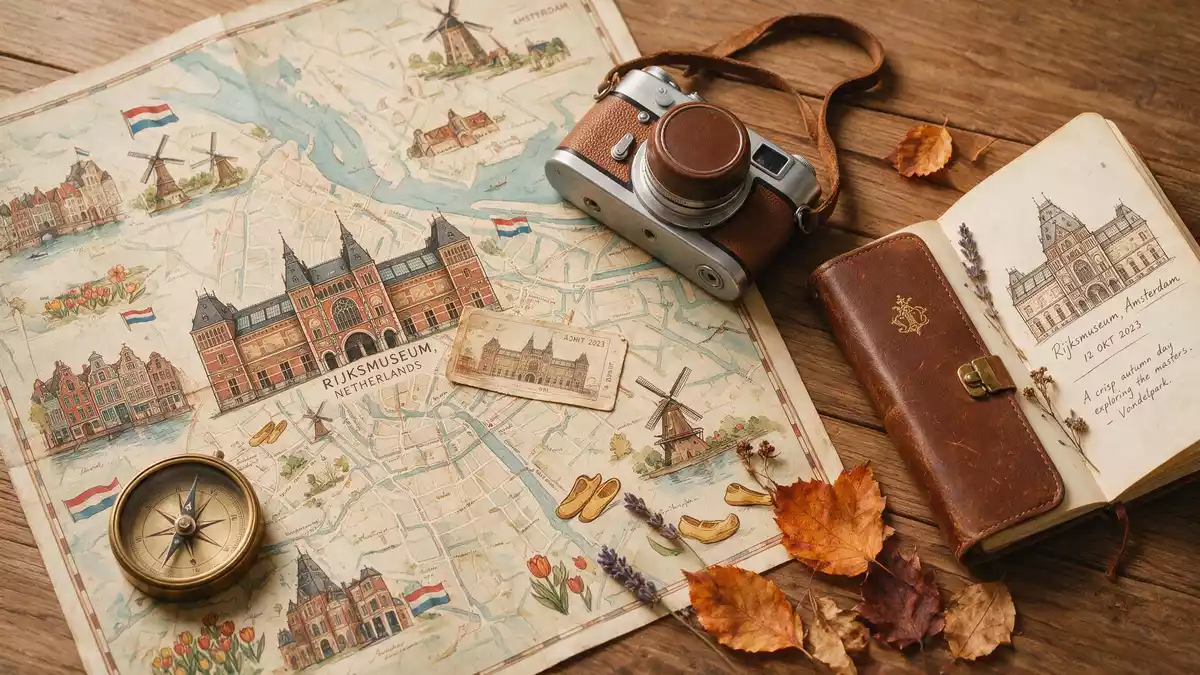
Rijksmuseum in Amsterdam is the national museum of the Netherlands, housed in a richly decorated nineteenth?century building designed by Pierre Cuypers and opened in 1885. The museum brings Dutch art and history from the Middle Ages through the modern era into a single complex, with galleries that frame masterpieces by Rembrandt, Vermeer and other painters against Cuypers’s historicising architecture.
A national collection in a purpose?built museum
The story of Rijksmuseum begins with the decision of the Batavian Republic to establish a national art collection in 1798, modelled on French examples of the time. A National Art Gallery opened in 1800 at Huis Ten Bosch in The Hague, marking the first public presentation of what became the national collection of the Netherlands.National Art Gallery opened in Huis Ten Bosch In 1808, under King Louis Napoleon Bonaparte, the collection moved to Amsterdam, where it was installed in the Royal Palace on Dam Square and later relocated to the Trippenhuis, a seventeenth?century city palace.
During the nineteenth century, the scale and ambition of the collection outgrew its earlier homes. A design competition led to the appointment of Pierre Cuypers, who conceived a large museum building blending Gothic and Renaissance elements with references to Dutch history and civic pride.Pierre Cuypers was chosen to be the architect Construction started in the 1870s, and the new Rijksmuseum building opened in 1885 as a dedicated home for the national collections.the building of the Rijksmuseum was designed by Pierre Cuypers and opened in 1885
Cuypers’s historicising architecture and museum layout
The outside of Rijksmuseum presents a long, symmetrical brick and stone façade facing the museum quarter, with towers, gables and sculptural decoration that recall both medieval and Renaissance forms. Cuypers’s historicising style uses arches, reliefs, coats of arms and imagery from Dutch history to make the building itself read as a narrative of the nation’s past.historicizing style, blending Gothic and Renaissance elements Inside, visitors pass through a succession of galleries organised broadly by period, with the architecture framing views towards key works.
One of the most recognisable interior sequences is the Gallery of Honour, a long central space lined with paintings from the Dutch Golden Age and culminating in the hall where Rembrandt’s “The Night Watch” is displayed.The Gallery of Honour with masterpieces by Vermeer and Rembrandt Light, ornament and painted decoration draw attention to the canvases while also showcasing Cuypers’s use of colour and pattern on walls and vaults. Elsewhere in the complex, the Philips Wing houses architectural fragments from across the Netherlands, setting pieces of stonework, sculpture and façade elements into a museum environment that echoes the building’s own eclectic style.fragment building, branded Philips wing, contains building fragments
Eight centuries of art and history under one roof
Rijksmuseum’s collection covers roughly eight centuries of Dutch art, crafts and history, from around 1200 to 2000. Around 8,000 objects are on display at any one time, drawn from a total collection of about one million objects.8,000 objects of art and history from their total collection of one million objects Painting from the seventeenth?century Dutch Golden Age forms a central strand, with works by Rembrandt, Frans Hals, Johannes Vermeer, Jan Steen and Jacob van Ruisdael among many others.particularly strong in 17th?century Dutch art
The museum also presents decorative arts, sculpture, Asian art and maritime artefacts that together describe how the Netherlands engaged with Europe and the wider world. Delftware, furniture, silver, ship models and armour appear alongside prints and drawings from the associated print room, the Rijksprentenkabinet, which holds an extensive collection of works on paper and illuminated manuscripts.Rijksprentenkabinet, one of Europe’s finest collections of prints and drawings Within the building, the Cuypers Library forms a tall, book?lined space dedicated to art?historical literature, underlining the museum’s role not only as a display space but also as a centre for research.
Visiting Rijksmuseum: what travellers from Western Europe should know
- Rijksmuseum stands on Museumstraat in Amsterdam’s museum quarter, close to Museumplein and within walking distance of Vondelpark and the historic canal belt.
- The museum interior includes staircases between levels and long gallery routes; visitors move through sequences of rooms that can involve extended periods on foot.
- The official language is Dutch and the currency is the euro.
Searching for Rijksmuseum on social platforms
These links open searches for Rijksmuseum on each platform.
Frequently asked questions about Rijksmuseum
Where is Rijksmuseum located in Amsterdam?
Rijksmuseum stands on Museumstraat beside Museumplein in Amsterdam’s museum quarter, within the southern part of the city’s central districts.
What can visitors expect inside Rijksmuseum?
Visitors encounter galleries arranged broadly by period, with Dutch Golden Age paintings, decorative arts, Asian collections, the Cuypers Library and architectural fragments displayed across the complex.
What makes Rijksmuseum distinctive among European museums?
The museum combines a national collection spanning roughly eight centuries with a purpose?built nineteenth?century building by Pierre Cuypers, whose architecture forms a central part of the visit.


