
Rijksmuseum, a national story in brick and Dutch art
Published on 09/19/2026 at 17:36 | Editorial responsibility: Rafael Müller, Editor-in-Chief AD HOC NEWS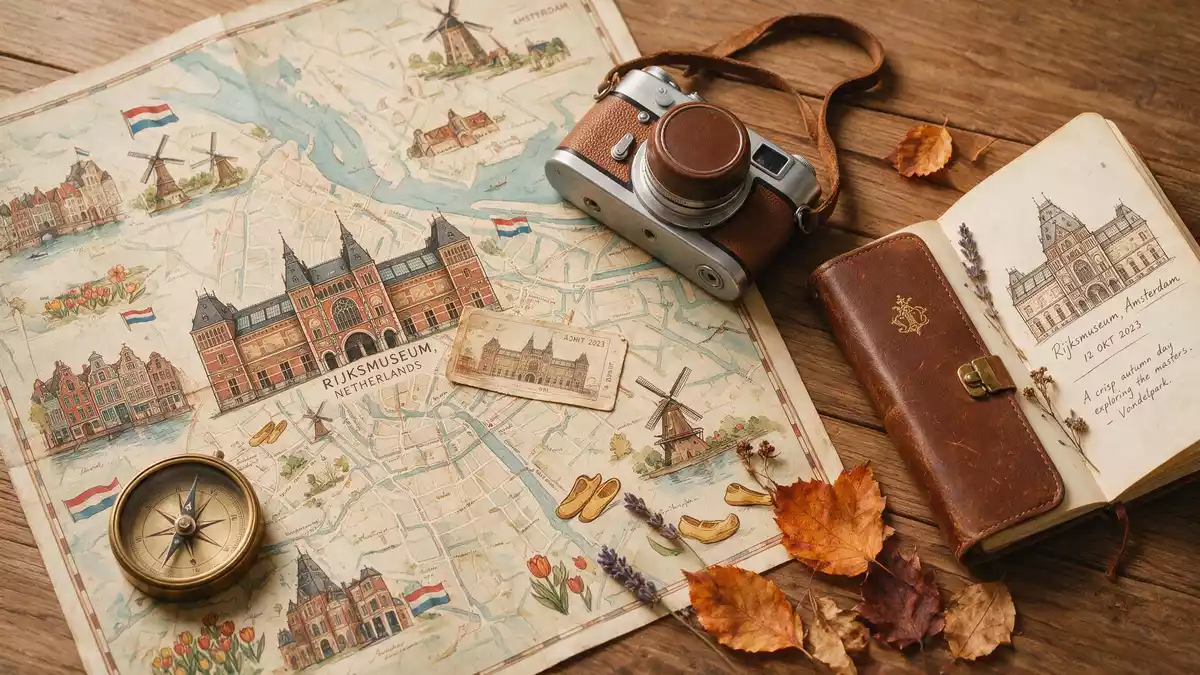
Rijksmuseum in Amsterdam is the national museum of the Netherlands, combining a monumental brick building with galleries that trace eight centuries of Dutch art and history.
A neo-Gothic landmark shaped by Pierre Cuypers
The present Rijksmuseum building stands on Museumplein in Amsterdam, designed by Dutch architect Pierre Joseph Hubert Cuypers in a historicising style that blends Gothic Revival and Renaissance elements with national symbolism.Pierre Cuypers designed the Rijksmuseum Construction of the main building began in the 1870s, and the museum was officially opened in 1885 as a purpose-built home for the national collections.a new building in the Gothic Revival style opened in 1885
The structure rises in red brick with stone detailing, its towers and turrets marking a distinctive silhouette against the open expanse of Museumplein.the building rises in brick with stone detailing Cuypers organised the museum as interconnected wings around inner courtyards, allowing long vistas through the building and setting up ceremonial approaches to key galleries. Inside, visitors encounter vaulted ceilings, murals, mosaics and extensive stained glass, alongside sculpted reliefs and decorative friezes that embed allegorical figures and historical scenes into the architecture.vaulted ceilings, murals and stained glass
From early national collection to Museumplein
The institution behind Rijksmuseum dates to a government decision on 19 November 1798 to establish a national museum on the French model, bringing important works together for public display.a national museum decision in 1798 In 1800 the Nationale Kunst-Galerij opened in The Hague, and in 1808 the collection was transferred to Amsterdam under King Louis Bonaparte, installed in the Royal Palace on Dam Square before moving to the seventeenth-century Trippenhuis on Kloveniersburgwal.the collection moved from The Hague to Amsterdam and Trippenhuis
By the later nineteenth century, the national collections required a dedicated home, and Cuypers’ Rijksmuseumgebouw on Museumplein provided a single complex where paintings, prints, decorative arts and historical objects could be brought together under one roof.the museum has been housed in Cuypers’ building since 1885 Subsequent renovations, including an extensive refurbishment between 2003 and 2013 overseen by Spanish architects Cruz y Ortiz, restored much of Cuypers’ original layout while adapting the nineteenth-century building for contemporary museum use.a refurbishment restoring the clear layout conceived by Cuypers
Eight centuries of Dutch art and history under one roof
Rijksmuseum’s collection focuses on art, crafts and history from around the thirteenth century to the twentieth century, presenting works from about 1200 to 2000 across its galleries.art, crafts and history from around 1200 to 2000 The collection numbers about one million objects, of which several thousand are on display at any one time, including paintings, sculpture, decorative arts, prints and objects from everyday life and maritime activity.a collection of one million objects with thousands on display
Seventeenth-century Dutch painting occupies a central place, with works by artists such as Rembrandt van Rijn, Frans Hals and Johannes Vermeer forming a core part of the collection.works by Rembrandt, Frans Hals and Vermeer Among the best-known paintings are Rembrandt’s “Night Watch”, Vermeer’s “The Milkmaid” and a self-portrait by Vincent van Gogh, presented alongside many other canvases that illuminate daily life, portraiture, landscape and maritime scenes from the Dutch Golden Age.Rembrandt’s “Night Watch” and Vermeer’s “The Milkmaid” Beyond painting, the museum holds Asian art, sculpture, decorative arts and an extensive collection of prints and drawings associated with the Rijksprentenkabinet, as well as the Cuypers Library, recognised as an important art history library in the Netherlands.the Rijksprentenkabinet and prints and drawings
Visiting Rijksmuseum: what travellers from Western Europe should know
- Rijksmuseum stands on Museumplein in the south of Amsterdam, close to the Stadhouderskade traffic axis and near other major museums around the square.
- The museum building has multiple floors linked by staircases and lifts, with long internal routes between wings and galleries that can involve considerable walking.
- The surrounding Museumplein area includes open lawns and paved routes, and tram lines run nearby, providing connections from Amsterdam Centraal and other districts.
- The official language is Dutch and the currency is the euro.
Searching for Rijksmuseum on social platforms
These links open searches for Rijksmuseum on each platform.
Frequently asked questions about Rijksmuseum
Where is Rijksmuseum located?
Rijksmuseum stands on Museumplein in the southern part of Amsterdam, within a district where several major cultural institutions are grouped together.
What can visitors expect inside Rijksmuseum?
Visitors encounter galleries presenting Dutch and international art, decorative objects and historical artefacts from about 1200 to 2000, arranged across multiple levels and wings.
What makes Rijksmuseum distinctive among European museums?
Rijksmuseum combines a neo-Gothic brick building by Pierre Cuypers, opened in 1885, with a national collection that highlights seventeenth-century Dutch painting and wider Dutch cultural history.


