
Recife Antigo, the island quarter where Recife began
Published on 09/14/2026 at 06:24 | Editorial responsibility: Rafael Müller, Editor-in-Chief AD HOC NEWS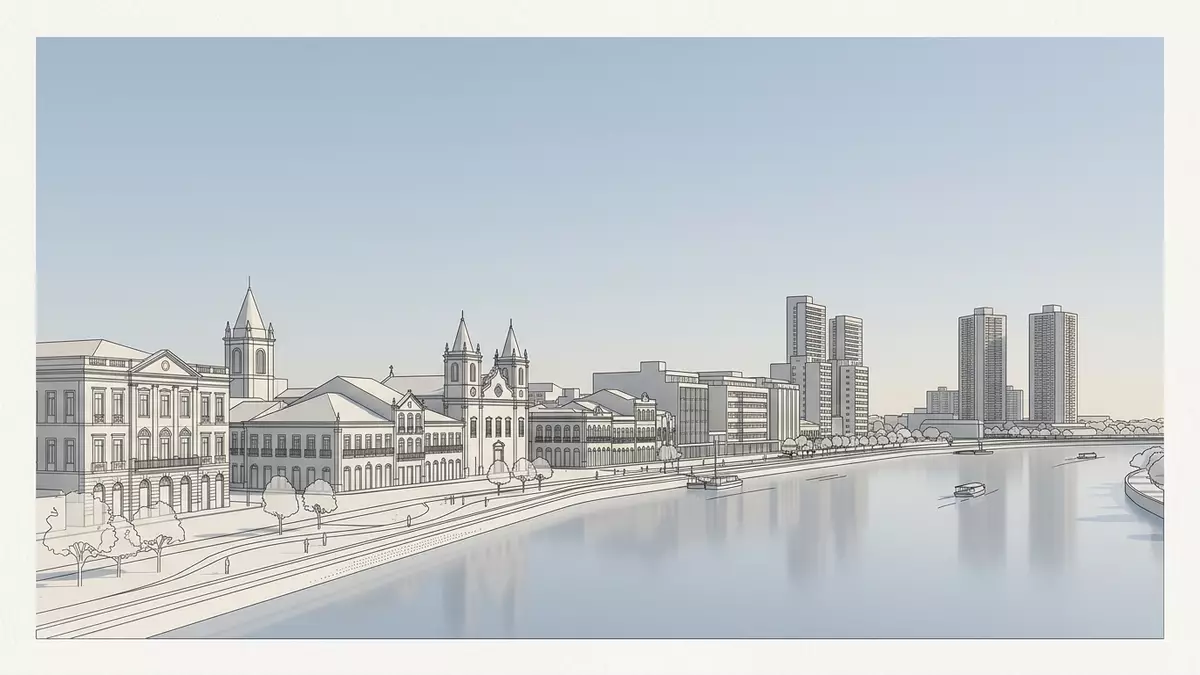
Recife Antigo in Recife, Brazil, is the historic island quarter where the city first took shape along rivers, docks and cobbled streets, laid out on low ground that reads as an island between channels and harbour basins. Officially known as Bairro do Recife, it corresponds to the eastern part of Recife’s historic centre and occupies the Island of Recife at the point where the Capibaribe and Beberibe rivers meet the Atlantic Ocean.
An island of streets between river and ocean
Recife Antigo occupies the Island of Recife at the mouth of the Capibaribe and Beberibe rivers, bordered by estuarine channels on one side and the Atlantic harbour on the other, so that many streets run with water along at least one edge.Recife Antigo as a waterfront island The district forms the eastern part of Recife’s historic centre, linked to other neighbourhoods by road bridges that cross the rivers and harbour basins to reach the mainland fabric.Island of Recife at the eastern side of the historic centre
The urban pattern preserves narrow streets close to the quayside, reflecting the role of Recife Antigo as the earliest urban core around the harbour, and combines them with broader avenues laid out during later urban reforms influenced by French models in the early twentieth century.French?influenced avenues from 1910 Churches, civic buildings and merchants’ houses line cobbled streets that run parallel to docks and quays, while former warehouses and customs buildings near the waterfront have façades that retain period details such as pilasters and cornices even where their interiors have been adapted for cultural and social uses.Recife Old Town around Marco Zero square
From sixteenth?century port to listed historic centre
Recife Antigo grew in the sixteenth century around a Portuguese port that loaded sugar cane from Pernambuco for departure to Europe, laying out streets and quays that established Recife as a trading city on Brazil’s north?eastern Atlantic coast.Initial Portuguese settlement in the sixteenth century During the seventeenth century, when Dutch forces occupied parts of Pernambuco, Recife Antigo underwent urbanisation that left visible marks in the street layout and in some historic buildings that still stand within the quarter.
The official neighbourhood name Recife, widely known as Recife Antigo, corresponds to the eastern part of the historic centre, and the ensemble of streets, squares and buildings set between river and ocean was listed in 1998 by Brazil’s Instituto do Patrimônio Histórico e Artístico Nacional as a site of architectural and urban interest.Listing in 1998 as a site of architectural and urban interest The district’s building stock therefore spans colonial churches, nineteenth?century civic structures and early twentieth?century avenues, with façades showing painted masonry, decorative ironwork and traces of commercial signage that recall its harbour?city past.
Marco Zero and landmark buildings in Recife Antigo
At the heart of Recife Antigo lies Praça Rio Branco, widely known as Marco Zero, the official point from which road distances in the region are measured and a symbolic marker of where Recife began as an urban settlement.Praça Rio Branco, better known as Marco Zero A bronze marker installed in the square in 1938 formalised this role, turning Marco Zero into both a geographical reference point and a civic monument tied to the city’s relationship with its rivers and the Atlantic.Bronze marker installed in 1938
Around Marco Zero and nearby streets stand former warehouses and port buildings whose structures have been adapted for cultural spaces and craft centres while maintaining their historic exteriors, so that brick and stucco façades with large doorways face the docks where cargo once moved. Among the religious buildings of Recife Antigo is the Kahal Zur Israel Synagogue on Rua do Bom Jesus, recognised as the first synagogue built in the Americas and part of the district’s layered religious history.Kahal Zur Israel Synagogue in Recife Antigo Other cultural institutions such as Paço do Frevo and the Centro Cultural Cais do Sertão occupy restored harbour?side premises, linking the built environment of the port to music and regional heritage.
Visiting Recife Antigo: what travellers from Western Europe should know
- Recife Antigo lies on the Island of Recife at the eastern side of Recife’s historic centre, bordered by the Capibaribe and Beberibe rivers and the harbour, and is connected to other parts of Recife by several road bridges crossing the waterways.
- The district’s streets are largely level, but approaches to some viewpoints and upper floors of historic buildings involve flights of steps or narrow staircases, and cobbled surfaces can make sections of the old town uneven underfoot.
- Recife Antigo sits within the city of Recife in north?eastern Brazil; the official language is Portuguese and the currency is the Brazilian real.
- Entry requirements depend on your nationality; UK travellers can check the FCDO travel advice at gov.uk/foreign-travel-advice, Irish travellers the Department of Foreign Affairs at ireland.ie.
Searching for Recife Antigo on social platforms
These links open searches for Recife Antigo on each platform.
Frequently asked questions about Recife Antigo
Where is Recife Antigo within Recife?
Recife Antigo corresponds to Bairro do Recife on the Island of Recife, forming the eastern part of Recife’s historic centre between the Capibaribe and Beberibe rivers and the Atlantic harbour.
What can visitors expect when walking through Recife Antigo?
Visitors encounter cobbled streets, historic churches, civic buildings and former port warehouses, with squares such as Marco Zero opening towards docks and river channels.
What makes Recife Antigo distinctive compared with other parts of Recife?
Recife Antigo combines its role as the city’s earliest harbour quarter with a waterfront island setting and a concentration of listed historic streets and buildings focused around Marco Zero and the old port.


