
Qalat Salah al-Din rises above Cairo’s historic core
Published on 09/24/2026 at 00:12 | Editorial responsibility: Rafael Müller, Editor-in-Chief AD HOC NEWS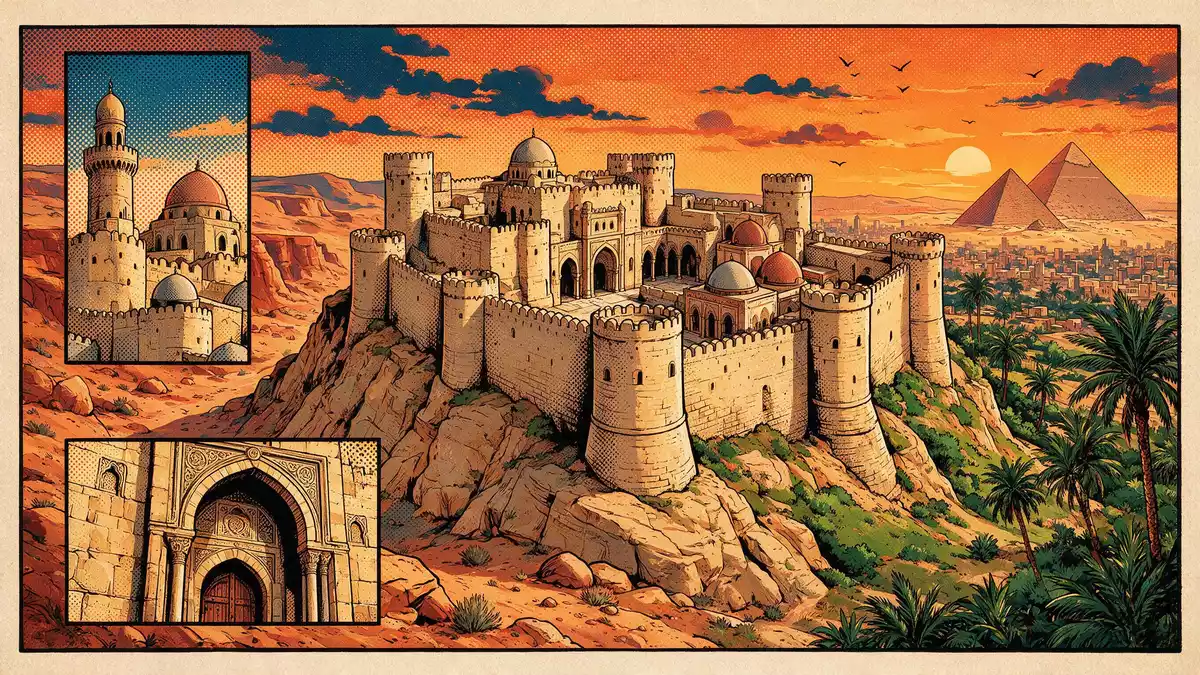
Qalat Salah al-Din rises on a spur of the Mokattam Hills above Kairo’s historic core. Its walls, mosques and museums bring together the Ayyubid fortress founded by Saladin in 1176 and buildings from later Egyptian dynasties.
The complex is part of Historic Cairo, inscribed on the UNESCO World Heritage List in 1979. Its most visible feature is the Mosque of Muhammad Ali, whose Ottoman dome and minarets form a high point above the citadel.
Qalat Salah al-Din and the Ayyubid foundation
Saladin, whose full name was Salah al-Din Yusuf ibn Ayyub, founded the Ayyubid dynasty in Egypt and Syria. Construction of the Cairo citadel began in 1176, during the twelfth century, and continued under his successors.
The fortress occupies elevated ground east of the historic centre. Its position, walls and towers belong to the military architecture of the Ayyubid period, while the wider citadel contains additions from Mamluk, Ottoman and modern Egyptian history. Cairo’s historic fortress remains closely associated with the city’s medieval development.
The citadel also belongs to the political history of Cairo. It served as the seat of Egyptian government and the residence of rulers for nearly 700 years, until the nineteenth century. The elevated enclosure therefore contains both defensive architecture and the remains of royal administration.
From fortress walls to Ottoman domes
The Mosque of Muhammad Ali was built between 1828 and 1848 for Muhammad Ali Pasha. Its Ottoman architectural language differs from the heavier medieval walls around it, creating a visible contrast within the citadel.
The mosque occupies the summit and has a large central dome, smaller domes and twin minarets. Its silhouette is visible across much of Kairo, while the surrounding enclosure contains other mosques, courtyards, gates and museum buildings. The Muhammad Ali Mosque belongs to the nineteenth-century phase of the complex.
Among the citadel’s principal historic buildings is the Mosque of Sultan al-Nasir Muhammad, a Mamluk monument from the fourteenth century. Its stonework and carved decoration record a period when Cairo was a major centre of Mamluk political and religious life.
Museums occupy parts of the enclosure, including collections connected with military and royal history. Their presence adds a civic and cultural function to a site whose walls were first associated with government and defence.
The citadel within Historic Cairo
Qalat Salah al-Din stands within the southern part of Historic Cairo, where mosques, madrasas, gates and urban quarters preserve the architectural history of Islamic Egypt. The citadel’s hill separates its walls from the dense streets below.
The wider World Heritage property was inscribed in 1979 and includes the citadel area, Ayyubid city walls and major Mamluk monuments. Historic Cairo’s inscription places the fortress within a larger record of Islamic urban culture.
The surviving complex is not a single-period monument. Ayyubid fortifications, Mamluk religious buildings, Ottoman architecture and museum interiors occupy the same hilltop enclosure. That mixture is visible in the change from plain defensive masonry to decorated stonework, domes and formal courtyards.
Views from the elevated site extend across Kairo’s historic districts and towards the wider urban landscape. The relationship between hill, walls and city is central to the place’s character, while the buildings provide a sequence of architectural periods within one compound.
The citadel’s historical importance also appears in its changing functions. Saladin’s foundation became a long-lived centre of Egyptian rule, then a monumental complex containing religious buildings and museums. Saladin’s Cairo citadel remains linked to the Ayyubid transformation of the city.
Visiting Qalat Salah al-Din: what travellers from Western Europe should know
- Qalat Salah al-Din stands in the Al-Qalaa district of Kairo, within the Khalifa administrative area. It occupies the Mokattam Hills east of the historic centre.
- The approach reaches an elevated fortress enclosure. Inside, visitors encounter courtyards, sloping ground, stone surfaces and mosque interiors rather than a single level exhibition building.
- The principal buildings include the Mosque of Muhammad Ali, the Mosque of Sultan al-Nasir Muhammad and museums connected with Egyptian military and royal history.
- The official language is Arabic and the currency is the Egyptian pound.
Searching for Qalat Salah al-Din on social platforms
These links open searches for Qalat Salah al-Din on each platform.
Frequently asked questions about Qalat Salah al-Din
Where is Qalat Salah al-Din?
Qalat Salah al-Din is in the Al-Qalaa district of Kairo, on a spur of the Mokattam Hills east of the historic centre.
What can visitors expect at the citadel?
The enclosure contains medieval walls, mosques, courtyards, museums and elevated views across Kairo’s historic districts.
What makes the citadel distinctive?
Its buildings combine an Ayyubid foundation, Mamluk religious architecture, Ottoman design and museum functions within one hilltop complex.


