
Qalat Salah al-Din, Cairo’s hilltop citadel of stone and skyline
Published on 09/15/2026 at 16:13 | Editorial responsibility: Rafael Müller, Editor-in-Chief AD HOC NEWS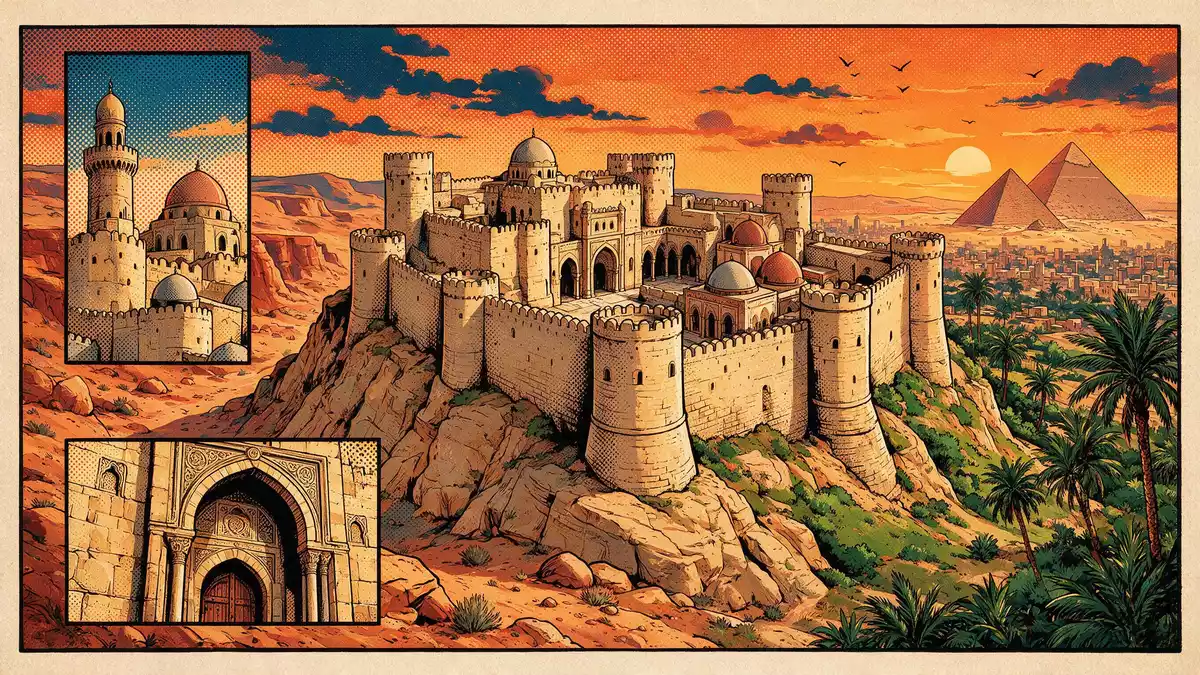
Qalat Salah al-Din in Kairo, known in English as the Citadel of Saladin or Cairo Citadel, is a medieval fortress complex that crowns the Mokattam Hills on the eastern side of Egypt’s capital. Built under the Ayyubid ruler Salah al-Din al-Ayyubi in the twelfth century, it later became a long-standing seat of Egyptian government overlooking the historic urban districts below.
Stone walls on the Mokattam Hills
The defining experience of Qalat Salah al-Din is its position above the city, with fortifications running along the slopes of the Mokattam Hills and framing views across Kairo’s older quarters and towards the Nile valley. The citadel occupies a limestone spur on the eastern side of the city, taking advantage of higher ground that rises above districts sometimes described as Islamic Cairo.a limestone spur on the eastern side The elevated site gives the fortress a clear presence in Kairo’s skyline, with its outer walls and towers standing above the dense urban fabric.
The citadel is part of the wider Historic Cairo area recognised on the UNESCO World Heritage List, a designation that underlines the cultural and architectural significance of the surrounding districts as well as the fortress itself.Historic Cairo UNESCO World Heritage Site Within its enclosure, the visitor moves between long stretches of masonry, open courts and later buildings set against the surviving mediaeval fortifications. The relationship between stone, slope and city is constant, with each vantage point revealing a slightly different alignment of minarets, domes and modern structures rising beyond the walls.
A twelfth-century fortress tied to Egypt’s rulers
Construction of Qalat Salah al-Din began in the late twelfth century under Salah al-Din al-Ayyubi, the Ayyubid sultan whose name the fortress still carries.late twelfth-century fortification Work on the citadel and its defences extended into the early thirteenth century, and the complex developed over succeeding dynasties as rulers added structures, reinforced walls and adapted the hilltop enclosure to their needs. For several centuries it served as the seat of government, linking military power with the administration of Egypt from its commanding position above the city.served as the political and military heart of Egypt
The Ayyubid origins of the fortress, followed by Mamluk and Ottoman interventions, give Qalat Salah al-Din a layered architectural character. Mediaeval curtain walls and towers frame later mosques and palatial buildings, most prominently the mosque associated with Muhammad Ali Pasha, whose nineteenth-century imprint is visible within the citadel’s interior.one of the most important landmarks of Islamic Cairo The result is a complex where the initial military function has been overlaid by ceremonial, religious and representational roles linked to different periods of Egyptian rule.
Inside the walls: courts, mosques and views
Within the enclosure of Qalat Salah al-Din, broad open areas and stone-paved approaches connect a sequence of buildings, terraces and vantage points. Visitors encounter mosques with prominent domes and minarets, museum spaces housed in historic structures, and open courts that reveal the thickness of the surrounding fortifications. These interior spaces sit within the geometry of the hilltop stronghold, with routes rising and falling as they follow the contours of the Mokattam slopes.
The views from the citadel are one of its lasting attractions, with long perspectives over Kairo’s historic quarters and towards the wider metropolitan area. From higher terraces and platforms, it is possible to trace the outline of major religious complexes and dense residential districts below, highlighting the way the fortress relates to the city it once governed.a fortress of Old Cairo At the same time, the interior organisation of the citadel, with its mixture of military archaeology and later monumental architecture, provides a concise survey of several centuries of Egyptian building.
Visiting Qalat Salah al-Din: what travellers from Western Europe should know
- Qalat Salah al-Din stands on the south-eastern side of Historic Cairo, on the slopes of the Mokattam Hills above districts such as El Abageyah in Qesm Al Khalifah. It is reached along urban roads from central Kairo.
- The terrain within the citadel involves gradients and stone surfaces, with approaches that rise from the surrounding streets to the hilltop enclosure and further changes in level inside the walls.
- The fortress lies close to historic districts often described as Islamic Cairo, placing it within reach of other mediaeval mosques and urban quarters on the eastern side of the city.
- The official language is Arabic and the currency is the Egyptian pound.
- Entry requirements depend on your nationality; UK travellers can check the FCDO travel advice at gov.uk/foreign-travel-advice, Irish travellers the Department of Foreign Affairs at ireland.ie.
Searching for Qalat Salah al-Din on social platforms
These links open searches for Qalat Salah al-Din on each platform.
Frequently asked questions about Qalat Salah al-Din
Where is Qalat Salah al-Din located?
Qalat Salah al-Din stands on the Mokattam Hills on the south-eastern side of Kairo, above Historic Cairo and districts such as El Abageyah in Qesm Al Khalifah.
What can visitors expect inside the citadel?
Visitors encounter mediaeval fortifications, mosques, museum spaces and open courts, along with elevated viewpoints offering long perspectives over Kairo’s historic quarters.
What makes Qalat Salah al-Din distinctive?
The citadel combines a twelfth-century hilltop fortress built under Salah al-Din al-Ayyubi with later monumental buildings, all tied to its role as a former seat of Egyptian government.


