
Qalat Salah al-Din and Cairo’s hilltop fortress
Published on 08/19/2026 at 14:51 | Editorial responsibility: Rafael Müller, Editor-in-Chief AD HOC NEWS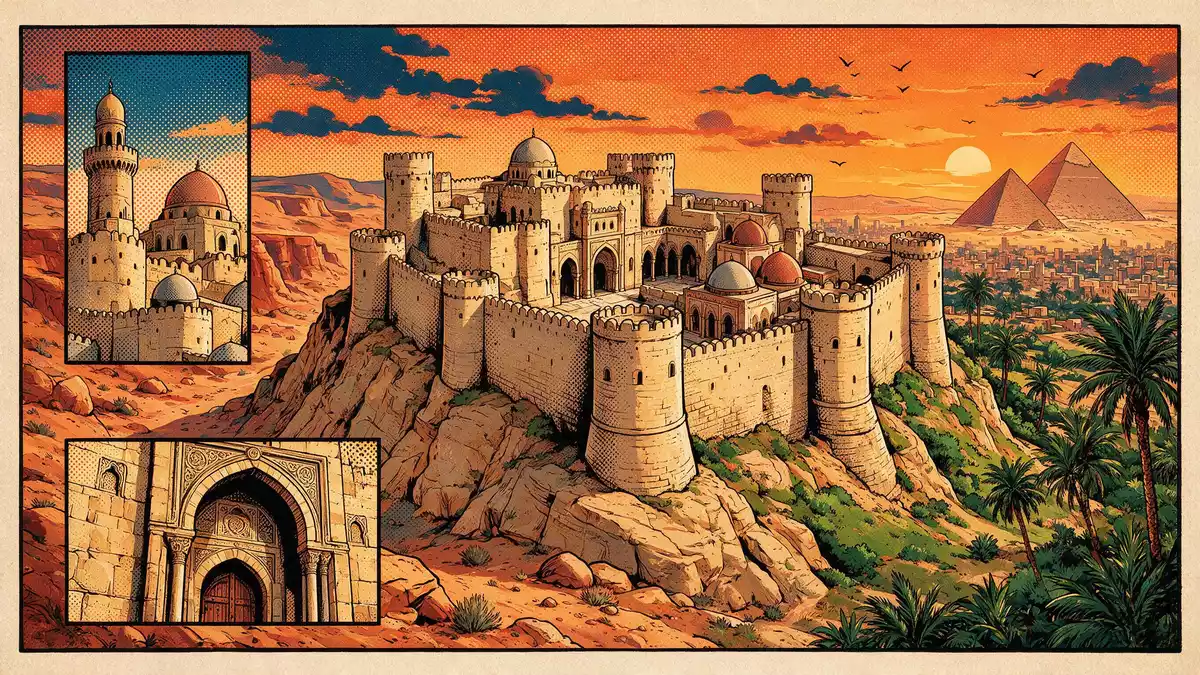
Qalat Salah al-Din rises above Kairo as a stone citadel shaped by Ayyubid, Mamluk and Ottoman building. Begun by Salah al-Din in 1176, it remains one of the city’s most recognisable hilltop fortresses.
Saladin’s fortress above Kairo
The core of Qalat Salah al-Din belongs to the Ayyubid period and to Salah al-Din himself, whose name remains attached to the site. The fortress began in 1176 and drew its earliest walls from the limestone of the Muqattam Hills, giving the citadel a direct material link to the ridge it occupies.1176 under Salah al-Din
The citadel is also tied to the longer history of Islamic Cairo, where it became the seat of government and later part of the Historic Cairo World Heritage area. That combination of rulership, military form and urban height still defines the place more than any single monument within it.Historic Cairo World Heritage
Layers of Mamluk and Ottoman power
The citadel did not remain a single-period fortress. Mamluk rulers expanded it, added palaces and mosques, and turned the complex into a royal centre whose buildings reached beyond purely defensive form.
Later Ottoman phases altered the enclosure again, and Muhammad Ali Pasha transformed much of the site in the nineteenth century. His mosque, with its large dome and tall minarets, now sits high above the older masonry and gives the citadel a second visual focus.Muhammad Ali’s mosque
The result is a compact record of shifting rule in Kairo. Stone towers, gates, courts and religious buildings sit close together, but they belong to different centuries and different political orders.late twelfth century fortress
Inside the citadel’s walls
One of the most striking surviving features is the well associated with Saladin, cut deep into rock and reached by a long spiral stair. Its shaft and stairwork make the water supply an important part of the fortress’s physical fabric, not just its history.Saladin’s well
The present layout includes mosques, museums and enclosed courts within a defensive shell of walls and towers. The site’s present form reflects repeated building campaigns, but the older Ayyubid core remains visible in the shape of the enceinte and the ridge-top setting.
UNESCO describes Qal’at Salah El-Din as part of a wider exchange of fortification traditions in the Near East during the Crusader era. That broader context helps place the fortress within a regional world of castles, dynasties and contested frontiers.fortified architecture
Visiting Qalat Salah al-Din: what travellers from Western Europe should know
- The citadel stands in Cairo on the Muqattam ridge, east of the historic city. It is reached by road, with the main mass of the fortress visible from the approaches below.
- The climb involves stone ground, changes in level and long passages inside the enclosure. Several parts of the complex are spread across different terraces.
- The site contains mosques, former palaces, museums and surviving gates. Its strongest impression comes from the mix of military masonry and later ceremonial buildings.
- The fortress belongs to Historic Cairo and forms part of a UNESCO World Heritage property. That status links it to the city’s wider medieval and Islamic landscape.
Searching for Qalat Salah al-Din on social platforms
These links open searches for Qalat Salah al-Din on each platform.
Frequently asked questions about Qalat Salah al-Din
Where is Qalat Salah al-Din?
It stands in Kairo on a ridge of the Muqattam Hills, east of the historic city. The fortress looks down over the urban plain and belongs to the landscape of Islamic Cairo.
What should a visit involve?
Expect stone enclosures, changes in level and a sequence of mosques, museums and gates inside a large fortified complex. The setting is compact, but the site spreads across more than one terrace.
What makes it distinctive?
Its distinction lies in the overlap of periods: Ayyubid foundations, Mamluk additions and Muhammad Ali’s nineteenth-century rebuilding. The result is a fortress where military architecture and later state buildings stand together.


