
Plaza de Espana in Sevilla, a sweeping arc of brick, water and tile
Published on 09/18/2026 at 12:14 | Editorial responsibility: Rafael Müller, Editor-in-Chief AD HOC NEWS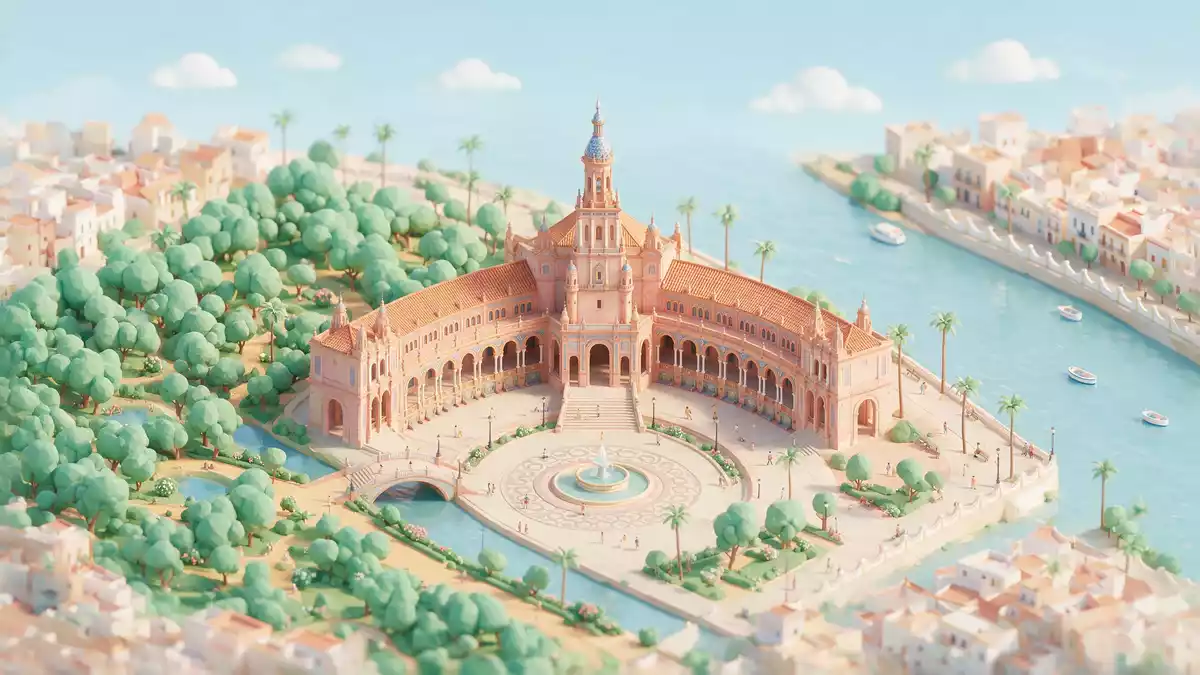
Plaza de Espana in Sevilla curves in a wide semi-circle of brick, water and ceramic colour along the edge of Maria Luisa Park, turning an early twentieth-century exposition site into a permanent architectural set-piece. Conceived under Sevillian architect Aníbal González and substantially completed in 1928 for the Ibero-American Exposition of 1929, it stages Spain as a continuous arc of regions, histories and craft traditions in glazed tile and red brick.
A semi-circular palace of brick and water
The core of Plaza de Espana is its expansive semi-circular plan, a brick-built arc that embraces a broad paved space and a shallow canal in front of it. The composition reads as a long palace wing with two towers at its ends, the curvature making the building appear to fold gently around the central space and the water that traces its inner edge.Plaza de Espana in Sevilla is described as a sweeping brick arc wrapped around water The ensemble stands on the north-eastern edge of Maria Luisa Park, where tree-lined walks meet the brick colonnades and towers.
Architecturally, Plaza de Espana belongs to the Spanish Regionalism of the early twentieth century, in which historicist references are reworked through local materials and crafts. González combined Renaissance Revival, Baroque Revival and Neo-Mudéjar motifs in the building’s elevations, so that pilasters, arches and cornices sit alongside tile panels and wrought-iron details drawn from Andalusian traditions.The Plaza de Espana in Seville is widely described as a landmark example of Regionalism Architecture mixing these styles The result is an arc that looks both historically rooted and clearly of the early twentieth century.
Aníbal González and the Ibero-American Exposition
Plaza de Espana emerged from the preparations for the Ibero-American Exposition of 1929, a world’s fair in which Sevilla presented its ties to Portugal and a wide range of American republics. Work on the complex began in 1914 under Aníbal González, who served as chief architect for the exposition and shaped much of the park-side ensemble.Accounts of the project describe González directing construction from 1914 Construction continued into the 1920s, and the plaza was substantially finished by 1928 in time for the exposition year.
The Ibero-American Exposition opened in 1929 and spread across Maria Luisa Park and its surroundings, with Plaza de Espana forming one of the largest single constructions within the fairgrounds.Spanish-language accounts describe the plaza as the largest construction of the exposition, built between 1914 and 1929 and projected by Aníbal González The brick arc acted as a national pavilion within a wider ensemble of pavilions and landscaped avenues, giving Spain a monumental architectural backdrop against which to present its narratives of history, technology and regional identity.
Tiles, provinces and bridges over the canal
Walked at ground level, Plaza de Espana reveals a dense layering of ceramic detail that anchors its broad gestures in specific regions and stories. Along the inner face of the arc, at the foot of the colonnade, sit a sequence of tiled alcoves, each dedicated to one of the Spanish provinces represented at the time of construction. These alcoves carry ceramic scenes, coats of arms and maps that turn a stroll along the colonnade into an encounter with Spain’s administrative and cultural geography.Guides to Plaza de Espana describe 48 tiled provincial alcoves with scenes, shields and maps The repetition of the alcove form, offset by variation in colour and imagery, creates a rhythm at eye level beneath the broader sweep of arches and cornices.
Between the building and the central paved space runs a canal that follows the plaza’s semi-circular line, crossed by bridges decorated with glazed ceramic balustrades and panels. Sources on the plaza’s symbolism note that four of these bridges represent historical kingdoms within Spain, linking the central island of paving to the colonnaded façade through structures of brick and tile.Descriptions highlight a canal along the perimeter crossed by four bridges representing the four ancient kingdoms of Spain The combination of water, brick, tile and the open sky makes the square read as both monumental and finely worked, a place where architectural mass and artisanal detail reinforce each other.
Visiting Plaza de Espana: what travellers from Western Europe should know
- Plaza de Espana lies within Maria Luisa Park, south of Sevilla’s historic core, and is reached on foot from the park’s avenues or by city buses that serve the surrounding streets.
- The central space is paved and open, while the arc of the building is reached by broad staircases and colonnaded walks that involve some climbing.
- To the west, beyond the trees of Maria Luisa Park, lies the Guadalquivir River, and several other former exposition pavilions stand within walking distance of the plaza.
- Spanish is the official language and the currency is the euro.
Searching for Plaza de Espana on social platforms
These links open searches for Plaza de Espana on each platform.
Frequently asked questions about Plaza de Espana
Where is Plaza de Espana in Sevilla?
Plaza de Espana stands within Maria Luisa Park in Sevilla, on the south-eastern side of the city’s historic centre and close to the Guadalquivir River.
What should visitors expect when they arrive at Plaza de Espana?
Visitors encounter a large semi-circular brick building with towers, a canal crossed by ceramic-decorated bridges, extensive paving in front and colonnaded walks with tiled alcoves.
What makes Plaza de Espana distinctive among Sevilla’s public spaces?
The plaza combines an early twentieth-century Regionalist architectural language with detailed ceramic representations of Spanish provinces, set around a canal and a broad open space within Maria Luisa Park.


