
Plaza de Espana in Sevilla, a crescent of brick, water and tile
Published on 08/26/2026 at 20:56 | Editorial responsibility: Rafael Müller, Editor-in-Chief AD HOC NEWS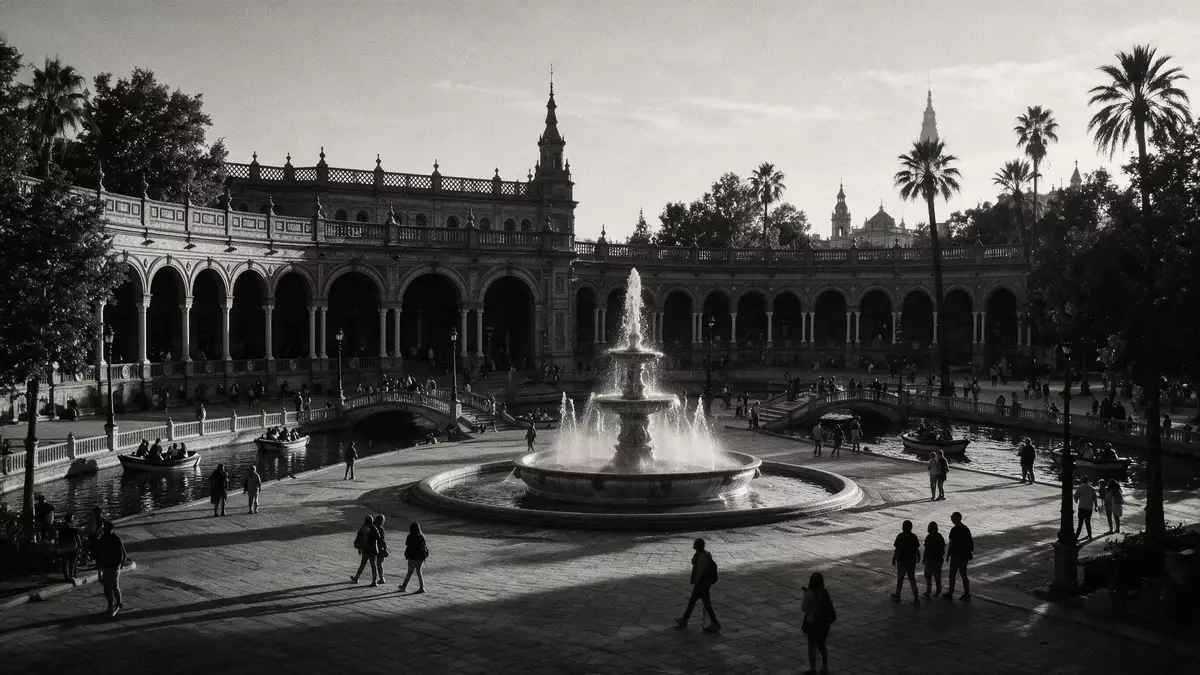
Plaza de Espana in Sevilla brings together a sweeping semi-circular brick building, a curving canal and a series of ceramic benches into one vast architectural stage. Set on the edge of Maria Luisa Park and designed by Aníbal González for the Ibero-American Exposition of 1929, it turns a ceremonial fairground site into a permanent celebration of Spanish regions and craft.
A semi-circular palace facing a canal
Seen from the park, Plaza de Espana reads as a great crescent of architecture embracing an open square, with water mirroring its curve at the base of the arc. The ensemble stands at the north-east side of Maria Luisa Park in Seville, occupying an area of around 50,000 square metres where the urban fabric meets landscaped gardens.The Plaza de España The half-ring of buildings is fronted by a broad paved space descending towards a canal that echoes the plan of the crescent and separates the main facade from the inner edge of the square.
Aníbal González, a Sevillian architect associated with Spanish Regionalist architecture, directed the project from 1914, and construction continued into the 1920s as Seville prepared for the Ibero-American Exposition of 1929.It was projected by Aníbal González The plaza’s plan is semicircular, with a tower at each end of the arc, creating a symmetrical composition whose extremities rise above the rest of the park and are visible from surrounding streets.Its floor plan is semicircular
Brick, tile and iron in Regionalist style
Plaza de Espana is a flagship of Spanish Regionalist architecture, a movement that blends references to earlier Spanish styles into new compositions. Here, Renaissance Revival and Baroque Revival motifs sit alongside Neo-Mudéjar flourishes drawn from historic Islamic-influenced architecture on the Iberian Peninsula, woven together into a single facade.Regionalism Architecture mixing styles Exposed brick forms the main body of the building, punctuated by stone-framed openings, projecting balconies and arcades running along the inner side facing the square.
Materials familiar from Seville’s craft traditions appear throughout the plaza. Ceramic tile from the Triana district, just across the river, clads parapets, balustrades and many wall surfaces, while wrought iron and carved stone add further texture.brick as the primary material, enlivened by marble and tile Along the upper levels, coffered ceilings, iron lamps and decorative cornices underline the plaza’s role as a showcase for regional craftsmanship as much as for architecture.
Ceramic geography: the provincial alcoves and bridges
At eye level along the inner base of the crescent, a remarkable sequence of tiled alcoves turns the architecture into a walkable map of Spain. Each recess is dedicated to one of the country’s provinces, with a bench and a ceramic composition that blends a map, heraldic motifs and scenes associated with that place.tiled alcoves and benches representing the provinces The series runs in geographical order, so crossing the square at this level becomes a tour through the country’s political geography expressed in glaze and relief.
Between the provincial alcoves and the canal, a set of low bridges carries the geometry of the crescent out over the water. Their balustrades and plinths are covered in the same kind of coloured ceramic as the benches, linking the bridges visually to the main facade behind.bridges with ceramic decoration From the central part of the square, the effect is of an almost continuous band of crafted surfaces, with the water cut into the middle like an ornamental moat that reflects towers, arcades and tiling.
Visiting Plaza de Espana: what travellers from Western Europe should know
- Plaza de Espana stands at the north-east edge of Maria Luisa Park in Sevilla, south of the historic centre; it is reached on foot from central districts or by city bus routes serving the park.
- The square itself is expansive and largely paved, with the ground rising gently from the canal up to the arcades, and staircases inside the crescent leading to upper galleries and viewpoints over the plaza.
- In summer heat the open paving can be exposed, while the arcaded walkways provide shaded routes along the inner side of the building above the provincial alcoves.
- Sevilla lies in Spain, where the official language is Spanish and the currency is the euro.
Searching for Plaza de Espana on social platforms
These links open searches for Plaza de Espana on each platform.Frequently asked questions about Plaza de Espana
Where is Plaza de Espana in Sevilla?
Plaza de Espana stands at the north-east end of Maria Luisa Park in Sevilla, on the southern side of the historic centre and close to the Guadalquivir River.
What can a visitor expect when visiting Plaza de Espana?
Visitors encounter a vast semi-circular brick building with towers, a curving canal, bridges with ceramic balustrades and a long sequence of tiled provincial alcoves along the inner facade.
What makes Plaza de Espana distinctive among Sevilla’s landmarks?
Its combination of Regionalist architecture, extensive Triana ceramic decoration and the way Spanish provinces are represented through tiled benches along a single sweeping crescent gives Plaza de Espana a character that is closely tied to geography and craft.


