Plain of Jars, an Iron Age stone landscape above Phonsavan
Published on 09/10/2026 at 18:23 | Editorial responsibility: Rafael Müller, Editor-in-Chief AD HOC NEWS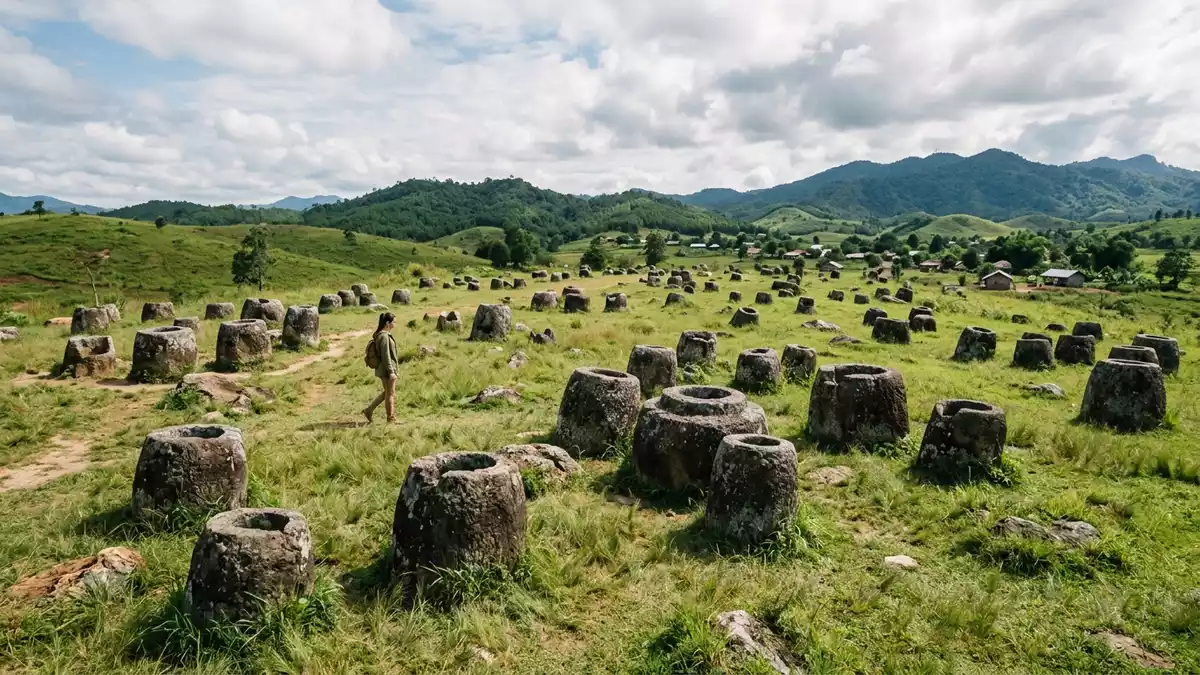
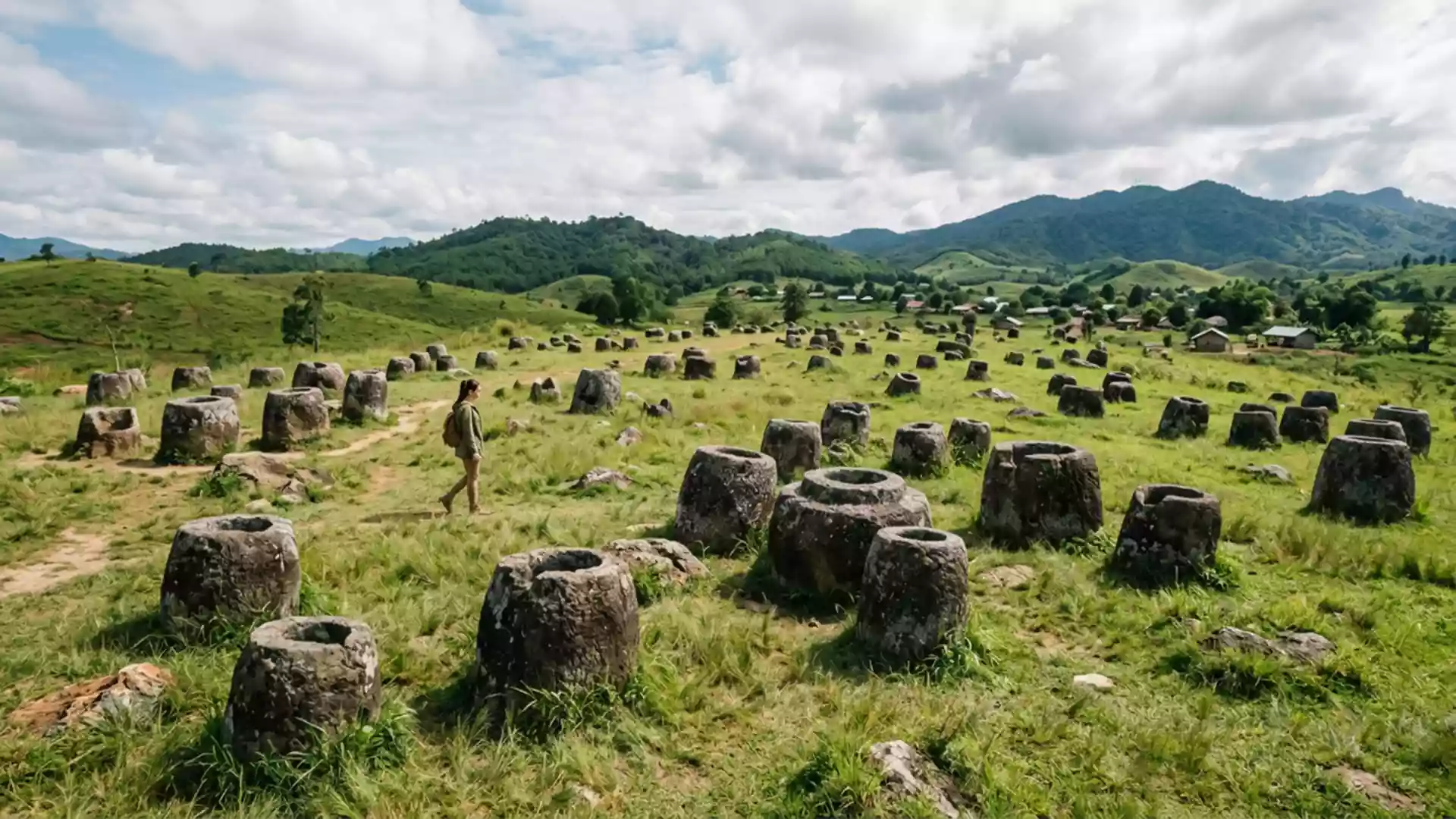
The Plain of Jars on the Xieng Khouang Plateau above Phonsavan in Laos is a broad upland landscape scattered with carved stone vessels from the Iron Age. Across grassy fields and low hills, clusters of jars stand where prehistoric communities shaped the plateau into a mortuary landscape that still resists simple explanation.
An open-air field of stone vessels
The Plain of Jars occupies parts of Xieng Khouang Province in northern Laos, with some of the best-known jar fields lying near the town of Phonsavan. The most investigated group of jars close to Phonsavan is widely referred to as Site 1, a field where large stone containers stand on sloping ground with views across the surrounding plateau.site near Phonsavan Beyond this single field, jar sites extend across upland plains, valleys and foothills, forming a serial landscape rather than one enclosed park.
The jars themselves are hewn from solid rock, mainly sandstone, though examples in materials such as granite and limestone also appear on the plateau.most are made of sandstone Their forms vary, but many rise several metres above the ground and weigh many tonnes, standing either alone or in dense groups with smaller jars clustered nearby.tubular-shaped megalithic stone jars On the Xieng Khouang Plateau more than 2,100 jars have been documented, a scale that turns the wider region into an outdoor archaeological site rather than a single monument.
Iron Age mortuary landscape and UNESCO recognition
Archaeological work places the principal phase of jar use in the Iron Age, broadly between about 500 BCE and 500 CE, linking the Plain of Jars with wider developments across mainland Southeast Asia in that period.dating to the early Iron Age Excavations around the jars have uncovered human remains, glass beads, iron tools and ceramics, as well as flat stone discs that appear to mark graves or seal certain vessels.burials and grave goods Together these finds indicate that the jars were not isolated objects but parts of a broader mortuary complex set into the plateau soil.
The working interpretation is that the jars formed one stage in a multi-phase burial process, with bodies placed inside the stone containers before bones were reburied nearby, tying the jars to the surrounding ground rather than treating them as stand-alone sculptures.funerary interpretations Fifteen components of this wider landscape, containing 1,325 large carved jars together with discs, quarries and other features, are inscribed on the World Heritage List as the Megalithic Jar Sites in Xiengkhuang – Plain of Jars.World Heritage inscription of 15 components For travellers, that inscription confirms both the archaeological significance of the site and its protected status within Laos.
Exploring jar sites around Phonsavan
Jar sites around Phonsavan occupy different kinds of terrain, from fairly open grassland to low hills with scattered trees, and approaches often cross uneven ground. The best-known trio of fields close to the town are commonly designated Site 1, Site 2 and Site 3, each with its own configuration of jars and associated features on the plateau.jar sites 1, 2 and 3 Paths between groups of jars typically follow the contours of the land, with gentle rises and dips that reflect the underlying hills rather than any formal layout.
Many of the accessible jar fields incorporate additional elements beyond the jars themselves, such as bomb craters from twentieth-century conflict, remnant trench lines and markers indicating areas cleared of unexploded ordnance.archaeological project on the plateau These later scars sit alongside Iron Age features, creating a layered landscape in which ancient stone vessels share space with more recent traces of war. Visits therefore combine an examination of prehistoric stonework with an awareness of more modern history in Xieng Khouang Province.
Visiting Plain of Jars: what travellers from Western Europe should know
- The Plain of Jars lies in Xieng Khouang Province in northern Laos, with the main accessible jar fields near Phonsavan, the provincial centre served by domestic flights and overland routes.
- Paths at the principal jar sites cross uneven grassland and low slopes, with sections of stone or earth steps and short stretches on packed soil that can be slippery in wet conditions.
- Some jar sites incorporate marked areas indicating clearance of unexploded ordnance, and visitors remain on established paths and within signed zones.
- The official language is Lao and the currency is the Lao kip.
- Entry requirements depend on your nationality; UK travellers can check the FCDO travel advice at gov.uk/foreign-travel-advice, Irish travellers the Department of Foreign Affairs at ireland.ie.
Searching for Plain of Jars on social platforms
These links open searches for Plain of Jars on each platform.
Frequently asked questions about Plain of Jars
Where is the Plain of Jars located?
The Plain of Jars lies on the Xieng Khouang Plateau in northern Laos, with many of its jar fields close to the town of Phonsavan.
What should visitors expect when exploring the jar sites?
Visitors encounter clusters of large carved stone jars across grassland and low hills, with uneven paths, steps and marked zones indicating safe areas among later war scars.
What makes the Plain of Jars distinctive among archaeological sites?
The site combines thousands of heavy stone jars from an Iron Age mortuary landscape with associated burials and discs, spread across a broad plateau rather than confined to a single enclosure.