
Parque Nacional Manuel Antonio’s rainforest meeting the Pacific
Published on 08/31/2026 at 18:46 | Editorial responsibility: Rafael Müller, Editor-in-Chief AD HOC NEWS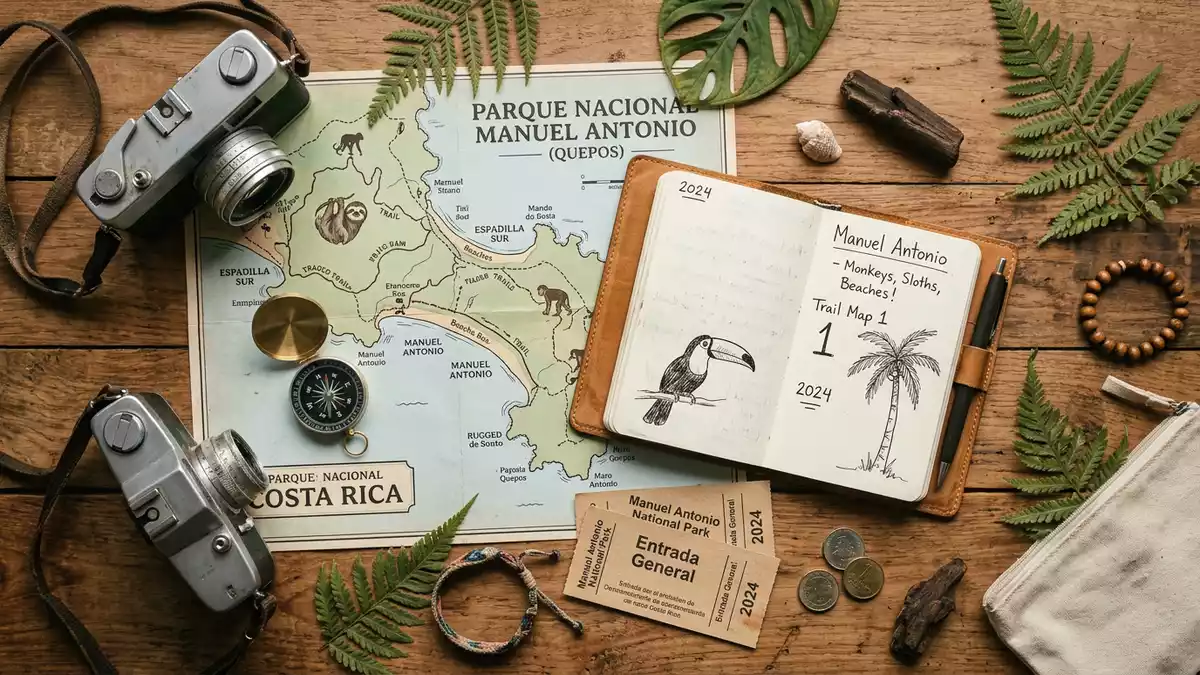
Parque Nacional Manuel Antonio on Costa Rica’s central Pacific coast is a compact national park where dense rainforest reaches down to pale sand and the Pacific Ocean. Created as a protected area in 1972, it lies just south of Quepos in Puntarenas province, bringing coastal forest, headlands and small offshore islands into one tightly framed landscape.Manuel Antonio National Park
Forest, shoreline and islands in a small park
Parque Nacional Manuel Antonio occupies a relatively small terrestrial area compared with many Costa Rican parks, yet its protected zone combines forested hills, coves and rocky points with a much larger stretch of marine environment.the park’s establishment in 1972 The land section forms a low peninsula with secondary ridges that drop towards beaches such as Playa Manuel Antonio and Playa Espadilla Sur, while the marine section covers waters around small islands and coastal reefs.the mix of terrestrial and marine hectares
Forest within Parque Nacional Manuel Antonio includes coastal rainforests and areas where trees frame the sand directly behind the shore. On Punta Catedral and similar headlands, paths rise through dense vegetation before emerging at viewpoints over the Pacific, with forest dropping steeply to cliffs and rocky inlets below.the protected headlands and coastline Offshore, small islands extend the park’s profile seaward, providing perches for seabirds and forming part of the wider conservation area on the central Pacific coast.
Trails, viewpoints and beaches
Inside Parque Nacional Manuel Antonio, a linked set of walking trails connects the main entrance with several beaches and viewpoints, making it possible to move between forest and shoreline on foot.the principal trails leading to Manuel Antonio Beach A main path runs from the entrance area towards Playa Manuel Antonio and Playa Espadilla Sur, with smaller branches leading towards lookouts over the sea and towards quiet sections of sand. Other named trails form loops around Punta Catedral or pass through mangrove zones, giving access to different habitats within the same compact park.Punta Catedral, mangrove and viewpoint trails
Several beaches lie entirely inside Parque Nacional Manuel Antonio’s boundaries, each with its own character. Playa Manuel Antonio is a sheltered stretch where forest backs the sand and paths arrive directly from the inland trail network. Playa Espadilla Sur lies nearby on the same side of the peninsula, giving a broader sweep of shore that contrasts with the more enclosed feel of Manuel Antonio’s bay.the principal beaches within the park Smaller coves such as Playa Gemelas are reached on narrower paths, where stretches of forest open suddenly to pockets of sand and rock facing the Pacific.
Wildlife and conservation on the Pacific coast
Parque Nacional Manuel Antonio forms part of Costa Rica’s Central Pacific Conservation Area, giving legal protection to coastal forest and marine habitats near Quepos.its status within the conservation system The park’s mixture of tree cover, mangroves and shoreline supports a wide range of animals, from monkeys moving through the canopy to sloths resting in branches along quieter trails. Birdlife includes species adapted to forest interiors as well as those associated with open coast and offshore rocks, and the marine section of the park protects waters used by fish, reptiles and seabirds.
Beyond individual species, the park represents a long-term attempt to conserve a dense pocket of biodiversity on a section of Costa Rica’s Pacific shoreline that has seen tourism grow around it.its role as a protected area near Quepos The declaration of Parque Nacional Manuel Antonio in the early 1970s placed both the land and adjoining marine area under protection, framing later visitor infrastructure around trails rather than roads within the core of the forest. As a result, moving through the park still involves walking under trees and between natural clearings, with built structures largely concentrated near the entrance and outside the boundary.
Visiting Parque Nacional Manuel Antonio: what travellers from Western Europe should know
- Parque Nacional Manuel Antonio lies on Costa Rica’s central Pacific coast just south of Quepos, reached on local roads including Route 618 that link the town with the park entrance.
The main entrance stands near the end of the Manuel Antonio village road. - Walking inside the park involves formed paths and boardwalks, some with gradients and steps, particularly on routes climbing towards Punta Catedral and other viewpoints above the sea.
- The surrounding area includes Quepos, the Manuel Antonio village and other sections of the Puntarenas coastline, with the park forming one of several protected areas along this stretch of Costa Rica.
- The official language is Spanish and the currency is the Costa Rican colón.
- Entry requirements depend on your nationality; UK travellers can check the FCDO travel advice at gov.uk/foreign-travel-advice, Irish travellers the Department of Foreign Affairs at ireland.ie.
Searching for Parque Nacional Manuel Antonio on social platforms
These links open searches for Parque Nacional Manuel Antonio on each platform.
Frequently asked questions about Parque Nacional Manuel Antonio
Where is Parque Nacional Manuel Antonio located?
Parque Nacional Manuel Antonio is on Costa Rica’s central Pacific coast in Puntarenas province, just south of Quepos and around 157 km from San José.
What can visitors expect inside the park?
Visitors encounter rainforest trails, mangrove sections, several beaches and viewpoints over the Pacific, with wildlife such as monkeys, sloths and coastal bird species present in the protected area.
What makes Parque Nacional Manuel Antonio distinctive among Costa Rican parks?
Its combination of compact size, mixed terrestrial and marine protection, easily reached beaches and forested headlands close to Quepos gives it a notably dense concentration of coastal habitats.


