
Parque del Retiro and Madrid’s royal garden in stone and glass
Published on 09/12/2026 at 17:11 | Editorial responsibility: Rafael Müller, Editor-in-Chief AD HOC NEWS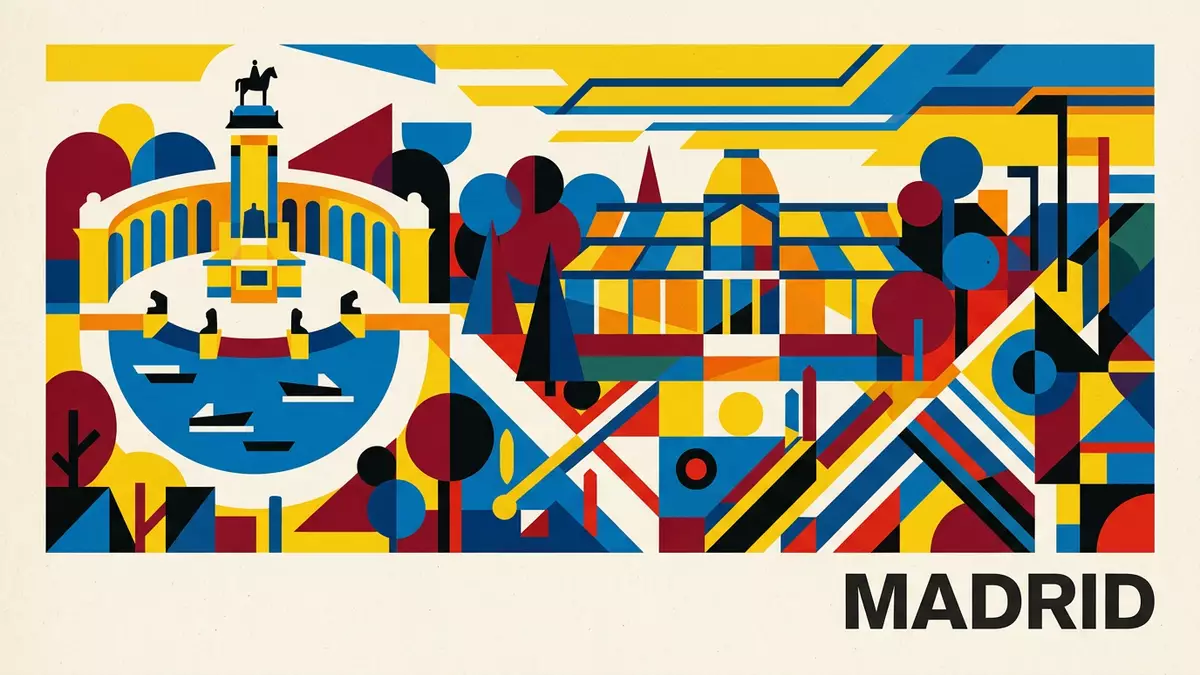
Parque del Retiro in Madrid is a broad urban park shaped by royal origins, later civic use and a series of distinct landmarks. Its mixture of formal monuments, tree-lined promenades and water gives the place a clear identity that still reads in layers.
From royal ground to civic park
The park began as part of the Buen Retiro estate under Philip IV and Gaspar de Guzmán, with a seventeenth-century court setting that later outlived its original function. Parque del Retiro forms part of the UNESCO World Heritage landscape of the Paseo del Prado and Buen Retiro, an acknowledgement of its role in Madrid’s historic centre.
Its tree cover, long avenues and large open spaces give it the scale of a city landscape rather than a simple garden. The park’s public character became established in the nineteenth century, and that shift remains visible in the way monuments, ponds and promenades sit together.
Glass, bronze and the great pond
The most striking built contrast in Parque del Retiro lies between the Palacio de Cristal and the heavier stone and bronze of the Monumento a Alfonso XII. The former, a late nineteenth-century iron-and-glass pavilion, stands among trees with a light, transparent frame. The latter rises beside the Estanque Grande with a long semicircular colonnade and an equestrian figure at the centre.
These two landmarks give the park much of its visual rhythm. One is enclosed and reflective, the other monumental and open, and both are tied to Madrid’s public memory without turning the park into a museum precinct.
Paths, roses and planted shade
Parque del Retiro also contains quieter formal spaces, including the Rose Garden and the broad planted walks around it. The rose beds add a tighter, geometric note to a park that elsewhere opens into lawns, basins and avenues. Mature trees dominate many stretches, giving the grounds a layered canopy rather than a single ornamental focus.
The park’s composition is part palace garden, part civic promenade and part exhibition ground. That combination explains why its architecture and planting feel varied while still belonging to one coherent urban place.
Visiting Parque del Retiro: what travellers from Western Europe should know
- The park lies in central Madrid, near the Paseo del Prado and the Jerónimos district. Retiro and Ibiza are the usual metro references for access.
- The grounds are level, but the monument to Alfonso XII includes steps and a raised upper section. The lake edge and the main promenades are easy to walk.
- The Crystal Palace stands in a wooded part of the park, with glass surfaces set among trees and lawns. The area around it feels more enclosed than the open space beside the Estanque Grande.
- The official language is Spanish and the currency is the euro.
- Entry requirements depend on your nationality; UK travellers can check the FCDO travel advice at gov.uk/foreign-travel-advice, Irish travellers the Department of Foreign Affairs at ireland.ie.
Searching for Parque del Retiro on social platforms
These links open searches for Parque del Retiro on each platform.
Frequently asked questions about Parque del Retiro
Where is Parque del Retiro?
Parque del Retiro sits in central Madrid, east of the Prado axis and close to the Jerónimos area. It is one of the city’s largest public green spaces.
What should a visit include?
The main elements are the tree-lined walks, the Estanque Grande, the Monumento a Alfonso XII and the Palacio de Cristal. Together they show the park’s mix of monument, garden and water.
What makes Parque del Retiro distinctive?
Its identity comes from the way royal, civic and artistic layers coexist in one park. The UNESCO listing, the glass pavilion and the lakeside monument make that mix easy to read.


