
Palenque and the carved heart of Maya Chiapas
Published on 09/09/2026 at 16:08 | Editorial responsibility: Rafael Müller, Editor-in-Chief AD HOC NEWS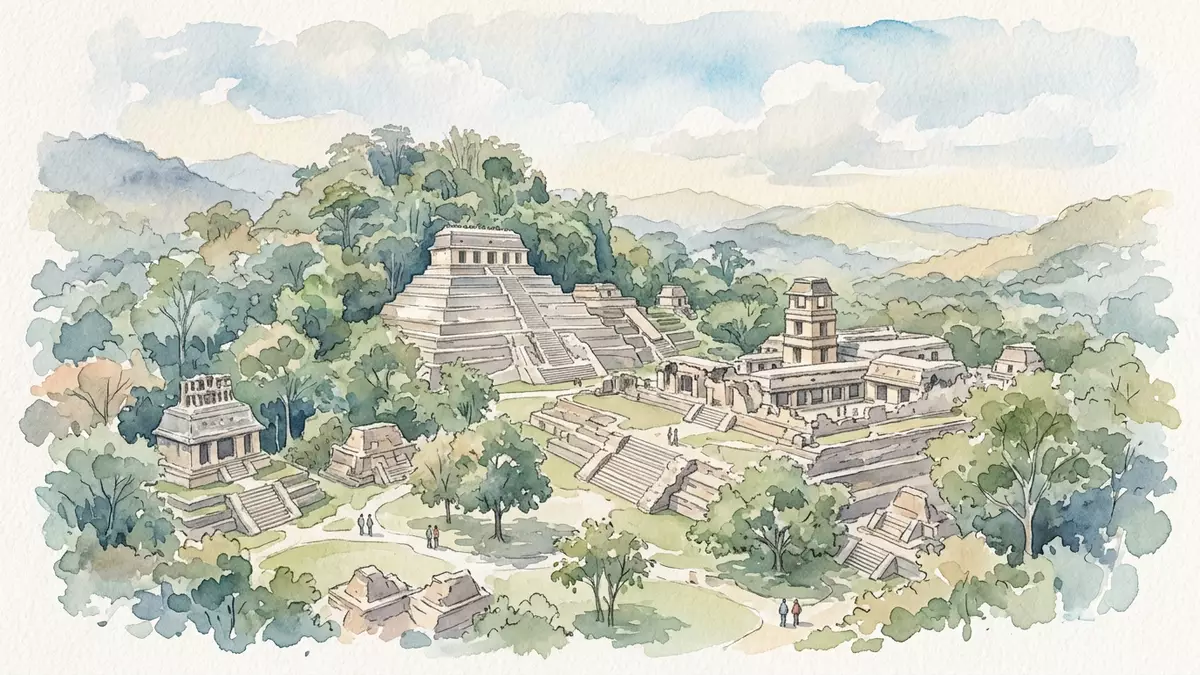
Palenque in Chiapas is a Classic-period Maya city whose stone buildings rise from dense forest and low hills. Its name belongs to a neighbouring settlement, while the ruins form a UNESCO World Heritage site recognised in 1987.
Palenque’s Classic-period stone setting
The site belongs to the Late Classic era, roughly the sixth to eighth centuries, when Palenque was a major Maya centre in the Usumacinta basin. Its architectural remains combine plastered surfaces, carved reliefs and vaulted rooms in a form that has long drawn close study.
The ancient city sits in Chiapas, in southern Mexico, near the Usumacinta River and south of Ciudad del Carmen. The broader protected property covers the archaeological zone and national park, which together form a cultural landscape rather than an isolated monument.
The Temple of the Inscriptions and royal memory
The Temple of the Inscriptions is the best-known structure at Palenque and a major reason the site is so closely associated with Maya dynastic history. It is a stepped pyramid with a temple above, and its inner walls carry long hieroglyphic texts.
That monument is linked to K’inich Janaab’ Pakal, known in English as Pakal the Great, and to the royal tomb found beneath it in 1952. The find fixed Palenque in the story of Maya rulership, writing and burial practice.
Architecture, reliefs and the Palenque style
Palenque is noted for its refined masonry, smooth plaster finishes and sculpted decoration. The palace complex includes galleries, vaulted corridors and interior spaces that belong to what scholars call the Palenque style.
Across the site, reliefs, tablets and stucco work provide the main visual language. The buildings do not rely on mass alone; they combine structure and ornament in a way that remains central to the site’s identity.
Visiting Palenque: what travellers from Western Europe should know
- The archaeological zone lies in Chiapas, close to the modern town of Palenque. Access is by road from the town, with the forested park and ruins forming a single destination.
- The terrain includes stone steps, steep pyramid sides and shaded paths through tropical vegetation. The ground around the monuments is uneven in places, and the site is spread across a broad area.
- The official language is Spanish and the currency is the Mexican peso.
- Entry requirements depend on your nationality; UK travellers can check the FCDO travel advice at gov.uk/foreign-travel-advice, Irish travellers the Department of Foreign Affairs at ireland.ie.
Searching for Palenque on social platforms
These links open searches for Palenque on each platform.
Frequently asked questions about Palenque
Where is Palenque?
Palenque is in Chiapas, in southern Mexico, near the town that shares its name. The archaeological zone lies near the Usumacinta basin.
What does a visit involve?
The site combines temples, a palace complex and forested paths across an uneven archaeological landscape. Stone steps and pyramid platforms are part of the visit.
What makes Palenque distinctive?
Palenque is distinguished by its carved reliefs, plastered masonry and the Temple of the Inscriptions. The monument is closely tied to Pakal the Great and to Maya dynastic history.


