
Palenque: a Maya city of stone and jungle
Published on 09/19/2026 at 18:45 | Editorial responsibility: Rafael Müller, Editor-in-Chief AD HOC NEWS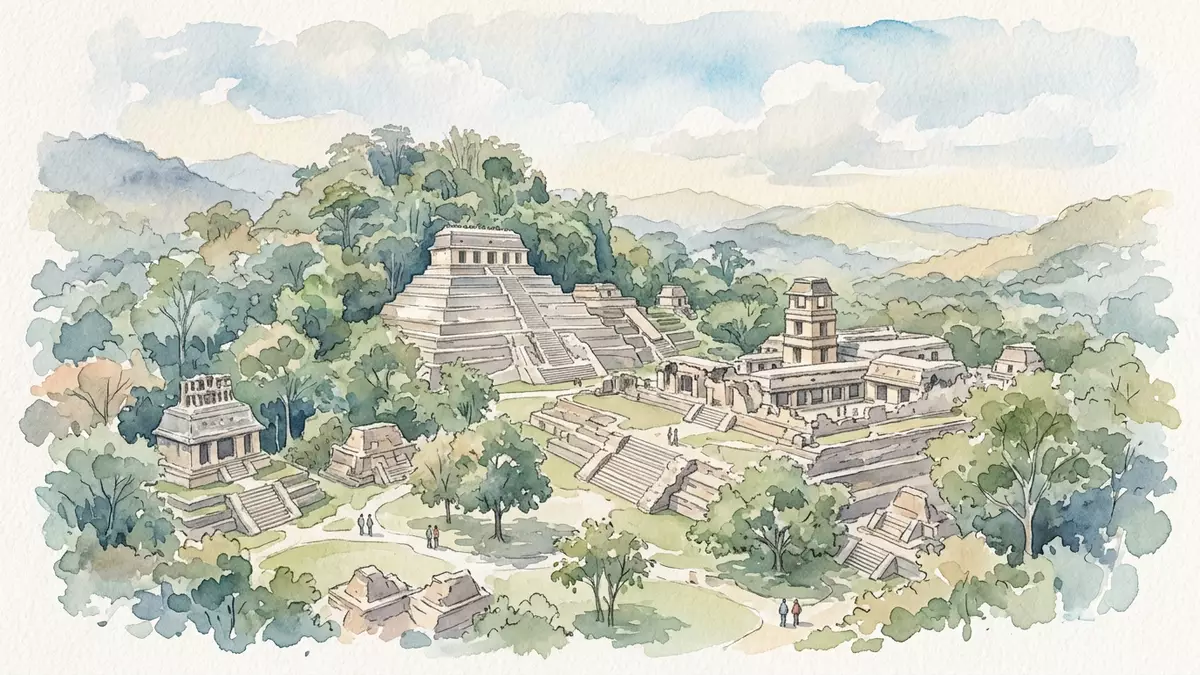
Palenque is an ancient Maya city in the Mexican state of Chiapas, where carved temples rise from dense tropical forest and waterways cut through a plateau of stone. Flourishing in the seventh century and abandoned by the ninth, it is renowned for refined architecture, hieroglyphic inscriptions and the striking contrast between monumental stone and jungle. The site is protected as the “Pre-Hispanic City and National Park of Palenque”, a UNESCO World Heritage property that links its ruins and surrounding forest into a single landscape.
A Classic-period Maya city in the Chiapas hills
Palenque lies in the foothills of the northern Chiapas mountain range, above the plains near the Usumacinta River in southern Mexico. The ruins stand a little above sea level on a limestone plateau cut by streams that form cascades and falls, a setting that matches the ancient Maya name Lakam Ha, “place of the great waters”.place of the great waters The accessible core of the site consists of temples, palaces and platforms arranged around plazas, backed by forested slopes where further structures remain partly covered.
Archaeological work places Palenque’s main occupation between about 200 and 900 CE, with its greatest flourishing in the seventh century under a line of powerful rulers.flourished between 600 and 750 CE The discovered area of the city covers several square kilometres, yet only a portion has been fully excavated and restored, leaving numerous buildings concealed beneath vegetation.only about 10% have been explored This combination of exposed monuments and hidden structures gives visits to Palenque a sense of both archaeological clarity and ongoing discovery.
Stone, stucco and inscription: architecture and art
The architecture at Palenque is built primarily in limestone, with temples and palatial ranges set on stepped platforms and crowned by roof structures that give the city its distinctive silhouette.ruined ancient Mayan city Many buildings preserve relief sculpture and stucco decoration, including figures of rulers and deities framed by elaborate borders. These surfaces once carried bright pigments, traces of which survive in sheltered places, hinting at the strong colours that once contrasted with the pale stone.
Among the most studied structures is the Temple of the Inscriptions, a stepped pyramid surmounted by a temple whose walls carry one of the longest known Maya hieroglyphic texts.one of the most famous monuments Constructed in the late seventh century as the funerary monument of the ruler K?inich Janaab? Pakal, it rises through eight levels to a temple that conceals an internal stairway descending to Pakal’s tomb.funerary monument for K?inich Janaab? Pakal The carved stone sarcophagus lid and surrounding inscriptions are key sources for understanding Palenque’s dynastic history and religious imagery.
Jungle, waterways and the national park
Palenque’s ruins stand within a national park that protects both the archaeological remains and the surrounding tropical forest. The protected area extends over more than 1,700 hectares, with numerous recorded structures and a wider zone of vegetation and wildlife.Pre-Hispanic City and National Park of Palenque The forest includes tall trees such as cedar and mahogany, lianas, understory plants and a range of fauna; the interplay of stone platforms and forest canopy shapes much of the site’s character.
Streams descend from the northern mountains through the park, creating terraces of water and a sequence of falls that pass close to the main groups of buildings.waterways empty over the plateau Paths link temple groups, palatial complexes and viewpoints where stonework appears framed by foliage. In many directions, visitors see excavated structures in the foreground and forested mounds beyond, indicating further platforms and walls beneath the trees.
Visiting Palenque: what travellers from Western Europe should know
- Palenque is in the northern part of Chiapas in southern Mexico, inland from the Gulf coast. The archaeological site lies a short distance from the modern town of Palenque, which serves as the main gateway.
- The terrain inside the site combines paved paths, grassy plazas and forest trails with stone stairways on temple platforms. Climbing some structures involves steep external staircases without handrails.
- The surrounding region is characterised by humid tropical forest and abundant surface water. During a visit, surfaces on shaded paths and steps can be damp, and tree cover limits direct sun in many areas.
- The official language is Spanish and the currency is the Mexican peso.
- Entry requirements depend on your nationality; UK travellers can check the FCDO travel advice at gov.uk/foreign-travel-advice, Irish travellers the Department of Foreign Affairs at ireland.ie.
Searching for Palenque on social platforms
These links open searches for Palenque on each platform.
Frequently asked questions about Palenque
Where is Palenque and what kind of place is it?
Palenque is an archaeological site of the ancient Maya in Chiapas, southern Mexico, set in tropical forest on the edge of the northern mountains.
What should visitors expect during a visit to Palenque?
Visitors encounter restored temples, palatial complexes and plazas connected by paths through forest, with stone stairways and uneven surfaces on many structures.
What makes Palenque distinctive among Maya sites?
Palenque is noted for harmonious architecture, sculpted stucco decoration and extensive inscriptions, all set within a protected national park of jungle and waterways.


