

Palenque: a Maya city in the Chiapas jungle
Published on 08/16/2026 at 13:24 | Editorial responsibility: Rafael Müller, Editor-in-Chief AD HOC NEWS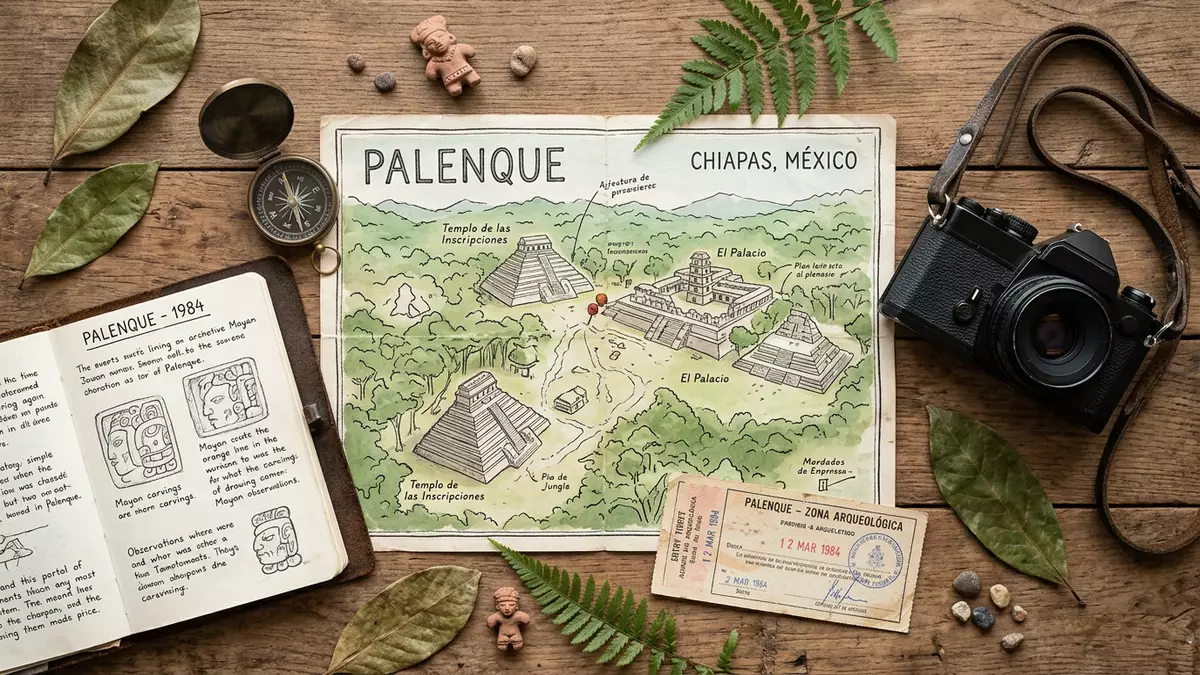
Palenque is an ancient Maya city-state in the Mexican state of Chiapas, where stone temples and palaces rise from jungle-covered hills at the edge of the Gulf coast plain. The ruins belong to the Pre-Hispanic City and National Park of Palenque, a UNESCO World Heritage Site inscribed in 1987 and known for its refined Classic-period architecture and sculpture.Pre-Hispanic City and National Park of Palenque
Stone architecture framed by rainforest
Palenque occupies a series of low limestone terraces on the northern slopes of the Chiapas highlands, overlooking the coastal plain that leads towards the Gulf of Mexico.northern mountain slopes of Chiapas The site sits near the Usumacinta River and lies adjacent to the modern town of Palenque, creating a striking encounter between a living Mexican municipality and a ruined Maya capital.adjacent to the modern town of Palenque Dense tropical vegetation surrounds the excavated core, so masonry platforms, stairways and roof combs emerge from greenery rather than from open desert.
The built zone recorded by archaeologists extends across more than 1,700 hectares, with hundreds of stone structures ranging from major temples to smaller platforms.1780 hectares and 1,400 buildings Only a fraction of these buildings have been cleared and explored, leaving long slopes and forest patches where unexcavated remains lie beneath the soil. The architecture uses cut limestone blocks and corbelled vaults, a typical Maya technique that creates interior spaces without arches or metal reinforcement. Roof combs and stairways give vertical emphasis to otherwise low, broad platforms.
Classic-period Maya history carved in stone
Palenque developed during the Maya Classic period and flourished particularly between about 500 and 700 CE, when its rulers controlled a territory linked to the Usumacinta basin.height between AD 500 and 700 Occupation at the site is dated from the Late Preclassic into the Early Postclassic, with the city abandoned by the late eighth century.Late Preclassic to Early Postclassic The ancient Maya name Bàak?, also rendered as Lakamha in another Maya language, points to the presence of water in the local landscape.Bàak? and Lakamha Today, the site shares its Spanish name with the neighbouring town.
The city is closely associated with K?inich Janaab? Pakal, often known in English as Pakal the Great, who ruled for much of the seventh century and whose tomb lies within the Temple of the Inscriptions.Pakal the Great Inscribed stone panels and stucco reliefs at Palenque record dynastic events, ritual scenes and mythological narratives, making the site an important archive of Maya history and cosmology.hieroglyphs and mythology Hieroglyphic texts in buildings such as the Temple of the Inscriptions and structures in the Cross Group have allowed epigraphers to reconstruct royal successions and alliances with other Classic-period centres.
Temples, palaces and elevated views
The most recognisable ensemble at Palenque is the group of civic and ceremonial buildings that includes the Temple of the Inscriptions, El Palacio and the Cross Group temples.civic and ceremonial stone buildings The Temple of the Inscriptions stands on a stepped pyramid platform with a temple at its summit, under which Pakal’s funerary chamber and carved sarcophagus were discovered.Temple of the Inscriptions El Palacio forms a sprawling complex of courtyards, corridors and rooms, notable for an elevated tower that rises above its roofs.
The Cross Group lies on a nearby terrace and consists of temples arranged around a platform, each bearing inscriptions and reliefs linked to Maya cosmology. From upper platforms and temple summits, visitors look across plazas, neighbouring structures and the surrounding canopy of the Lacandona jungle.surrounded by the Lacandona jungle The combination of masonry and forest gives the site a layered character, where built forms, tree trunks and distant ridges occupy the same visual field.
Visiting Palenque: what travellers from Western Europe should know
- Palenque lies in northern Chiapas in southern Mexico, close to the modern town of Palenque and southwest of Villahermosa in Tabasco. Long-distance buses and regional flights connect nearby urban centres with the town, and road access leads onward to the archaeological zone.Chiapas state, Mexico
- The archaeological site stands on uneven ground at around 150 m (490 ft) above sea level, with stairways, terraces and sloping paths linking the main complexes.150 meters above sea level Moving between temples and palaces involves climbing stone steps and crossing open plazas.
- The national park around Palenque includes forested areas, streams and smaller ruins beyond the central monumental core.archaeological site and national park Footpaths extend from the main structures towards less visited parts of the site.
- The official language is Spanish and the currency is the Mexican peso.
- Entry requirements depend on your nationality; UK travellers can check the FCDO travel advice at gov.uk/foreign-travel-advice, Irish travellers the Department of Foreign Affairs at ireland.ie.
Searching for Palenque on social platforms
These links open searches for Palenque on each platform.
Frequently asked questions about Palenque
Where is Palenque in Mexico?
Palenque lies in Chiapas in southern Mexico, close to the modern town of the same name and near the Usumacinta River on the edge of the Gulf coastal plain.near the Usumacinta River
What can visitors expect at the site?
Visitors encounter a compact monumental core of temples and palaces framed by forest, with stone stairways, plazas and platforms linking buildings such as the Temple of the Inscriptions, El Palacio and the Cross Group.group of ceremonial buildings
What makes Palenque distinctive among Maya ruins?
Palenque is recognised for its elegant Classic-period architecture, extensive hieroglyphic inscriptions and sculpted reliefs, as well as for the tomb of Pakal the Great in the Temple of the Inscriptions and its setting within a national park of jungle and streams.outstanding Maya site from the Classic Period


