
Palais Bahia in Marrakesch and its crafted courtyards
Published on 09/16/2026 at 07:07 | Editorial responsibility: Rafael Müller, Editor-in-Chief AD HOC NEWS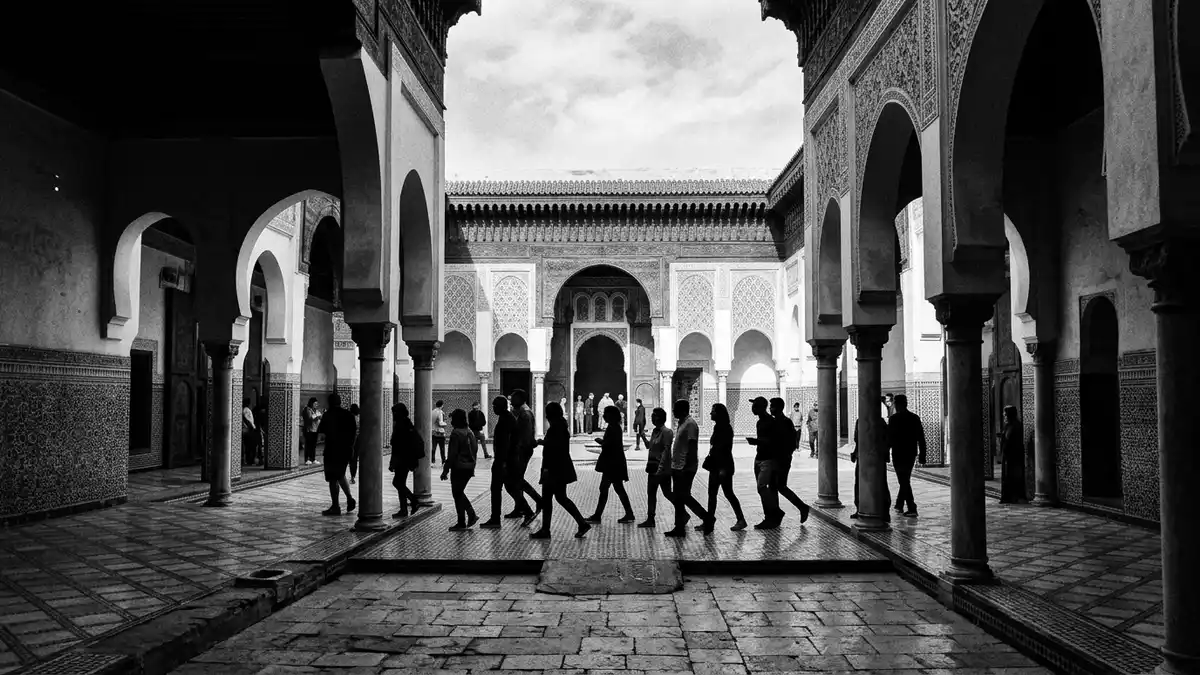
Palais Bahia in Marrakesch is a 19th?century palace complex where a sequence of courtyards, salons and gardens reveals late Moroccan craftsmanship at an urban scale. Built under Grand Vizier Si Moussa and expanded by his son Ba Ahmed in the final years of the nineteenth century, it gathers residence, power and everyday life into one sprawling ensemble in the medina.
Courtyards as the organising fabric of Palais Bahia
Palais Bahia is laid out as a series of enclosed courtyards, each with its own character, around which rooms and galleries are arranged. The complex occupies several hectares within the historic fabric south?east of Marrakesch’s main square, close to the old Mellah district, and its courtyards form the primary way the palace is experienced.located in the medina The courtyards range from intimate planted spaces framed by arcades to broader paved courts that lead towards ceremonially scaled halls.
The palace took shape between the mid and late nineteenth century, beginning under Si Moussa in the 1860s and reaching its largest form under Ba Ahmed around 1900.expanded from 1894 to 1900 Its name, “Bahia”, is linked to the Arabic idea of brilliance and beauty, and the palace became associated with the Alawi court in this period.nineteenth?century Moroccan architecture The courtyards tie the different residential and reception quarters together, forming a mosaic of spaces rather than a single grand hall.
Stucco, zellige and carved wood: the craft of the interiors
Inside Palais Bahia, the surfaces of walls, ceilings and floors are worked extensively with traditional Moroccan decorative techniques. Zellige tilework, composed of small geometric tiles set in complex patterns, runs across dadoes and floors in the main courtyards and reception rooms.zellige tile work and stucco Above the tiles, white and coloured stucco carving creates bands of calligraphy, arches and floral motifs. Ceilings in key salons are formed from painted and carved cedar wood, with layered geometric patterns picked out in strong colours.
The overall style of the palace belongs to the Moorish, or Islamic Moroccan, tradition associated with the Alawi dynasty, combining elements drawn from Andalusian and local urban house forms.architecture islamique / moresque Courtyards are edged by arcades on pillars, and rooms open from them with doors and windows framed by carved plaster and wood. The decorative programme was expanded during Ba Ahmed’s phase of building in the 1890s, when craftsmen from cities such as Fez were employed to work on the palace at length.craftsmen from Fez Together, stucco, tile and timber turn the palace into a sustained display of late nineteenth?century Moroccan craft.
From vizier’s residence to protected heritage site
Palais Bahia began as the residence of Si Moussa, a grand vizier at the Alawi court, and grew further under his son Ba Ahmed, who also held the role of grand vizier to Sultan Moulay Abdelaziz.linked to the Alawi court After Ba Ahmed’s death, the palace passed through different hands within the royal sphere. During the French Protectorate in Morocco, parts of Palais Bahia were used as an official residence by Resident?General Lyautey.French Protectorate residence Later in the twentieth century, the complex became a classified historic monument administered by Moroccan cultural authorities as a heritage site.
Today Palais Bahia functions both as a museum and as a place where official events can be hosted. It is recognised as one of the major monuments of nineteenth?century Moroccan architecture and one of the principal heritage sites in the country.major monument of Moroccan heritage Only part of its many rooms and hectares of grounds is accessible on a standard visit, yet the accessible courtyards and halls give a clear sense of how a large vizierial residence under the Alawi dynasty was arranged.portion of eight hectares and 150 rooms
Visiting Palais Bahia: what travellers from Western Europe should know
- Palais Bahia stands in the medina of Marrakesch, south?east of the main square and near the Mellah, and is reached on foot through the lanes around Rue Riad Zitoun el Jdid.
- The palace complex is largely level at courtyard scale, but some interior areas are reached by short staircases and passages with uneven stone paving.
- The official language is Arabic and the currency is the Moroccan dirham.
- Entry requirements depend on your nationality; UK travellers can check the FCDO travel advice at gov.uk/foreign-travel-advice, Irish travellers the Department of Foreign Affairs at ireland.ie.
Searching for Palais Bahia on social platforms
These links open searches for Palais Bahia on each platform.Frequently asked questions about Palais Bahia
Where is Palais Bahia in Marrakesch?
Palais Bahia lies in the southern part of the medina of Marrakesch, near the Mellah and along streets such as Rue Riad Zitoun el Jdid.
What can visitors expect inside Palais Bahia?
Visitors walk through successive courtyards and halls with extensive zellige tiles, carved stucco and painted cedar wood ceilings, giving a close view of Moroccan palace craftsmanship.
What makes Palais Bahia distinctive among Moroccan palaces?
Its late nineteenth?century courtyards, tied to the residences of Si Moussa and Ba Ahmed under the Alawi dynasty, combine large?scale layout with exceptionally detailed decorative work.


