
Palais Bahia and the layered courtyards of Marrakesch
Published on 08/28/2026 at 20:01 | Editorial responsibility: Rafael Müller, Editor-in-Chief AD HOC NEWS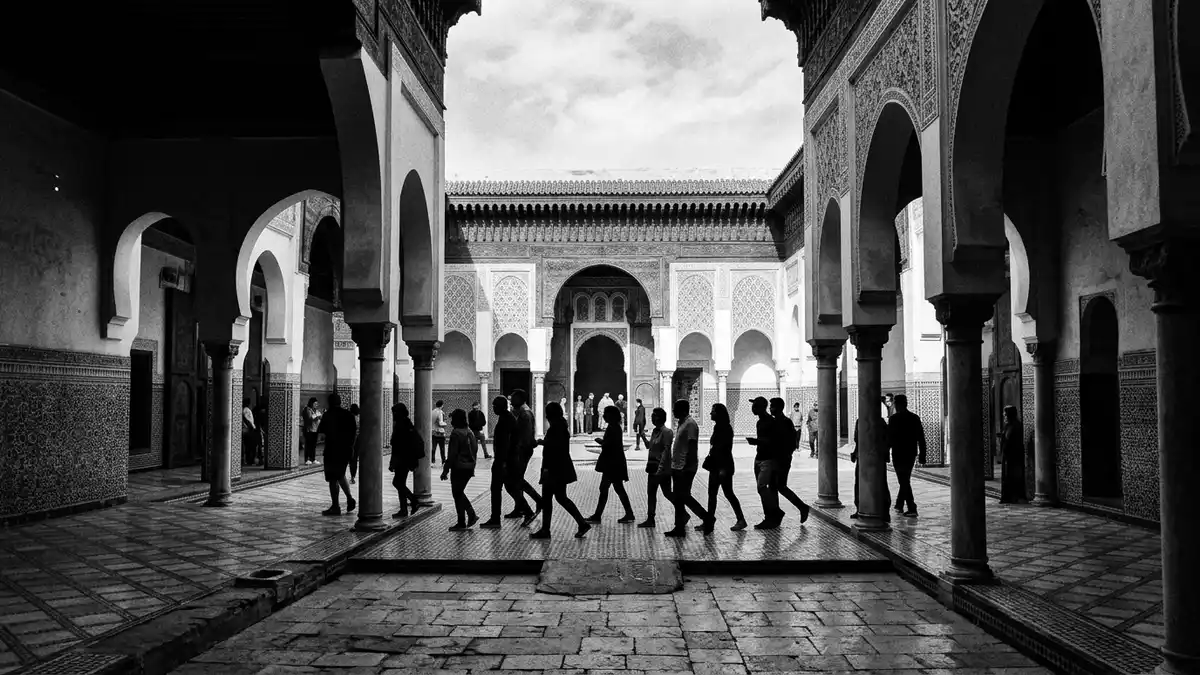
Palais Bahia in Marrakesch is a late nineteenth-century palace of courtyards, riads and richly worked interiors. It grew under Si Moussa and his son Ba Ahmed, both linked to the Alawi court, and it remains tied to that political world.
Palais Bahia and its courtly foundations
The palace began in the 1860s under Si Moussa, grand vizier to Sultan Muhammad ibn Abd al-Rahman. Its later expansion under Ba Ahmed, grand vizier to Sultan Moulay Abdelaziz, carried the complex to 1900. The name Bahia is linked to Ba Ahmed’s favourite wife, and the palace is part of Marrakesch’s historic medina.
That sequence gives Palais Bahia a clear historical frame: a court residence shaped across decades of rule, patronage and enlargement. Its visible richness still reads through the spaces themselves, from formal courtyards to private chambers and gardens. The palace is a strong example of Moroccan palace architecture under the Alawi dynasty, with the Alawi court at its centre.
Courtyards, riads and decorated rooms
The layout is a chain of inner courtyards and riad gardens, with rooms arranged around them. The Grand Riad is the oldest part, while later additions include the Grand Courtyard and the halls to its sides. The palace is also known for carved stucco, zellij tilework and painted cedar ceilings.
Those materials give the complex its particular surface language. Marble paving appears in the larger courts, while cedar wood, plaster and ceramic tile recur in the rooms and galleries. The blend of Moroccan craft traditions is one of the palace’s defining features, and painted cedar ceilings remain among the most recognisable elements.
From the Grand Riad to the Grand Courtyard
The older northern sector is centred on the Grand Riad, with adjoining rooms that belong to Si Moussa’s phase. Further south and east, Ba Ahmed’s expansion produced more public-looking spaces and a grand hall that completes the sequence. The palace’s plan is irregular rather than symmetrical, which reflects its growth in stages.
That irregularity is visible in the way one court opens into another. The visitor moves from one defined space to the next, with galleries, doors and side rooms creating a layered composition rather than a single vast hall. The result is a palace that reads as a built accumulation, and the Grand Courtyard is the clearest large-scale expression of that sequence.
Visiting Palais Bahia: what travellers from Western Europe should know
- Palais Bahia stands in Marrakesch’s medina, south-east of the historic centre. It is reached on foot through the old city streets, and the palace sits near other major monuments of the district.
- The complex is spread across courtyards, galleries and chambers, so the ground plan changes as you move through it. Some parts are open-air riads, while others are enclosed rooms with decorated ceilings and walls.
- Stone, marble and tiled paving recur underfoot. The larger courts and the older garden spaces present different surfaces and scales within the same complex.
- The official language is Arabic and the currency is the Moroccan dirham.
Searching for Palais Bahia on social platforms
These links open searches for Palais Bahia on each platform.
Frequently asked questions about Palais Bahia
Where is Palais Bahia?
Palais Bahia is in Marrakesch, inside the medina and south-east of the historic core. It sits within the old urban fabric rather than on a separate parkland site.
What can be expected inside?
Expect a sequence of courtyards, riad gardens and decorated rooms. Marble, zellij and cedar wood appear throughout the palace.
What makes it distinctive?
Its distinction lies in the layered growth of the palace and the craftsmanship of its surfaces. The Grand Riad, the Grand Courtyard and the painted woodwork give it a clear visual identity.


