
Palacio Real de Madrid: stone grandeur on Madrid’s western ridge
Published on 09/16/2026 at 15:27 | Editorial responsibility: Rafael Müller, Editor-in-Chief AD HOC NEWS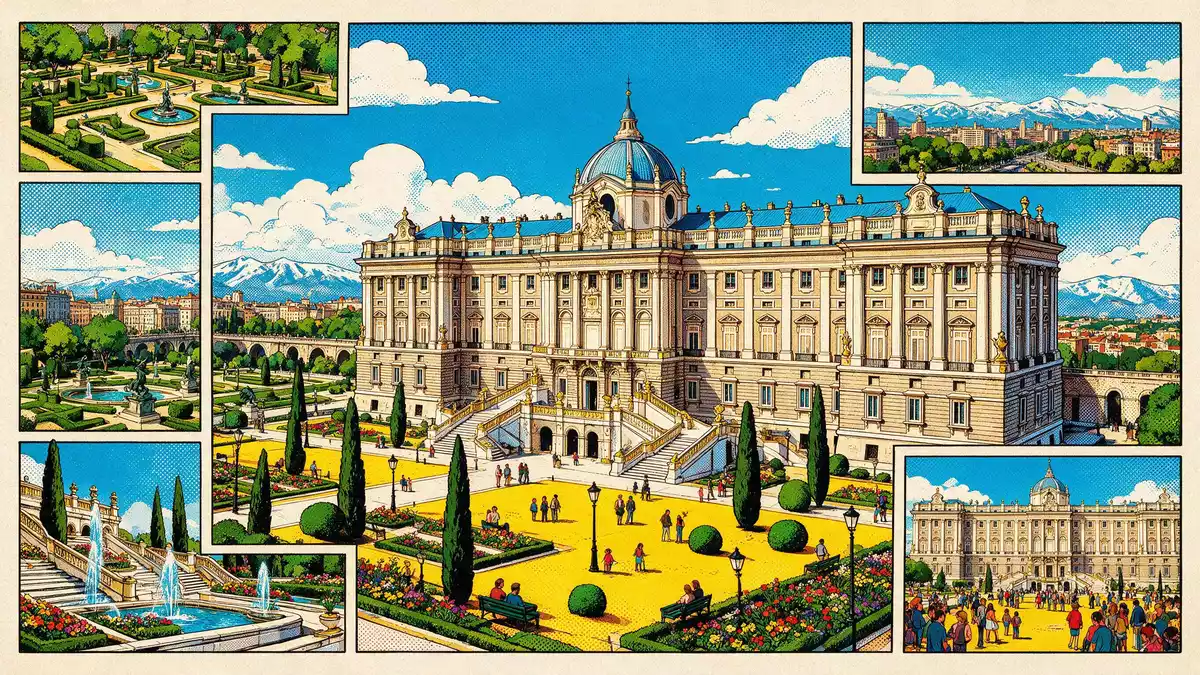
Palacio Real de Madrid stretches across the western edge of Madrid on a high ridge above the Manzanares valley, a vast stone rectangle built for Spain’s Bourbon court in the eighteenth century. Rising on the former site of the Alcázar of Madrid, it became the principal royal residence under Carlos III in 1764 and still serves as the Spanish monarchy’s main ceremonial palace.principal royal residence
A palace shaped by Bourbon ambition and Italian design
The current Palacio Real de Madrid was commissioned by Philip V, the first Bourbon king of Spain, after a devastating fire destroyed the Habsburg Alcázar in 1734.fire destroyed the Habsburg Alcázar Construction began in 1738 and the main structure was completed in 1764, creating an immense stone palace aligned with the crest of the hill above the old town.completed in 1764
Italian architect Filippo Juvarra prepared the original baroque design, later adapted and executed on site by Giovanni Battista Sacchetti and further developed by Francesco Sabatini and Ventura Rodríguez.Giovanni Battista Sacchetti The resulting palace combines baroque massing with classical order, its long façades organised into horizontal storeys and vertical bays that read clearly even at a distance.baroque and classical
Stone, courtyards and ceremonial rooms on the city’s edge
Palacio Real de Madrid is built largely from pale limestone resting on a granite base, giving the façades a layered effect: a darker plinth below and lighter walls above.limestone on granite The plan forms a broad quadrangle wrapped around courtyards, with formal fronts facing Plaza de la Armería to the east and the gardens to the north.quadrangle wrapped around courtyards
The interior contains an extensive sequence of state rooms, including the Throne Room, royal chapel and galleries that display tapestries, paintings and court furnishings from the Habsburg and Bourbon periods.state rooms and chapel One wing houses the Real Armería, the royal armoury, where historic arms and armour from different reigns are arranged as part of the palace collections.Real Armería
From moorish fortress to eighteenth-century city palace
The site of Palacio Real de Madrid has served rulers for many centuries. A fortress attributed to the ninth-century Emir Muhammad I of Córdoba once stood on this promontory, guarding approaches to central Spain.fortress attributed to Muhammad I After Christian control was established, the complex evolved into the Alcázar of Madrid, which became a principal residence of the Spanish Habsburg monarchs in the sixteenth century.principal residence of the Habsburgs
Following completion of the new palace in 1764, Carlos III established Palacio Real de Madrid as the main royal residence in the city, though later monarchs such as Alfonso XIII eventually moved their daily household to palaces elsewhere while retaining this building for major state occasions.Carlos III established it as residence The palace’s evolution from fortress to Alcázar to eighteenth-century stone complex is visible in its setting on the city’s edge, above the river valley and aligned with historic streets that still lead towards its gates.evolution from fortress to palace
Visiting Palacio Real de Madrid: what travellers from Western Europe should know
- Palacio Real de Madrid stands in central Madrid west of Plaza Mayor, with approaches from Calle de Bailén and Plaza de Oriente making it reachable on foot from many city neighbourhoods.
- The palace complex occupies a raised terrace above the Manzanares valley, and visiting its exterior areas involves broad paved spaces and some stairways and ramps between the square and the gardens.
- The official language in Spain is Spanish and the currency is the euro.
Searching for Palacio Real de Madrid on social platforms
These links open searches for Palacio Real de Madrid on each platform.
Frequently asked questions about Palacio Real de Madrid
Where is Palacio Real de Madrid located in the city?
Palacio Real de Madrid stands on a high terrace west of Madrid’s historic centre, between Plaza de Oriente and the green slopes descending towards the Manzanares valley.
What should visitors expect inside Palacio Real de Madrid?
Visitors encounter long façades leading into courtyards and a sequence of ceremonial rooms, including the Throne Room, chapel and galleries containing artworks, tapestries and royal furnishings.
What makes Palacio Real de Madrid distinctive among European palaces?
Its combination of eighteenth-century baroque and classical architecture in pale stone, its position on Madrid’s western ridge and its continuous role as Spain’s principal ceremonial palace give it a distinctive character.


