
Palacio Real de Madrid: stone grandeur above the Manzanares
Published on 08/30/2026 at 14:11 | Editorial responsibility: Rafael Müller, Editor-in-Chief AD HOC NEWS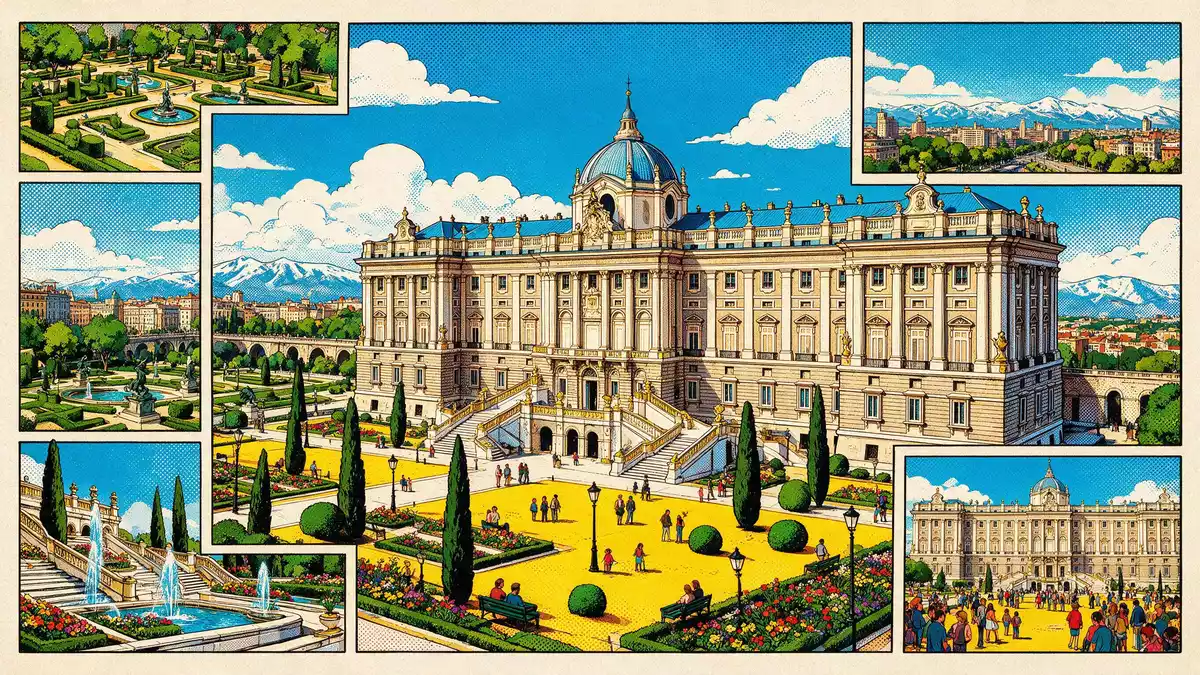
Palacio Real de Madrid crowns the western edge of Madrid on a high plateau above the Manzanares valley, a vast royal residence in stone that grew from a medieval fortress into a Bourbon palace completed in 1764. The site carries more than eight centuries of courtly and defensive history, from a ninth-century Islamic stronghold to the Baroque and Classical mass of the palace built for Philip V.
From fortress ridge to Bourbon residence
The ridge where Palacio Real de Madrid stands was first occupied in the ninth century by an Islamic fortress attributed to Muhammad I, Emir of Córdoba, guarding approaches towards Toledo and the river valley below.ninth-century Islamic fortress After Christian forces took Madrid in the eleventh century, Castilian kings retained and expanded this stronghold, which evolved into the Antiguo Alcázar, or Old Castle, by the sixteenth century.Antiguo Alcázar
On 24 December 1734 a devastating fire destroyed the Alcázar, clearing the hilltop for a new project commissioned by Philip V, the first Bourbon king of Spain, who ordered a palace in masonry rather than timber to reduce the risk of future fires.fire of 1734 Construction began in the late 1730s following grand Baroque plans initially drafted by Italian architect Filippo Juvarra and later adapted by Giovanni Battista Sacchetti and other court architects, with the complex finally ready for occupation by Charles III in 1764.occupation by Charles III in 1764
Baroque massing and Classical order
The palace presents a regular, rectangular plan built in pale limestone and tougher granite, giving the façades a two-tone character against Madrid’s sky and the drop towards the river.limestone and granite façades The main elevations are organised with Baroque massing – a large, block-like volume – overlaid by Classical elements such as pilasters, cornices and rhythmically spaced windows, giving the immense structure a legible order rather than exuberant ornament.
Inside, state apartments and ceremonial halls are arranged along formal axes and courtyards, with interiors lined in marble, stucco and gilded wood that reflect successive eighteenth- and nineteenth-century campaigns of decoration under monarchs such as Charles III, Charles IV, Ferdinand VII and Alfonso XII.marble, stucco and gilded wood The building’s sheer scale and stone construction set it apart from many earlier European royal residences that relied more heavily on timber, emphasising permanence on the exposed ridge above the Manzanares.
Gardens, plaza and urban setting
Palacio Real de Madrid forms part of a wider ensemble that includes Plaza de la Armería to the south, opening towards the Almudena Cathedral, and the formal Sabatini Gardens on the northern side, named for architect Francesco Sabatini who worked on later additions to the complex.Sabatini Gardens to the north Terraced garden layouts step down towards the valley, giving clear views of the palace’s façades and the surrounding landscape.
The palace stands in central Madrid at Calle de Bailén, within walking distance of older Habsburg-era streets and the city’s historic centre.Calle de Bailén address Although the Spanish royal family no longer resides there on a daily basis, the building continues to serve as a ceremonial venue for state receptions and official occasions, reinforcing its role as an emblem of Spanish monarchy and architecture rather than a private home.
Visiting Palacio Real de Madrid: what travellers from Western Europe should know
- The palace stands on Madrid’s western ridge above the Manzanares valley, close to the Almudena Cathedral and Plaza de España, and is reached on foot from central districts.
- The complex includes extensive stone-paved courtyards and garden terraces with level changes; moving between plaza, interior and gardens involves stairways and sloping paths.
- The official language is Spanish and the currency is the euro.
Searching for Palacio Real de Madrid on social platforms
These links open searches for Palacio Real de Madrid on each platform.Frequently asked questions about Palacio Real de Madrid
Where is Palacio Real de Madrid located within the city?
Palacio Real de Madrid stands on Calle de Bailén on Madrid’s western edge, near the Almudena Cathedral and the historic centre around Plaza Mayor.
What can visitors expect inside Palacio Real de Madrid?
Visitors encounter formal state apartments and ceremonial halls arranged around courtyards, with interiors finished in marble, stucco and gilded wood from various royal periods.
What makes Palacio Real de Madrid distinctive among European palaces?
Its combination of Baroque massing and Classical order, full stone construction after the 1734 fire and prominent position above the Manzanares valley give the palace a characteristic profile.


