
Palacio Real de Madrid and its stone crown above the city
Published on 09/15/2026 at 10:47 | Editorial responsibility: Rafael Müller, Editor-in-Chief AD HOC NEWS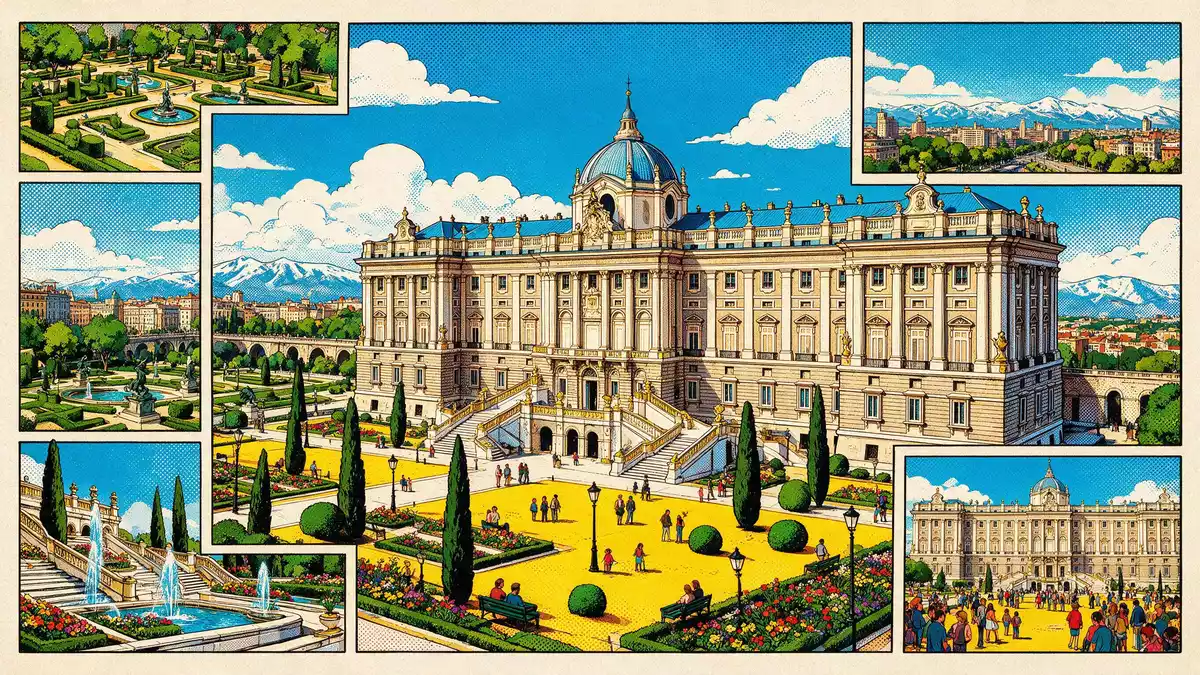
Palacio Real de Madrid is the great royal palace above Madrid’s western edge, a vast rectangle of stone and brick shaped in the eighteenth century for the Bourbon dynasty and still dominating the city’s skyline.
A palace born from fire and dynasty
The site of Palacio Real de Madrid carries royal history back to a defensive fortress raised in the Islamic period, later transformed into the Alcázar of Madrid under the Christian kings of Castile.fortress built by Mohammed I That earlier residence burned in a devastating fire in 1734 during the reign of the first Bourbon king of Spain, Philip V, clearing the ridge for a new vision of monarchy.fire on 24 December 1734
Philip V ordered a new palace on the same ground, with design work begun by the Italian architect Filippo Juvarra and developed on site by Giovanni Battista Sacchetti, creating a residence that drew on Baroque and Classical traditions of court architecture.plans influenced by Versailles and Italian baroque Building started in the late 1730s and the main structure was completed in the mid eighteenth century, with Charles III establishing the palace as his residence from 1764.Carlos III moved into the palace in 1764
Stone, scale and layout on Madrid’s ridge
The most striking feature of Palacio Real de Madrid is its sheer scale: a massive quadrangular building arranged around courtyards, with façades in pale limestone and darker granite rising above the slope towards the Manzanares valley.made of limestone and granite The decision to build in stone and brick produced a residence that is both monumental and robust, echoing the form of a citadel while housing ceremonial rooms rather than fortifications.made entirely of stone and brick rather than wood
Inside, the palace contains hundreds of rooms arranged in sequences of salons, galleries and chambers, with interiors finished in marble, stucco, gilded wood and rich fabrics.interiors of marble, stucco and gilded wood The north side opens towards formal gardens named for the architect Francesco Sabatini, and the east looks across a large paved square to the Almudena Cathedral, placing the palace in a clear ensemble of royal and religious architecture on Madrid’s high ground.gardens named in his honour
From royal residence to ceremonial landmark
Palacio Real de Madrid served as the principal residence of Spanish monarchs from the reign of Charles III through to Alfonso XIII in the early twentieth century, housing generations of the Bourbon dynasty within its stone walls.home of Spain’s monarchs until 1931 In the twentieth century the royal family moved to another residence elsewhere in Madrid, while the palace took on a role as the official site for major state ceremonies, receptions and formal audiences.a premier state venue
The building’s ceremonial function is reflected in its grand staircases, throne room, armoury and royal chapel, all arranged to support processions and formal gatherings rather than everyday domestic life. Its position above the western side of Madrid means that visitors encounter not only interiors but also wide views over the river valley and the city’s newer districts beyond the ridge.occupies the site of Mayrit on the ridge
Visiting Palacio Real de Madrid: what travellers from Western Europe should know
- Palacio Real de Madrid stands on the western side of central Madrid, near Plaza de Oriente and alongside the Almudena Cathedral, reached easily by the city’s metro and bus network.
- The approach to the main entrances involves broad exterior stairways and large paved squares, and movement inside the palace follows long corridors and wide flights of stairs.
- The palace grounds adjoin formal gardens on the northern side, so a visit combines interior rooms with outdoor terraces overlooking the Manzanares valley.
- Madrid is in Spain, where the official language is Spanish and the currency is the euro.
Searching for Palacio Real de Madrid on social platforms
These links open searches for Palacio Real de Madrid on each platform.
Frequently asked questions about Palacio Real de Madrid
Where is Palacio Real de Madrid located within the city?
Palacio Real de Madrid stands on the western side of central Madrid above the Manzanares valley, close to Plaza de Oriente and the Almudena Cathedral.
What should visitors expect during a visit?
Visitors encounter grand ceremonial rooms, formal staircases and extensive paved squares outside, together with views towards the river valley and nearby gardens.
What makes Palacio Real de Madrid distinctive among European palaces?
Its combination of eighteenth-century Bourbon architecture, limestone and granite construction, and its commanding position on Madrid’s ridge gives the palace a distinctive presence.


