
Palacio Real de Madrid and its stone ceremonial front
Published on 09/04/2026 at 22:02 | Editorial responsibility: Rafael Müller, Editor-in-Chief AD HOC NEWS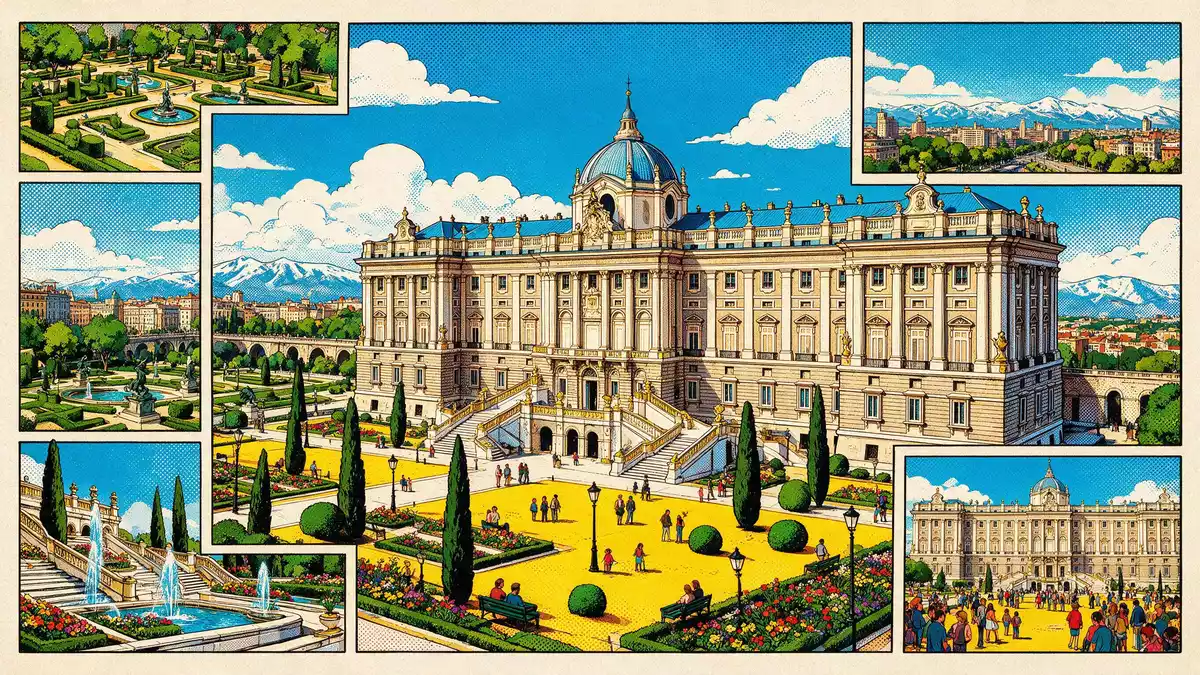
Palacio Real de Madrid rises as a stone ceremony of granite, limestone and courtly rooms in central Madrid. Built for Philip V after the old Alcázar burned in 1734, it keeps the palace’s Bourbon identity visible in its scale and planning.
Granite, limestone and Bourbon ambition
The palace takes its place in Madrid as a royal building with a clear Baroque outline and a classical discipline. Its exterior combines heavy masonry with measured order, and the result is formal without being severe. Baroque ambition appears in the mass of the building, while the materials keep it rooted in the city rather than floating above it.
Filippo Juvarra is the name most closely tied to the palace’s first great design phase, and Giovanni Battista Sacchetti completed the work after Juvarra’s death. Construction began in 1738 and the building was later adapted by Francesco Sabatini, whose name belongs to the palace’s long architectural story. Filippo Juvarra and Giovanni Battista Sacchetti both belong to the palace’s core identity, along with the eighteenth century that shaped it.
Rooms of ceremony and state
Inside, Palacio Real de Madrid is organised around state rooms, galleries and ceremonial sequences. The Grand Staircase, Throne Room, Hall of Columns and Royal Chapel give the palace its public rhythm, while the Royal Armory and the library extend that range into collections and scholarship. The room sequence is one of the building’s strongest features because it keeps use and display in the same frame.
The interiors carry a strong mix of decorative languages: rococo, neoclassical and earlier court styles appear side by side. Paintings by Goya, Velázquez, Tiepolo and Mengs anchor the rooms in Spanish and wider European court culture. Goya and Velázquez sit within that wider artistic range, and the palace’s collections add armour, porcelain, furniture and clocks to the picture.
A palace used for state and display
Palacio Real de Madrid remains associated with state ceremony, and that role shapes the way the building reads as a whole. It is a ceremonial residence rather than a domestic home, and that distinction is clear in its ordered rooms, formal stairways and large public interiors. The building’s scale and decor keep attention on presentation, rank and sequence.
The palace also preserves the material culture of the Spanish court: textiles, silver, armour, clocks and musical instruments all contribute to that atmosphere. The Stradivarius instruments and the Royal Armory are among the best-known parts of the collections, and they give the palace a second identity as a place of display and conservation. The ceremonial residence remains the key idea that ties the building together.
Visiting Palacio Real de Madrid: what travellers from Western Europe should know
- The palace stands on Calle de Bailén in Madrid, close to Ópera metro station and the western side of the city centre.
- The approach involves large forecourts and long formal spaces rather than a compact street frontage.
- The official language is Spanish and the currency is the euro.
- The palace is linked with the Sabatini Gardens, Plaza de Oriente and the Almudena Cathedral.
Searching for Palacio Real de Madrid on social platforms
These links open searches for Palacio Real de Madrid on each platform.
Frequently asked questions about Palacio Real de Madrid
Where is Palacio Real de Madrid?
It stands on Calle de Bailén in central Madrid, near Ópera station and the cathedral district. Its setting includes the Plaza de la Armería and the gardens beside the palace.
What does a visit involve?
The visit centres on state rooms, staircases and collections rather than a single hall. The palace’s rooms present a formal sequence of decoration, armour, art and courtly objects.
What makes it distinctive?
Its combination of Bourbon history, Juvarra’s initial design, Sacchetti’s completion and Sabatini’s later work gives the building a layered identity. Granite, limestone and ceremonial interiors keep that history visible.


