
Palacio Real de Madrid and its stone-built royal scale
Published on 09/23/2026 at 17:41 | Editorial responsibility: Rafael Müller, Editor-in-Chief AD HOC NEWS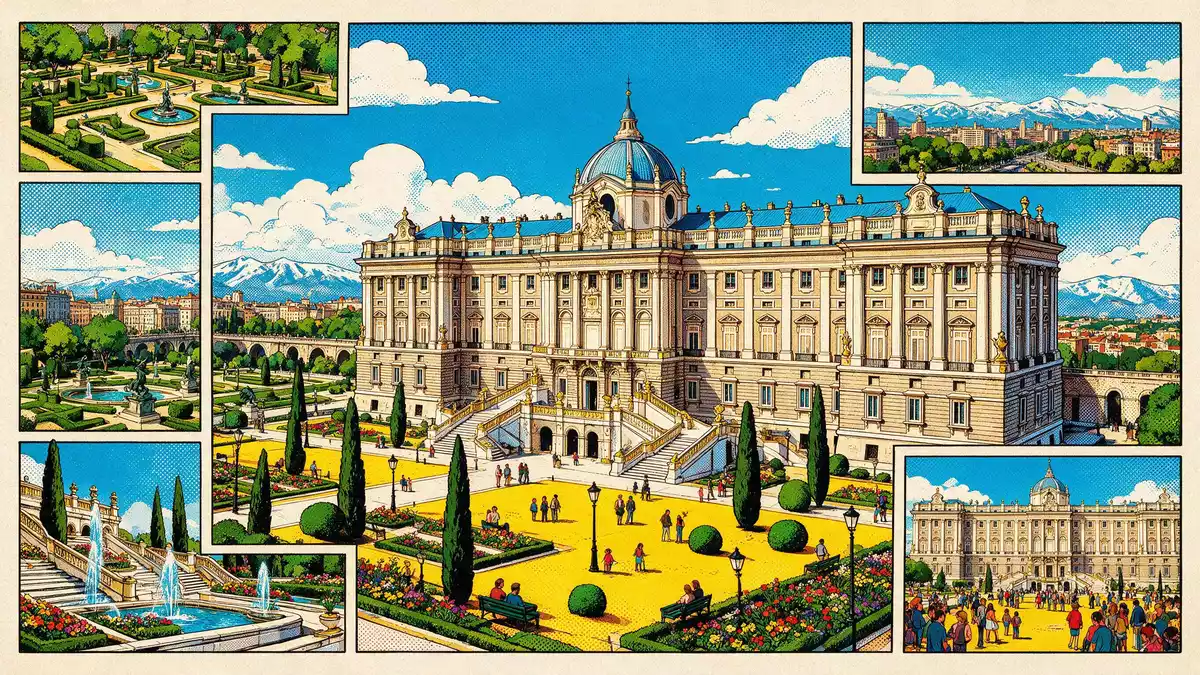
Palacio Real de Madrid occupies a long ridge above the western side of Madrid, with pale stone façades surrounding a large central courtyard. The palace combines the scale of an eighteenth-century royal residence with rooms, artworks and ceremonial spaces linked to Spain’s monarchy.
Palacio Real de Madrid: a Bourbon palace in stone
Philip V ordered the palace after the Alcázar of Madrid was destroyed by fire in 1734. Building work began in 1738, and the completed residence entered royal use under Charles III in 1764. The building’s history therefore belongs to the Bourbon dynasty and to the remaking of Madrid as Spain’s capital.
Filippo Juvarra prepared the first designs, while his pupil Giovanni Battista Sacchetti developed the plans used for construction. Francisco Sabatini also contributed to the palace. Their work produced a formal building of granite and limestone, with a strong horizontal profile and façades organised around a courtyard.
The palace is the official residence of the Spanish royal family, although the family lives elsewhere in Madrid. Palacio Real de Madrid remains associated with state ceremonies, royal representation and the public history of Spain.
Rooms, collections and ceremonial interiors
Inside, the palace presents a sequence of rooms with different decorative languages. The Main Staircase is linked to Sabatini, while the Throne Hall has a ceiling painted by Giovanni Battista Tiepolo. The Gasparini Room carries elaborate eighteenth-century decoration with floral motifs.
The Royal Chapel contains string instruments made by Antonio Stradivari. The collection connects the palace’s ceremonial setting with the musical culture of the Spanish court. Other rooms display clocks, furniture, chandeliers, textiles and decorative objects accumulated by successive monarchs.
Paintings include works associated with Diego Velázquez, Francisco Goya, Caravaggio and other major European artists. The Royal Armoury presents weapons and armour connected with Spanish monarchs and members of the royal family, with pieces extending back to the medieval period.
The Royal Kitchen occupies part of the palace’s lower level. Its copper vessels, ceramic containers and working equipment provide a material record of court life, distinct from the ceremonial rooms above.
From royal residence to public heritage
Charles III was the first monarch to occupy the new palace. Charles IV and Ferdinand VII added furnishings and decorative details, while Alfonso XIII was the last king to live there. These reigns remain visible in the rooms, objects and changing arrangements of the royal interiors.
The palace also stands beside major landmarks of Madrid. Its southern side faces Plaza de la Armería, while La Almudena Cathedral rises nearby. Campo del Moro lies beyond the western side, and Sabatini Gardens occupy ground north of the palace.
Palacio Real de Madrid is part of Spain’s national heritage and functions as both a ceremonial building and a cultural collection. Its significance rests in the combination of architecture, royal use and preserved objects, rather than in a single room or decorative style.
The building’s stone exterior gives the palace a measured appearance, while the interiors shift between grand court decoration, religious art, domestic furnishings and military objects. That contrast can be read throughout the visit, from the broad courtyard to the intimate rooms and specialised collections.
Visiting Palacio Real de Madrid: what travellers from Western Europe should know
- Palacio Real de Madrid is on Calle de Bailén in central Madrid, beside Plaza de Oriente and La Almudena Cathedral. Metro stations include Ópera and Plaza de España.
- The palace route includes the Main Staircase, whose broad flight contains over 70 steps. Several rooms are arranged across a substantial historic building.
- The surrounding area includes Campo del Moro, Sabatini Gardens, Plaza de Oriente and the Royal Collections Gallery. These sites create a concentrated cultural district around the palace.
- The official language is Spanish and the currency is the euro.
Searching for Palacio Real de Madrid on social platforms
These links open searches for Palacio Real de Madrid on each platform.
Frequently asked questions about Palacio Real de Madrid
Where is Palacio Real de Madrid?
Palacio Real de Madrid stands on Calle de Bailén in central Madrid, beside Plaza de Oriente and La Almudena Cathedral.
What can visitors expect inside?
The palace contains ceremonial rooms, royal furnishings, paintings, the Royal Chapel, the Royal Armoury and historic kitchen spaces.
What makes the palace distinctive?
Its identity comes from the combination of Bourbon architecture, royal state use and collections linked to centuries of Spanish court life.


